- Plants
- ›Vascular Plants
- ›flowering plants
- ›Dicots
- ›sandalwoods, mistletoes, and allies
- ›showy mistletoes
- ›Psittacantheae
- ›Psittacanthinae
- ›Psittacanthus
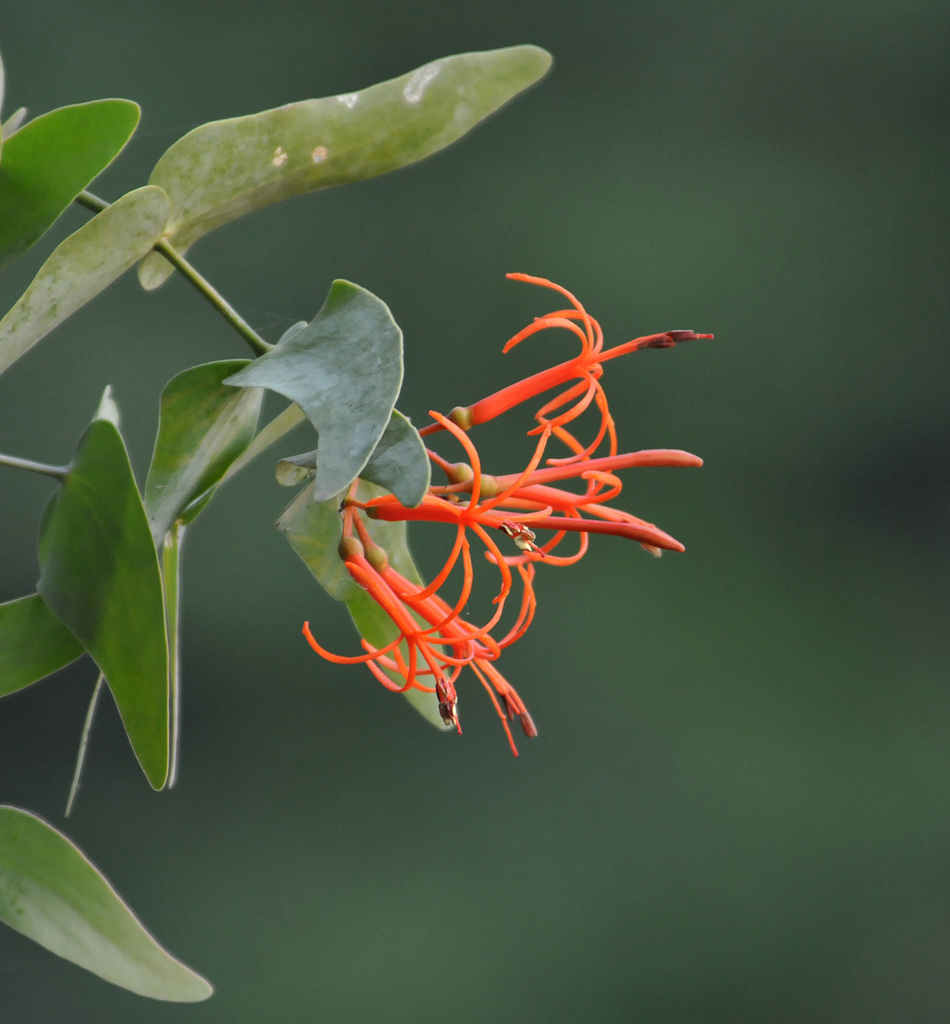
Psittacanthus cordatus
Psittacanthus cordatus is a species of Neotropical mistletoe in the family Loranthaceae, which is native to Bolivia and
Brazil.
From the article Psittacanthus cordatus on Wikipedia (CC BY-SA), quoted section by section
Description
Psittacanthus cordatus initially grows upward and then becomes pendulous, with the shape of its stems being circular. The leaves are opposite, with the base of the leaf being obtuse to cordate, and the apex, acute. The position of the racemose inflorescence is both axillary and terminal. The flowers form groups of three (triads) on a stem, and are red to yellow. The style is straight.
Range & habitat
It is found in the Amazon rainforest, the Central Brazilian Savanna, Atlantic Rainforest and Pantanal, in the Caatinga, Carrasco Vegetation, Cerrado ecoregion, Riverine Forest and/or Gallery Forest, Terra Firme Forest, flooded forest (Várzea), and Tropical Rain Forest.
Wikipedia: “Habitat”
In human culture
Psittacanthus comes from the Greek psittakos (parrot), and the Greek anthos (flower), chosen according to Don, possibly because of the bright colours. Cordatus is from the Latin cordate(heart-shaped).
== References ==
Wikipedia: “Etymology”
Where it lives
Recorded sightings
—
geo-referenced records in GBIF, from museums, herbaria and field observers.
Drag the globe to turn it. Dots are where records exist, not a range map; darker means more records.
In the stacks
Searching the stacks…
Every page naming Psittacanthus cordatus in the Biodiversity Heritage Library →
This page is assembled live from iNaturalist, GBIF, Wikipedia, the Source Library and the Internet Archive. It is not yet part of the hand-edited codex. iNaturalist taxon 850083.