- Plants
- ›Vascular Plants
- ›flowering plants
- ›Dicots
- ›Legumes, Milkworts, and Allies
- ›Legumes
- ›Acacias, Mimosas, Mesquites, and Allies
- ›Parkia
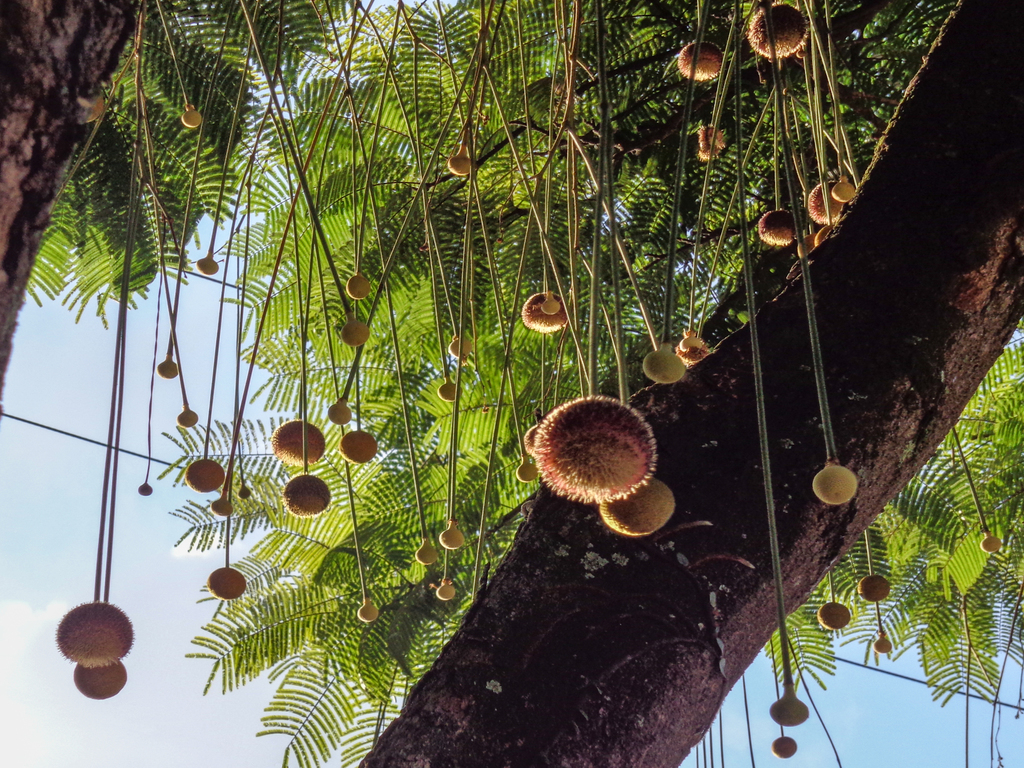
Parkia pendula
Parkia pendula is a species of neotropical evergreen tree found throughout Central and South America. It is part of the Parkia genus, a group of flowering plants that are part of the legume family, Fabaceae.
From the article Parkia pendula on Wikipedia (CC BY-SA), quoted section by section
Description
Parkia pendula trees range from 15 to 50 meters in height and can be up to 1.2 meters in diameter. The bark is either whitish-grey or reddish-brown and plated, with many lenticels. The strong, fruity aroma of a blooming Parkia pendula can be attributed to monoterpenes in the flower, specifically the stereoisomers (Z) 𝛽-ocimene and (E) 𝛽-ocimene. Unlike other Parkia species, Parkia pendula has a flattened and layered crown of leaves. The horizontal branches support alternating bipinnate leaves that come in about 15 to 27 pairs, narrowing to a maximum of 3 leaves whorled about a node. The leaves themselves are dark green and oblong, with curved distal ends.
Flowers. The flowers produced by Parkia pendula grow as inflorescences, particularly pseudanthiums. They have yellowish-pink petals arranged radially. The heads are about to 3.4 cm in length and have a diameter of 4.5 to 4.9 cm. Each pseudanthium contains ~1300 small flowers densely packed around a spherical receptacle. The flowers themselves hang off of thin, woody stems known as peduncles approximately one meter below the crown of the tree. Flowers typically bloom from December to January in Costa Rica, and from January to August in Venezuela. Fertile flowers have a gamosepalous calyx beneath their corolla and display five distinctive lobes. …
Range & habitat
Parkia pendula can be found in primary and secondary forests, from altitudes of 20 to 500 meters above sea level. It prefers well-drained, subtropical environments, ideally thriving on hills or slopes with a 30% incline that experience more than 4000 mm of precipitation annually. They commonly grow alongside Peltogyne purpurea, Caryocar costaricense, and Qualea paraensis. An adult tree is very flood tolerant, capable of withstanding long-term submersion. Despite this, early seedlings can only survive a few weeks in flooded conditions, limiting the range of environments Parkia pendula can thrive in.
Range & distribution. Parkia pendula can be found in a variety of countries, mainly Bolivia, Brazil, Colombia, Costa Rica, French Guiana, Guyana, Honduras, Nicaragua, Peru, Suriname, and Venezuela. It grows in many lowland forests, with a large reserve found in a national park in Espirito Santo, Brazil.
Threats. Insects, specifically certain species of beetles, deposit eggs inside the bud of Parkia pendula, acting as a parasite on the seeds. Despite this, there is no considerable impact on the persistence of the species and the IUCN lists it as a species of Least Concern.
Wikipedia: “Habitat”
What it does
The Parkia pendula tree exhibits mass flowering, typically with 150 to 200 capitula blooming in one night. The flowers open sequentially from the base to the tip. The capitula appear bright red due to the color of the anthers and filaments, then become yellow-red at dusk when nectar and pollen are produced. When the styles elongate, the plant takes on a purple-red hue, finishing the dramatic color shift all within one night. Flowers are usually shed afterwards within a span of 3 to 4 days.
Pollination. Like other members of the Mimosoideae subfamily, Parkia pendula exhibits pollen aggregation, specifically polyads. It further differentiates itself from other members of Mimosoideae by having globose polyads rather than flattened polyads from pollen grain layering. Parkia pendula polyads are about 100 mm in diameter and composed of 32 pollen grains, with an outer exine that is grooved. The stigma for each fertile flower only contains a cavity for one polyad, but since the number of pollen grains matches the number of ovules, one polyad can fertilize all the ovules of a flower.
Parkia pendula is chiropterophilous, meaning it is largely pollinated by bats. While a dozen different species have been observed pollinating Parkia pendula, the most common is Phyllastomus discolor. Bats are attracted to the large quantity of nectar produced by nectariferous flowers. …
Wikipedia: “Reproduction”
At the table
The wood from Parkia pendula is moderately heavy, with a density of 0.57 g/cm3. Processed wood typically has a white or yellow color, with a thick textured grain. It is resistant to fungal infections, but porous enough for preservatives, so it is commonly used in furniture and carpentry. Due to its high growth rate and capability to attract wild animals while fixing copious amounts of nitrogen, Parkia pendula is perfectly suited to afforestation. It can be planted in degraded, barren environments and serve as a dependable foundation for establishing a forest. The seed pod gum is also notably used to catch birds.
Medicinal use. Parkia pendula has been known to treat dysentery, headaches, inflammation, itching, and fevers. The bark has commonly been used by locals to treat stomach aches. Research has been conducted examining the use of lectin as a histochemistry marker to distinguish meningothelial tumors and as treatment for cutaneous wounds in normal and immunocompromised mice. PPeL, the lectin produced when Parkia pendula seeds are purified, binds to cell surface carbohydrates in oligosaccharides and glycoconjugates, expressing cytoplasmic staining which can be used to characterize tumor cell types.
== References ==
Wikipedia: “Uses”
Where it lives
Recorded sightings
—
geo-referenced records in GBIF, from museums, herbaria and field observers.
Drag the globe to turn it. Dots are where records exist, not a range map; darker means more records.
In the stacks
Searching the stacks…
Every page naming Parkia pendula in the Biodiversity Heritage Library →
This page is assembled live from iNaturalist, GBIF, Wikipedia, the Source Library and the Internet Archive. It is not yet part of the hand-edited codex. iNaturalist taxon 85032.