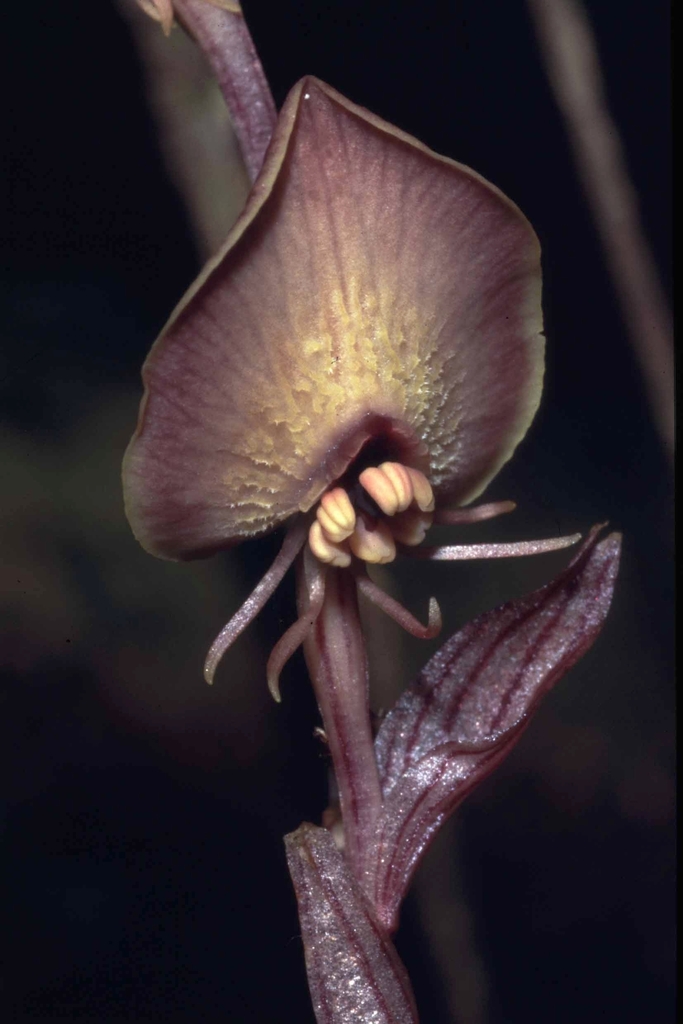
Corsia ornata
Corsia ornata is a species of flowering plant in the genus Corsia of the small family Corsiaceae, part of the monocot order Liliales. They are saprophytes (Myco-heterotrophs), lacking the ability to photosynthesise, being dependent on other organisms for their nutrition. The plant lives underground, sending up purplish stems above ground in order to flower. The leaves are reduced to scales. One of the six petal-like tepals named the labellum (a little lip), is specialised, being enlarged and hanging protectively over the reproductive organs. It was discovered in New Guinea in 1875, but has since been sighted in Queensland, Australia.
From the article Corsia ornata on Wikipedia (CC BY-SA), quoted section by section
Description
The Corsiaceae lack chlorophyll and hence the ability to photosynthesise, instead being mycoheterotrophic (deriving nutrition as parasites on fungi). C. ornata, although perennial, only appears above ground when flowering, arising from short creeping rhizomes, reaching up to 25 cm in height. From the rhizomes, arise long, cylindrical and finely corrugated, unbranched and upright growing stems that are terete (almost circular in cross section) and narrowly ribbed. The above ground portion of the plant is a purplish to purplish-red in color. Leaves are reduced to acute (sharply pointed) sheath-shaped scales 1–2 cm in length, arranged alternately on the stem, with 3–5 nerves and similar bracts. The pedicels are glabrous and 2.5–4 cm long.
The upright individual flowers are terminal and stand on flower stems that are 2.5–4 cm long. Of the six tepals (in two whorls), five are linear, obtuse and pale yellow in colour, 11–13 millimeters long, one-nerved and hairless. The sixth, outer tepal, called the labellum, is either light yellow to light purple with a darker purple veins nerve or purplish brown. It is greatly enlarged (1.2–1.8 cm long, 1–1.6 cm wide) and cordate (heart-shaped) and obtuse, with a cordate base. The labellum initially surrounds the flower bud and, after opening, protects the other flower organs. …
Range & habitat
Corsia ornata is found at a number of widely spaced locations in the western part of New Guinea, particularly on Bird's Head Peninsula. One sighting in Queensland, Australia, makes it the only species found outside of New Guinea. Corsia ornata occurs in forests, between 400 and 2,100 m, in humus rich soils.
Wikipedia: “Distribution and habitat”
Where it lives
Recorded sightings
—
geo-referenced records in GBIF, from museums, herbaria and field observers.
Drag the globe to turn it. Dots are where records exist, not a range map; darker means more records.
In the stacks
Searching the stacks…
Every page naming Corsia ornata in the Biodiversity Heritage Library →
This page is assembled live from iNaturalist, GBIF, Wikipedia, the Source Library and the Internet Archive. It is not yet part of the hand-edited codex. iNaturalist taxon 850366.