- Plants
- ›Vascular Plants
- ›flowering plants
- ›Dicots
- ›myrtles, evening primroses, and allies
- ›myrtle family
- ›Myrtoideae
- ›Myrteae
- ›Decasperminae
- ›Rhodamnia
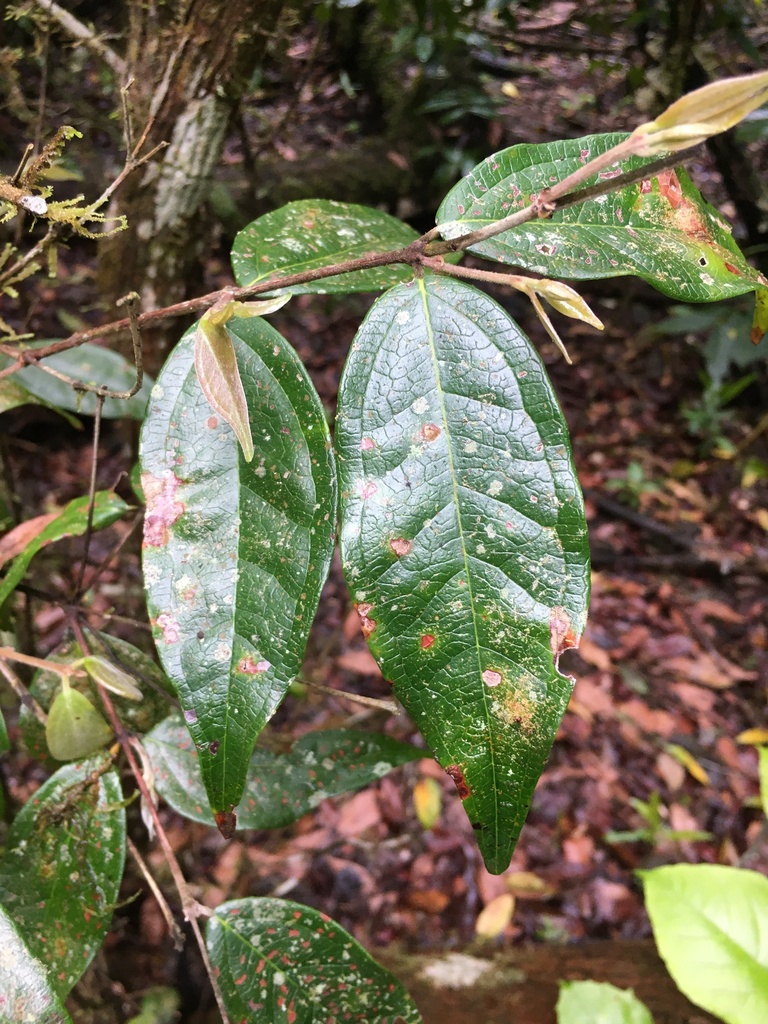
Iron Malletwood
Rhodamnia sessiliflora
Rhodamnia sessiliflora, commonly known as iron malletwood, is a small tree in the eucalyptus family Myrtaceae, found only in the Wet Tropics bioregion of Queensland, Australia.
From the article Rhodamnia sessiliflora on Wikipedia (CC BY-SA), quoted section by section
Description
Rhodamnia sessiliflora is a small tree up to 10 m (33 ft) tall, and the trunk may be buttressed. The new shoots and young twigs are clothed in very fine pale or white hairs, and leaves are simple (undivided) and without lobes or teeth on the margins. They are arranged in opposite pairs on the twigs, on petioles up to 8 mm (0.31 in) long. Leaves are ovate to elliptic and measure up to 13 cm (5.1 in) long by 6 cm (2.4 in) wide. They have two intramarginal veins, a feint one very close to the margin and a conspicuous one about 5 mm (0.20 in) inside the margin. Flowers are produced in small clusters in the leaf axils—i.e. in the angle between the petiole and the twig. They have four cream or white petals about 3 mm (0.12 in) long. The fruit is a globose, purple or black berry about 1 cm (0.39 in) diameter, containing anywhere from 14 to 40 small seeds about 3 mm (0.12 in) long.
Phenology. Flowering occurs from October to July and fruit appear from December to June.
Range & habitat
Rhodamnia sessiliflora is restricted to coastal and subcoastal parts of northeastern Queensland, extending from about Rossville south to the Paluma Range National Park. It grows in well developed rainforest and monsoon forest on various soils, at altitudes from near sea level to about 1,000 m (3,300 ft).
Wikipedia: “Distribution and habitat”
What it does
Fruit of this tree are eaten by cassowaries (Casuarius casuarius), figbirds (Sphecotheres vieilloti), spotted catbirds (Ailuroedus maculosus) and Lewin's honeyeaters (Meliphaga lewinii).
Wikipedia: “Ecology”
Where it lives
Recorded sightings
—
geo-referenced records in GBIF, from museums, herbaria and field observers.
Drag the globe to turn it. Dots are where records exist, not a range map; darker means more records.
In the stacks
Searching the stacks…
Every page naming Rhodamnia sessiliflora in the Biodiversity Heritage Library →
This page is assembled live from iNaturalist, GBIF, Wikipedia, the Source Library and the Internet Archive. It is not yet part of the hand-edited codex. iNaturalist taxon 850384.