- Plants
- ›Vascular Plants
- ›flowering plants
- ›monocots
- ›Aroids, Water Plantains, Seagrass, and allies
- ›tape-grass family
- ›Halophila
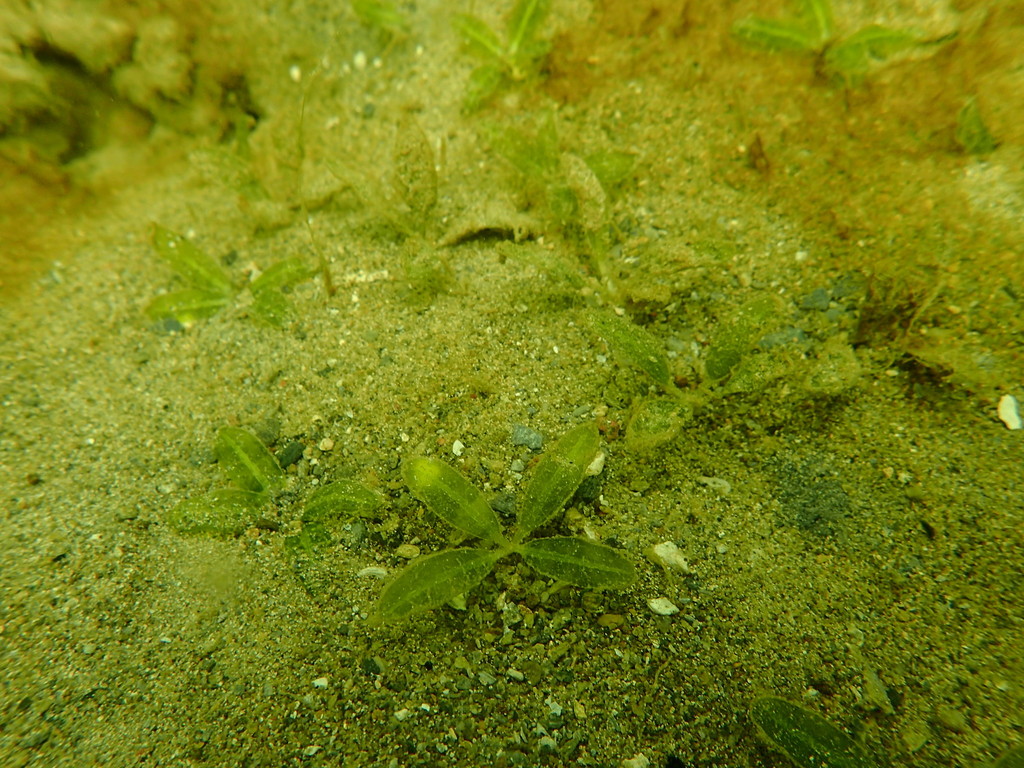
Midrib Seagrass
Halophila baillonis
Halophila baillonis is a species of aquatic plant in the family Hydrocharitaceae. It is referred to by the common name clover grass. It is native to Brazil, Cayman Islands, Colombia, Costa Rica, Jamaica, Leeward Islands, Netherlands Antilles, Panama, Puerto Rico, Trinidad and Tobago, and Venezuela. It is listed on the IUCN Red List as "vulnerable" due to its naturally rare occurrence and fragmented populations.
From the article Halophila baillonis on Wikipedia (CC BY-SA), quoted section by section
Description
This seagrass has fragile rhizomes with a single stem and a single root at each node. The shoots are erect and up to 24 mm (1 in) long, each with two obovate, keeled, scales in the central portion and a pseudo-whirl of four leaves at the tip. The leaf-blades are oblong to lanceolate, 7 to 12 mm (0.28 to 0.47 in) long by 3 to 4 mm (0.12 to 0.16 in) wide, with pronounced midribs and fine marginal serrations. There may be as many as 2,500 shoots per square metre.
Range & habitat
Clover grass is native to the Caribbean area. It is known from several sites in the Greater Antilles, Lesser Antilles, Colombia, Venezuela and Belize, but its distribution is very patchy. It was previously known from Guanacaste Province on the Pacific coast of Costa Rica, but has not been seen there since a severe storm in 1996 and is not known from elsewhere in the Pacific. It grows on sandy or muddy bottoms and its depth range is down to about 15 m (50 ft). In 2015 it was found on the coast of Brazil in the state of Paraíba on a sheltered bar at the mouth of the Mamanguape River.
Wikipedia: “Distribution and habitat”
What it does
Where it is plentiful, as in Belize, it is sometimes found growing among the prop roots of mangroves, intermingled with Thalassia testudinum, Halophila decipiens, Halodule wrightii and Caulerpa spp.. It provides food for the West Indian manatee and concealment for young nurse sharks. The scorched mussel lives in the seagrass meadows and fish such as the flag-fin mojarra and the permit feed on the mussels and consume the seagrass while doing so.
Wikipedia: “Ecology”
Where it lives
Recorded sightings
—
geo-referenced records in GBIF, from museums, herbaria and field observers.
Drag the globe to turn it. Dots are where records exist, not a range map; darker means more records.
In the stacks
Searching the stacks…
Every page naming Halophila baillonis in the Biodiversity Heritage Library →
This page is assembled live from iNaturalist, GBIF, Wikipedia, the Source Library and the Internet Archive. It is not yet part of the hand-edited codex. iNaturalist taxon 850540.