- Plants
- ›Vascular Plants
- ›flowering plants
- ›Dicots
- ›proteas, lotuses, planes, and allies
- ›Protea family
- ›Primitive Proteas
- ›Persoonieae
- ›Persoonia
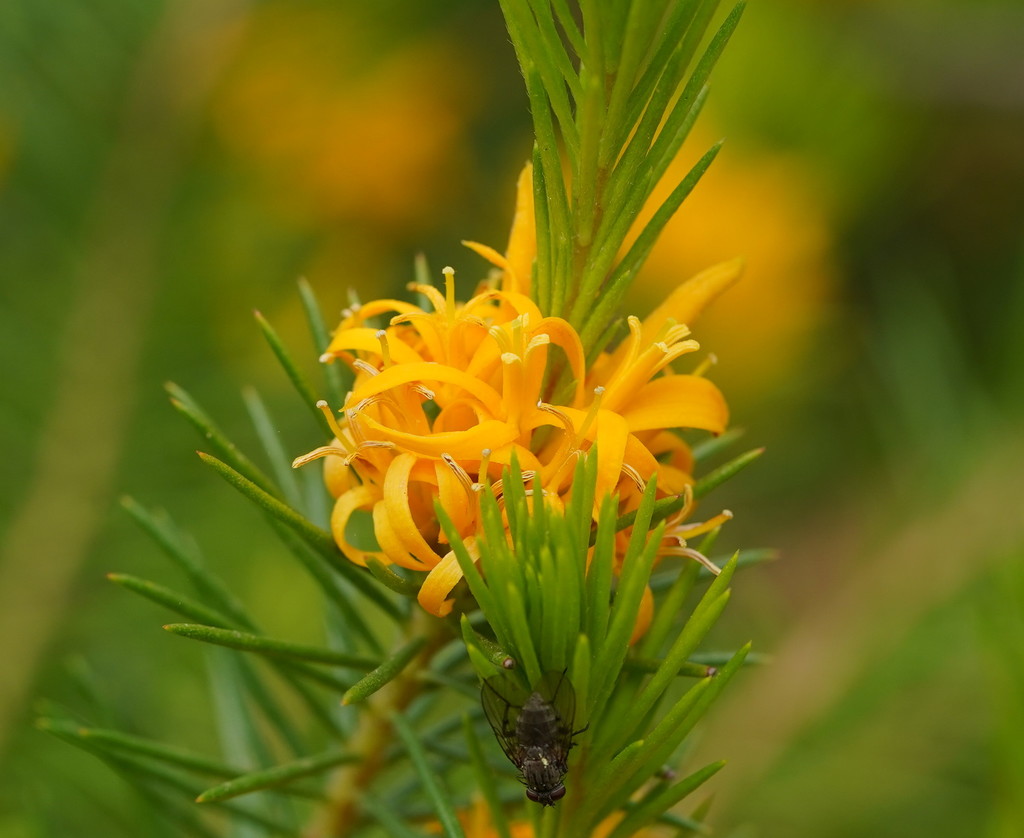
Prostrate Geebung
Persoonia chamaepitys
Persoonia chamaepitys, commonly known as the prostrate- or mountain geebung, is a shrub endemic to New South Wales in eastern Australia. It has a prostrate habit, reaching only 20 cm (7.9 in) high but spreading up to 2 m (6.6 ft) across, with bright green spine-like leaves and small yellow flowers appearing in summer and autumn.
From the article Persoonia chamaepitys on Wikipedia (CC BY-SA), quoted section by section
Description
A prostrate shrub, Persoonia chamaepitys reaches to around 20 cm (8 in) high and spreads up to 1–2 m (3.3–6.6 ft) across. The new growth is hairy. The tiny spine-like leaves measure 0.7–1.9 cm long and 0.5–1 mm wide. Flowering occurs over spring and summer (October to January), the small yellow flowers arising from or near the ends of branchlets.
Range & habitat
Persoonia chamaepitys is restricted to central New South Wales from the Upper Goulburn Valley south through the Blue Mountains and Woronora Plateau and into the Budawang Range. It is common around Katoomba to Mount Victoria. It grows at an altitude of 360 to 1,100 m (1,180 to 3,610 ft), on sandstone-based soils in heath or dry sclerophyll forest. Those seen in the Blue Mountains seem to originate on a slope or mound.
Wikipedia: “Distribution and habitat”
What it does
Long-tongue bees of the genera Chalicodoma and Hylaeus and Eumenid wasps forage among the flowers, although only the long-tongue bee species Leioproctus raymenti is a pollinator. The fruit are eaten and scattered by vertebrates, such as kangaroos, possums, and currawongs and other large birds. Persoonia chamaepitys is killed by bushfire and regenerates from seed that has remained dormant in the soil.
Wikipedia: “Ecology”
How it is grown
The species is sometimes seen in cultivation, but has proven difficult to propagate from either seed or cuttings. It makes an attractive rockery plant, its bright green foliage and yellow flowers are features.
== References ==
Wikipedia: “Cultivation”
Where it lives
Recorded sightings
—
geo-referenced records in GBIF, from museums, herbaria and field observers.
Drag the globe to turn it. Dots are where records exist, not a range map; darker means more records.
In the stacks
Searching the stacks…
Every page naming Persoonia chamaepitys in the Biodiversity Heritage Library →
This page is assembled live from iNaturalist, GBIF, Wikipedia, the Source Library and the Internet Archive. It is not yet part of the hand-edited codex. iNaturalist taxon 850709.