- Plants
- ›Vascular Plants
- ›flowering plants
- ›Dicots
- ›Sunflowers, Bellflowers, Fanflowers, and Allies
- ›fanflower family
- ›Goodenia
- ›Monochila
- ›Scaevolina
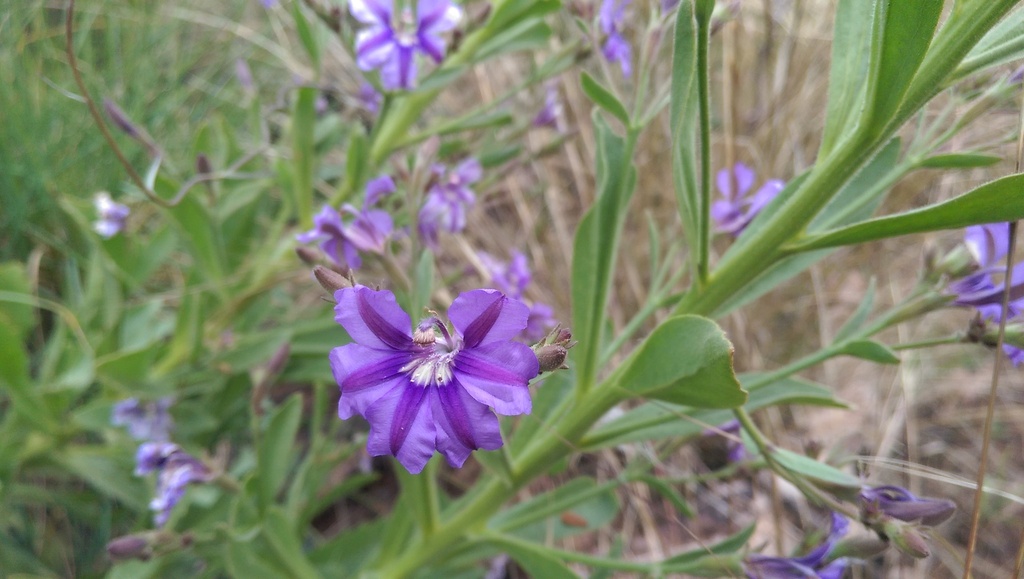
Goodenia stobbsiana
Goodenia stobbsiana is a shrub that is native to the north of Western Australia. It has blue flowers that appear between March and October in the species native range. The species was first formally described by botanist Ferdinand von Mueller in 1881 in Fragmenta Phytographiae Australiae, based on a collection by J. Forrest near the Yule River.
From the article Goodenia stobbsiana on Wikipedia (CC BY-SA), quoted section by section
Description
Goodenia stobbsiana is a much-branched perennial subshrub that typically grows to a height of up to 80 cm (31 in) with sticky foliage. The leaves at the base of the plant and on the stems are egg-shaped to lance-shaped with the narrower end towards the base, 40–70 mm (1.6–2.8 in) long and 20–30 mm (0.79–1.18 in) wide, sometimes with teeth on the edges. The flowers are arranged in loose thyrses up to 400 mm (16 in) long on a peduncle up to 50 mm (2.0 in) long with leaf-like bracts and linear bracteoles up to 10 mm (0.39 in) long, each flower on a pedicel up to 4 mm (0.16 in) long. The corolla is blue with lobes up to 14 mm (0.55 in) long. Flowering mainly occurs from March to October.
Range & habitat
This goodenia grows in stony soil, often in disturbed or burned areas, mainly in the Pilbara region of north-western Australia.
Wikipedia: “Distribution”
Where it lives
Recorded sightings
—
geo-referenced records in GBIF, from museums, herbaria and field observers.
Drag the globe to turn it. Dots are where records exist, not a range map; darker means more records.
In the stacks
Searching the stacks…
Every page naming Goodenia stobbsiana in the Biodiversity Heritage Library →
This page is assembled live from iNaturalist, GBIF, Wikipedia, the Source Library and the Internet Archive. It is not yet part of the hand-edited codex. iNaturalist taxon 851479.