- Animals
- ›Arthropods
- ›Hexapods
- ›Insects
- ›Winged and Once-winged Insects
- ›Grasshoppers, Crickets, and Katydids
- ›Katydids, Crickets, and Allies
- ›Katydids, wētā, and allies
- ›Wētā, Jerusalem Crickets, and Allies
- ›Wētā and King Crickets
- ›Anisoura
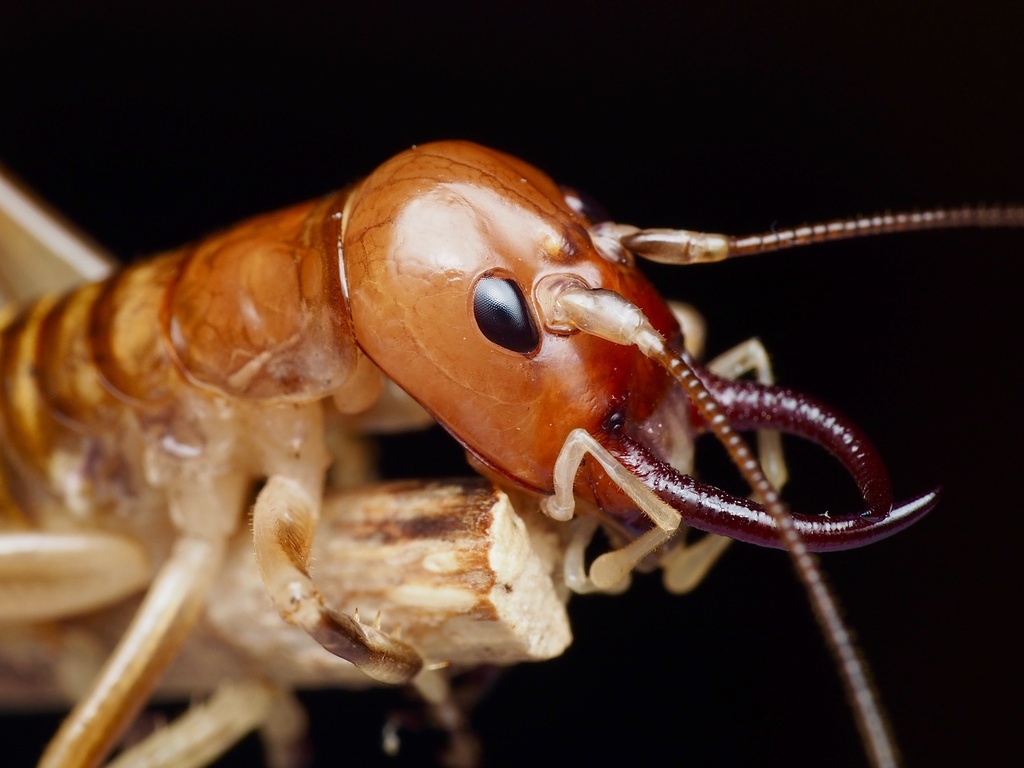
Northland Tusked Weta
Anisoura nicobarica
The Northland tusked wētā, Anisoura nicobarica, is a rare monotypic wētā of the family Anostostomatidae, endemic to the northern half of Northland in New Zealand, and originally described in 1932. The type specimen was wrongly labelled as coming from the Nicobar Islands, so the species was named Anisoura nicobarica. It was erroneously described again in 1950 by a different author, who placed it in the ground wētā genus Hemiandrus (as Hemiandrus monstrosus).
From the article Northland tusked wētā on Wikipedia (CC BY-SA), quoted section by section
Description
Tusked wētā are distinctive because of the long curved "tusks" adult males have projecting forward from their jaws. The tusks are not used for biting but are used to push an opponent. Among the three species of tusked wētā, the Northland tusked wētā, Anisoura nicobarica is the smallest measuring up to 21 mm in body length. The Middle Island tusked wētā, Motuweta isolata, being the biggest measuring up to 70 mm in body length and the Raukumara tusked wētā, Motuweta riparia, is 30–40 mm long. The Northland tusked wētā is reddish brown and their hind tibia contains small spines. The tusks are devoid of stridulatory ridges, which are a feature of both M. isolata and A. nicobarica. Unlike ground wētā (Hemiandrus sp.), tusked wētā have ears on their front legs (fore-tibia).
Range & habitat
The Northland tusked wētā is arboreal so needs native forest and scrub. Similar to the tree wētā, Hemideina thoracica, both species occupy holes (galleries) in mānuka and other trees and shrubs during the day. Unlike tree wētā, the tusked wētā makes a seal to close the hole entrance. Because the Northland tusked wētā hides in hollow branches and trunks of mānuka it is often found associated with firewood.
Wikipedia: “Habitat”
What it does
Like other tusked wētā species, the Northland tusked wētā prefers feeding on an animal diet consisting of live and dead insects and spiders.
Wikipedia: “Diet”
Listen
Looking for field recordings…
Where it lives
Recorded sightings
—
geo-referenced records in GBIF, from museums, herbaria and field observers.
Drag the globe to turn it. Dots are where records exist, not a range map; darker means more records.
In the stacks
Searching the stacks…
Every page naming Anisoura nicobarica in the Biodiversity Heritage Library →
This page is assembled live from iNaturalist, GBIF, Wikipedia, the Source Library and the Internet Archive. It is not yet part of the hand-edited codex. iNaturalist taxon 85228.