- Plants
- ›Vascular Plants
- ›flowering plants
- ›Dicots
- ›Heathers, Balsams, Primroses, and Allies
- ›primrose family
- ›Cape Myrtle subfamily
- ›Ardisia
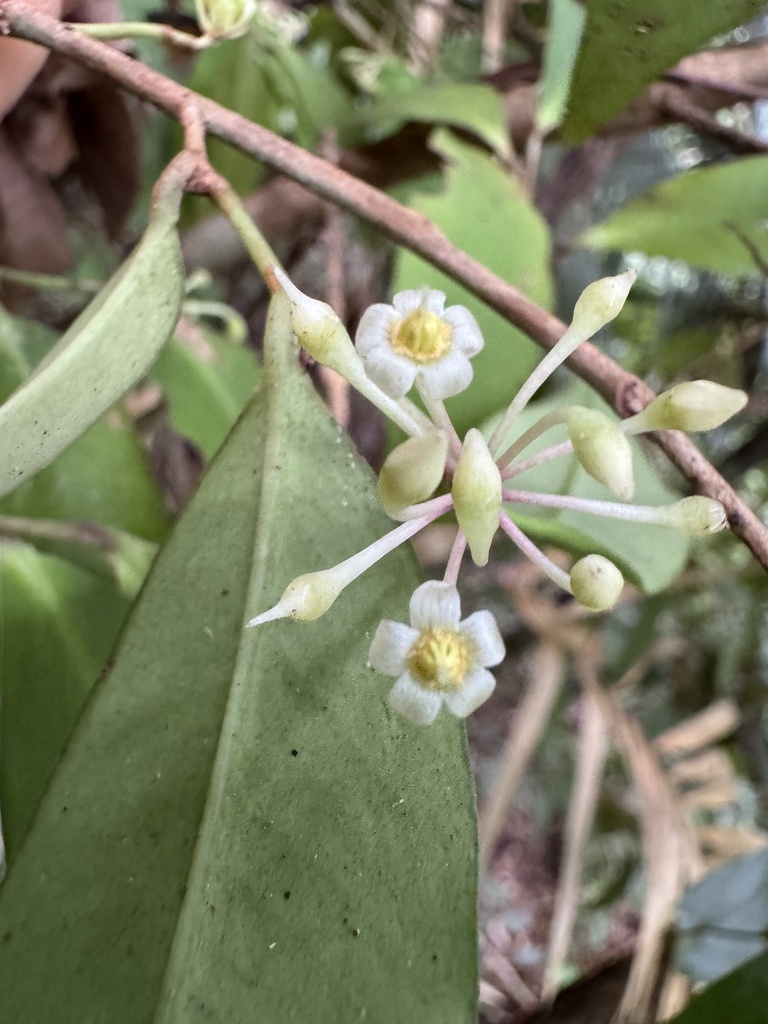
Ardisia brevipedata
Ardisia brevipedata, commonly known as rambling spearflower, is a species of plant in the primrose family Primulaceae. It is native to the Wet Tropics bioregion of Queensland, Australia.
From the article Ardisia brevipedata on Wikipedia (CC BY-SA), quoted section by section
Description
Ardisia brevipedata is an understorey shrub or small tree usually growing to about 3 m (9.8 ft) in height, and occasionally to 6 m (20 ft). The leaves are arranged on the twigs either alternately or spirally, and are attached by petioles about 7 mm (0.3 in) long. The leaf blades are elliptic to obovate, up to 17 cm (6.7 in) long and 5 cm (2.0 in) wide, and the venation is obscure. Inflorescences of 12—25 individual flowers emerge from the leaf axils in umbels. The flowers five petals and sepals which are pale translucent pink, cream or green, and measure about 3 mm (0.12 in) long and 5 mm (0.20 in) wide. The fruit is a red globose berry about 10 by 13 mm (0.39 by 0.51 in).
Range & habitat
The species is found in the Wet Tropics bioregion of northeast Queensland, ranging from Paluma Range National Park in the south to the area around Rossville in the north. It inhabits rainforests at altitudes from sea level to about 1,400 m (4,600 ft). Plants of the World Online and the Global Biodiversity Information Facility state that the plant also occurs in New Guinea, while Australian Tropical Rainforest Plants and Flora of Australia both state that it is endemic to Queensland.
Wikipedia: “Distribution and habitat”
Where it lives
Recorded sightings
—
geo-referenced records in GBIF, from museums, herbaria and field observers.
Drag the globe to turn it. Dots are where records exist, not a range map; darker means more records.
In the stacks
Searching the stacks…
Every page naming Ardisia brevipedata in the Biodiversity Heritage Library →
This page is assembled live from iNaturalist, GBIF, Wikipedia, the Source Library and the Internet Archive. It is not yet part of the hand-edited codex. iNaturalist taxon 852399.