- Animals
- ›Arthropods
- ›Hexapods
- ›Insects
- ›Winged and Once-winged Insects
- ›Grasshoppers, Crickets, and Katydids
- ›Katydids, Crickets, and Allies
- ›Katydids, wētā, and allies
- ›Wētā, Jerusalem Crickets, and Allies
- ›Wētā and King Crickets
- ›King Crickets
- ›Deinacridini
- ›Deinacrida
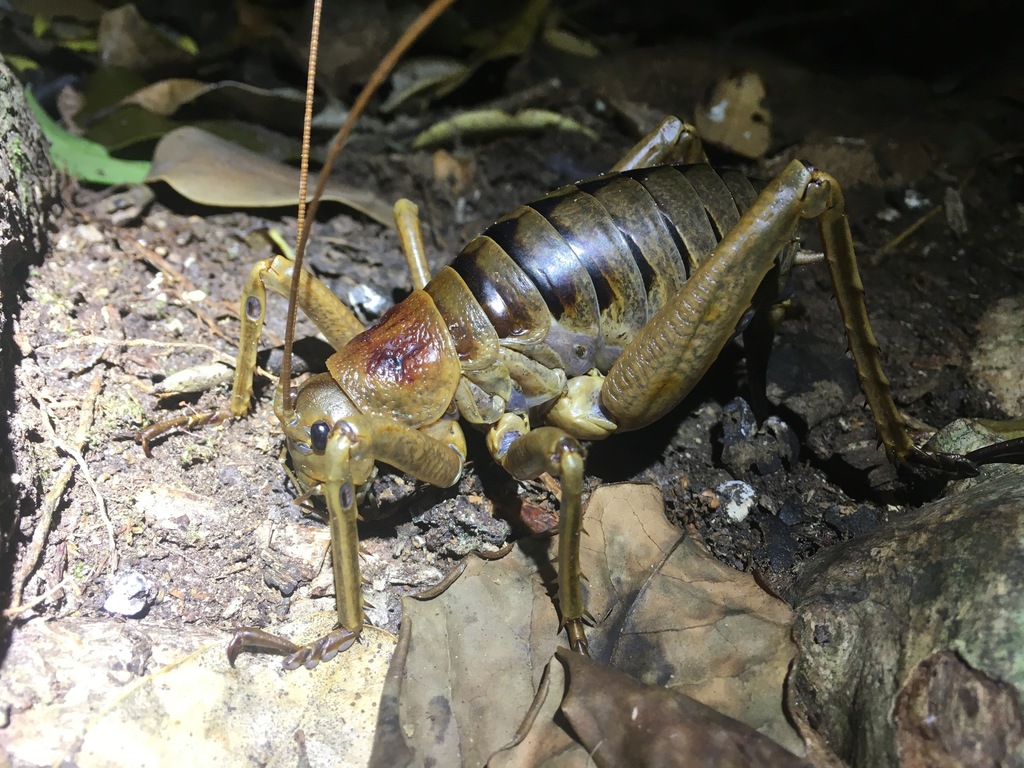
Poor Knights Giant Weta
Deinacrida fallai
Deinacrida fallai or the Poor Knights giant wētā is a species of insect in the family Anostostomatidae. It is endemic to the Poor Knights Islands off northern New Zealand. D. fallai are commonly called giant wētā due to their large size. They are one of the largest insects in the world, with a body length measuring up to 73 mm. Their size is an example of island gigantism. They are classified as vulnerable by the IUCN due to their restricted distribution.
From the article Deinacrida fallai on Wikipedia (CC BY-SA), quoted section by section
Description
Deinacrida fallai was only described as a new species in 1950. It is the second largest wētā species in the world, with females weighing up to 40g and measuring up to 73mm (2.87 inches) in length. Females are prominently larger than males. D. fallai are light brown in colour with dark brown legs. They have black stripes along the side of their body, as well as a black line marking along the dorsal surface of their body. Their bodies are distinctively broad and they have rounded heads with short mandibles. The Poor Knights giant wētā primarily feed on kanuka and pohutukawa. Although they rely primarily on vegetation for their nutrition, it is likely that they are omnivorous. In captivity, D. fallai partially ate a male tree wētā (Hemideina thoracica). Their faces are yellow-brown in colour and are extremely large, relative to its size.
Range & habitat
Deinacrida fallai has a limited distribution and is known to exist only on the rat-free Poor Knights Islands. They are common on the two large islands, Aorangi and Tawhiti Rahi. D. fallai scat/frass has also been found on Archway Island, although no definite specimens have been recorded from here. There have been no other records of its presence on neighboring islands or from the North Island of New Zealand. They are forest dwelling, arboreal insects, spending most of their time on tree trunks and branches at night. During the day they spend their time above ground, perching in foliage or hiding in the lose bark of pohutukawa. They thrive in the undisturbed pohutukawa forests on these islands where they co-exist with low to moderate density populations of tuatara. Although they are arboreal, they do also venture to the ground for oviposition, and have been found under stones in the forest.
Wikipedia: “Distribution and habitat”
What it does
Adult D. fallai live a relatively nomadic lifestyle, moving from tree to tree periodically. They are nocturnal in their general activities such as ecdysis, feeding, and oviposition, but mate during the day. They occur as solitary individuals and spend their day sitting among tree branches. Although D. fallai are one of the largest/heaviest insect species, they have relatively agile movements and are easily able to jump long distances up and down tree trunks and branches. They can also move quickly if they are disturbed, however, their initial reactions to disturbance is usually to freeze. This in an effective response to predators that rely mostly on visual cues. In general, males are more aggressive than females and males have been observed displaying sexual aggression towards other males during copulation. When D. fallai are threatened or disturbed they raise their hind legs vertically over their head. They also quickly move their legs up and down to make a crackling or rasping sound over their stridulatory apparatus for the duration of disturbance. This fearsome display strongly deters any potential predators. Nymphs up to the fifth instar display protective behaviours by burrowing head first into the soil, leaving only their hind tibia and tarsi exposed.
Wikipedia: “Behaviour”
Listen
Looking for field recordings…
Where it lives
Recorded sightings
—
geo-referenced records in GBIF, from museums, herbaria and field observers.
Drag the globe to turn it. Dots are where records exist, not a range map; darker means more records.
In the stacks
Searching the stacks…
Every page naming Deinacrida fallai in the Biodiversity Heritage Library →
This page is assembled live from iNaturalist, GBIF, Wikipedia, the Source Library and the Internet Archive. It is not yet part of the hand-edited codex. iNaturalist taxon 85241.