- Plants
- ›Vascular Plants
- ›flowering plants
- ›monocots
- ›palms, bullanocks, and allies
- ›palms
- ›Arecoideae
- ›Areceae
- ›Rhopalostylidinae
- ›Rhopalostylis
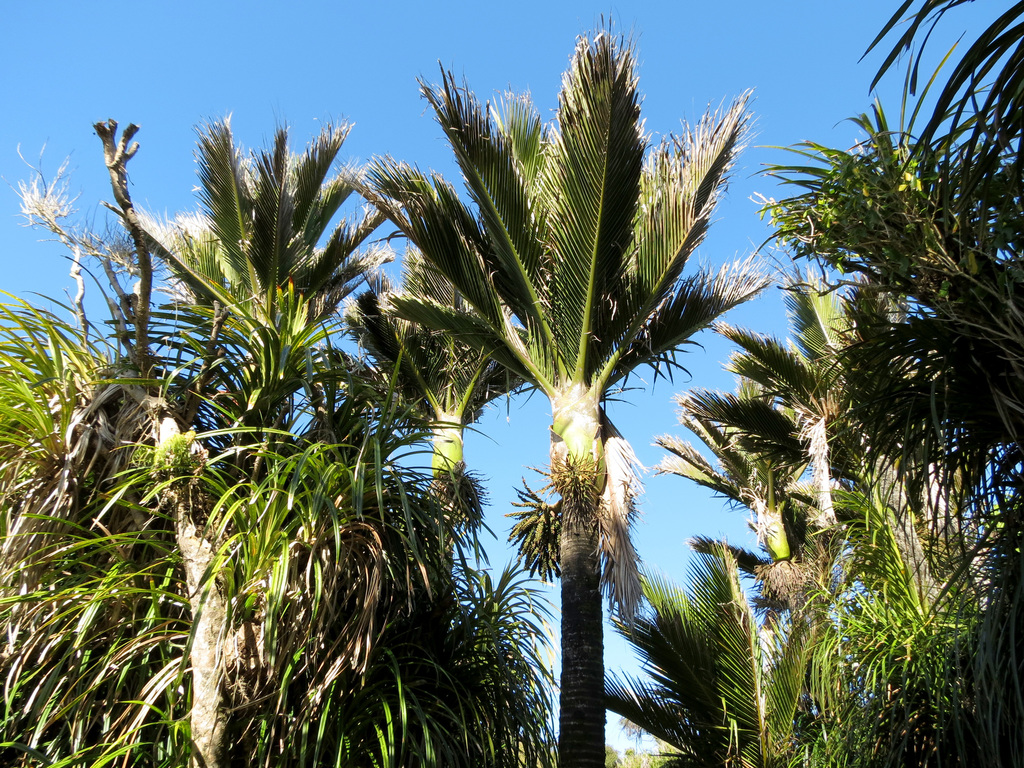
Nīkau palm
Rhopalostylis sapida
Rhopalostylis sapida, commonly known as nīkau, is a palm tree endemic to New Zealand, and the only palm native to mainland New Zealand.
From the article Rhopalostylis sapida on Wikipedia (CC BY-SA), quoted section by section
Description
Nīkau grow up to 15 m (49 ft) tall, with a stout, green trunk which bears grey-green leaf scars. The trunk is topped by a smooth, bulging crownshaft up to 1 m (3 ft 3 in) long. The fronds are up to 3 m (9.8 ft) long, and the closely set, sometimes overlapping leaflets are up to 1 m (3 ft 3 in) long. The inflorescence is multibranched and from 20–40 cm (7.9–15.7 in) long. The tightly packed flowers are unisexual and coloured lilac to pink. Male flowers are borne in pairs, and have six stamens. The female flowers are solitary. The fruit is elliptic or oblong, and generally measures about 10 by 7 mm, and is red when ripe. Nīkau produce flowers between November and April, and fruit ripens from February to November, taking almost a year to fully ripen.
Variation. The nīkau palm shows considerable variation in the wild. Plants from the South Island and the offshore islands of the North Island have larger, more-gracefully-arching fronds and are popular in cultivation. The Chatham Islands form is particularly different, having a distinct juvenile form and larger fruits, and a thicker covering of fine hairs on the fronds. More research is needed into its precise relationship with the mainland form. …
Range & habitat
The nīkau palm is the only palm species endemic to mainland New Zealand. Its natural range is coastal and lowland forest on the North Island, and on the South Island as far south as Ōkārito (43°20′S) in the west and Banks Peninsula (43°5′S) in the east. It also occurs on Chatham Island and Pitt Island/Rangiauria to the south-east of New Zealand, where it is the world's southernmost palm at 44° 18'S latitude.
Wikipedia: “Distribution and habitat”
What it does
While tropical plants were more commonly found in New Zealand in past epochs, Rhopalostylis sapida is the sole member of Arecaceae to survive the ice ages in mainland New Zealand. Nīkau palm kernels are an important food source for kererū and kākā. Among the insects associated with this palm is the little-known pleasing fungus beetle Hapalips prolixus, adults and larvae of which have been found at the base of old nīkau fronds. Whether they feed on the palm or (like most members of their family) on molds or fungi is not clear; the adults have also been found in tree ferns. Fungus pathogen Pseudocercospora arecacearum can be found on the fronds of the palm.
Wikipedia: “Ecology”
At the table
Māori have many traditional cultural uses for nīkau. The bases of the inner leaves and the young flower clusters are a traditional food, eaten raw or cooked. Food was wrapped in the leaves for cooking, and the old fibrous leaves are used for kete, floor mats, and waterproof thatch for buildings. Nīkau is a versatile material to use in weaving, as the fibres can be used raw without any need for processing. The heart of the palm, called rito, is a traditional delicacy, only rarely eaten as harvesting will kill the entire tree. Rito has importance in traditional rongoā medicinal practices due to its use as a laxative, seen as especially important for use prior to childbirth. Unripe berries are a traditional food, while ripe berries are inedible, and are used to create traditional necklaces, and during the 19th century, were used as ammunition to shoot birds with muskets, when shot was scarce.
Wikipedia: “Māori cultural uses”
How it is grown
Nīkau make an excellent potted plant, and are quite hardy. They tend to be slow-growing. They grow readily from seed if the fruit is soaked in water for a few days and then gently scrubbed to remove the flesh. The seed will then germinate readily if placed in sealed plastic bags in partial shade, after which they can be planted in deep pots. The pots should be tall and narrow to provide room for the taproot and to lessen the likelihood of root damage when transplanting. Transplanting juveniles is generally successful if the main root is left intact. Nīkau do not have a true tap root. Once the main root has been established to a fairly shallow depth of about 400 mm (16 in), roots take on form consistent with other palms. Successful transplanting is possible, but nīkau are very fickle if any trunk is present. It is best done in summer, but a substantial root ball should be preserved, and shade should be provided at the new location – at the very least by tying the outer fronds closer to the centre. Ground watering is recommended because crown watering can induce terminal rot at the very slow-growing new spike. Delays should be avoided in getting nīkau into new ground, and substantial die-back of all but the central spike can be expected. Nīkau thrive on cool temperatures, but are not commonly subject to freezing weather in their natural habitat. …
Wikipedia: “Cultivation”
In human culture
Nīkau is a word borrowed and adapted from the Māori language; cognates of this word in the closely related Eastern Polynesian languages of the tropical Pacific refer to the fronds or the midrib of the coconut palm (niu). A common folk etymology for nīkau is that the word means "no coconuts", but there is no evidence. The species epithet sapida means "savoury", and is a reference to the edible nature of the plant. The English language name "cabbage palm" was first used in the journals of James Cook and Joseph Banks, used to refer to the edible palm heart of Rhopalostylis sapida.
Wikipedia: “Etymology”
Where it lives
Recorded sightings
—
geo-referenced records in GBIF, from museums, herbaria and field observers.
Drag the globe to turn it. Dots are where records exist, not a range map; darker means more records.
In the stacks
Searching the stacks…
Every page naming Rhopalostylis sapida in the Biodiversity Heritage Library →
This page is assembled live from iNaturalist, GBIF, Wikipedia, the Source Library and the Internet Archive. It is not yet part of the hand-edited codex. iNaturalist taxon 85274.