- Plants
- ›Vascular Plants
- ›flowering plants
- ›Dicots
- ›Sunflowers, Bellflowers, Fanflowers, and Allies
- ›bellflower family
- ›bellflower subfamily
- ›Campanula
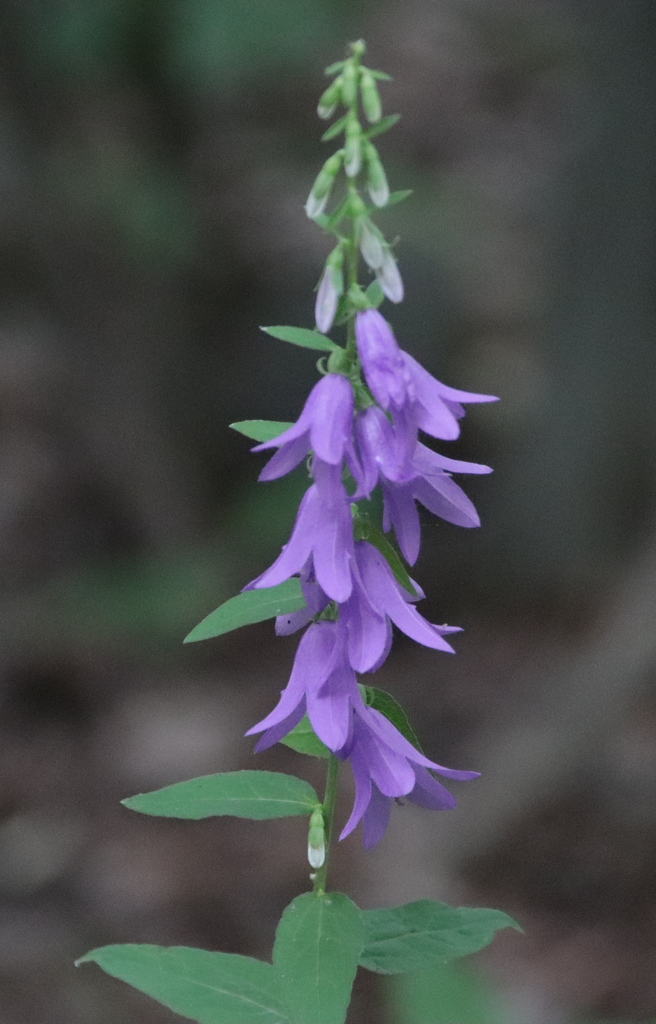
Creeping Bellflower
Campanula rapunculoides
Campanula rapunculoides, known by the common names creeping bellflower, rampion bellflower, rover bellflower, garden bluebell, creeping bluebell, purple bell, garden harebell, and creeping campanula, is a perennial herbaceous plant of the genus Campanula, belonging to the family Campanulaceae. Native to central and southern Europe and west Asia, in some parts of North America it is an extremely invasive species.
From the article Campanula rapunculoides on Wikipedia (CC BY-SA), quoted section by section
Description
Campanula rapunculoides reaches on average 30–80 centimetres (12–31 in) of height, with a maximum of 120 centimetres (47 in). The stem is simple, erect and lightly pubescent and the leaves are usually shortly hairy. The basal leaves are triangular, narrow, with a heart-shaped or rounded base, jagged edges and are up to 12 centimetres (4.7 in) long. The upper stem leaves are sessile, lanceolate, and shortly stalked. The inflorescence consists of nodding spikelike racemes with numerous drooping flowers. The flowers are bright blue-violet (rarely white), 2 to 4 centimetres (0.79 to 1.57 in) long, with short petioles standing to one side in the axils of the bracts. The bracts are quite different and smaller than the leaves. The sepals are lanceolate to ovate-lanceolate, entire, wide at the base up to 2.5 millimetres (0.098 in). The corolla is bell-shaped, with five deep lobes slightly ciliate. The flowering period extends from June through September. The flowers are pollinated by insects (bees, flies, butterflies, etc.) (entomophily). The fruit is a capsule with five pores near the base, where the seeds are spread. The plant seeds abundantly (each plant can produce 15,000 seeds), and while some roots come out when it is pulled, the horizontal rhizomes grow vertical storage tubers, which may not be anywhere near the surface portions of the plant. …
Range & habitat
This plant is native to Europe and western Siberia, where it grows in semi-shaded areas like open woods, the edges of denser forests, and meadowland. It has been introduced to North America, where it has become an extremely invasive weed; it chokes out other plants, and eliminating it is nearly impossible due to its multiple propagation mechanisms. Like many related Campanula species and more distant relatives, it is edible and was historically grown for food. The roots, shoots, and leaves are all edible. The roots can be eaten raw or cooked, and the upper parts are mild-flavoured; indeed rather bland, commonplace, and somewhat chewy-leaved; the basal leaves are often cooked as a pot herb, where they blend in with other leaves unnoticeably.
Wikipedia: “Distribution”
In human culture
The genus Latin name (Campanula), meaning 'small bell', refers to the bell-shape of the flower, while the specific name (rapunculoides) refers to the similarity to Campanula rapunculus.
Wikipedia: “Etymology”
Where it lives
Recorded sightings
—
geo-referenced records in GBIF, from museums, herbaria and field observers.
Drag the globe to turn it. Dots are where records exist, not a range map; darker means more records.
In the stacks
Searching the stacks…
Every page naming Campanula rapunculoides in the Biodiversity Heritage Library →
This page is assembled live from iNaturalist, GBIF, Wikipedia, the Source Library and the Internet Archive. It is not yet part of the hand-edited codex. iNaturalist taxon 85321.