- Plants
- ›Vascular Plants
- ›flowering plants
- ›Dicots
- ›Sunflowers, Bellflowers, Fanflowers, and Allies
- ›Sunflowers, Daisies, Asters, and Allies
- ›Asteroideae
- ›Sunflowers and Allies
- ›Zinniinae
- ›Echinacea
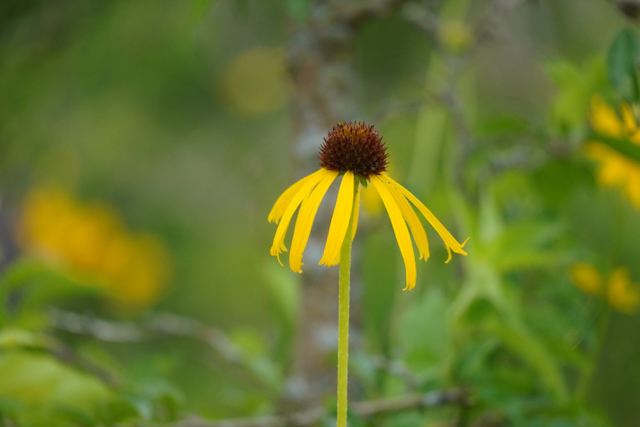
yellow coneflower
Echinacea paradoxa
Echinacea paradoxa, the yellow coneflower or Bush's purple coneflower, is a North American species of flowering plant in the sunflower family. It is native to southern Missouri, Arkansas, and south-central Oklahoma, with one isolated population reported from Montgomery County in eastern Texas. It is listed as threatened in Arkansas.
From the article Echinacea paradoxa on Wikipedia (CC BY-SA), quoted section by section
Description
Echinacea paradoxa is a perennial herb up to 90 cm (3 ft) tall with multiple, slightly hairy stems arising from the rootstock. Most of the leaves are basal leaves with smooth margins. They are alternate, becoming shorter higher up on the stem, and they are completely absent on the upper two-thirds of the stem. The basal leaves are 8–45 cm (3–18 in) long and narrowly elliptic to lanceolate, and the stem leaves are 4–35 cm (2–14 in) long and linear to narrowly elliptic or narrowly lanceolate. One plant can produce several flower heads, each with white, pink, or yellow ray florets surrounding a central head of numerous disk florets. Each flower head is about 5–6 cm (2–2.5 in) across. The central head is dome-shaped and dark reddish brown to nearly black. It is prickly to the touch. It blooms in May and June.
Range & habitat
Echinacea paradoxa var. paradoxa, or yellow coneflower, is endemic to the Ozarks of Missouri and Arkansas. It is listed as imperiled in Arkansas. Echinacea paradoxa var. neglecta, or Bush's purple coneflower, is currently only known to exist in the wild in the Arbuckle Mountains region of southeastern Oklahoma. One isolated population was reported from Montgomery County in eastern Texas. It is listed as critically imperiled in Oklahoma and presumed extirpated in Texas. Habitats include partially sunny to sunny savannas, glades, limestone outcroppings, barrens, open hillsides, and bald knobs.
Wikipedia: “Distribution and habitat”
Where it lives
Recorded sightings
—
geo-referenced records in GBIF, from museums, herbaria and field observers.
Drag the globe to turn it. Dots are where records exist, not a range map; darker means more records.
In the stacks
Searching the stacks…
Every page naming Echinacea paradoxa in the Biodiversity Heritage Library →
This page is assembled live from iNaturalist, GBIF, Wikipedia, the Source Library and the Internet Archive. It is not yet part of the hand-edited codex. iNaturalist taxon 85332.