- Animals
- ›Arthropods
- ›Hexapods
- ›Insects
- ›Winged and Once-winged Insects
- ›Ants, Bees, Wasps, and Sawflies
- ›Narrow-waisted Wasps, Ants, and Bees
- ›Ants, Bees, and Stinging Wasps
- ›Bees and Apoid Wasps
- ›Thread-waisted Wasps
- ›Sphecinae
- ›Sphecini
- ›Sphex
- ›Sphex
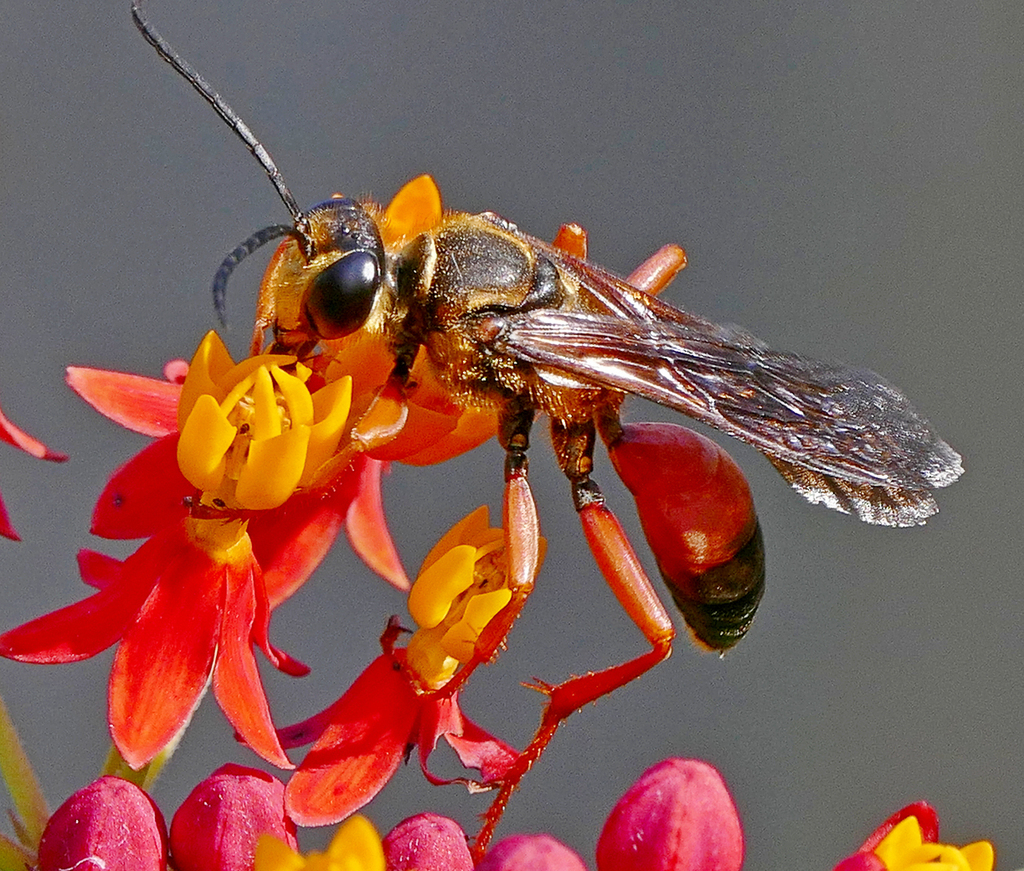
Great Golden Digger Wasp
Sphex ichneumoneus
Sphex ichneumoneus, known commonly as the great golden digger wasp or great golden sand digger is a wasp in the family Sphecidae. It is identified by the golden pubescence on its head and thorax, its reddish orange legs, and partly reddish orange body. This wasp is native to the Western Hemisphere, from Canada to South America, and provisions its young with various types of paralyzed Orthoptera.
Douglas Hofstadter cites the observation by Woodridge of S. ichneumoneus continually repeating behavior (checking a burrow before pulling in a cricket) as an example of genetic determinism, calling the behavior "sphexish". It is an example of a fixed action pattern, as described by H.J. Brockmann, where the sign stimulus is the sight of paralyzed prey in correct orientation (head facing burrow) and position (≤3 cm from entrance in alignment with the dug mound) and the behavioral sequence is to pull the prey into the burrow by its antennae, if present (otherwise the wasp will position the prey outside, go into the burrow alone, reemerge headfirst and reevaluate, although it may uncommonly attempt to pull the prey in by another part of its body). The burrow of the great golden sand digger consists of a descending shaft with individual brood chambers arranged at right angles to it. This arrangement makes it difficult to pull prey into a brood chamber without getting stuck and is one possible reason why the wasp always checks to ensure the path is clear before preferentially pulling its prey down by its antennae.
Listen
Looking for field recordings…
Where it lives
Recorded sightings
—
geo-referenced records in GBIF, from museums, herbaria and field observers.
Drag the globe to turn it. Dots are where records exist, not a range map; darker means more records.
In the stacks
Searching the stacks…
Every page naming Sphex ichneumoneus in the Biodiversity Heritage Library →
This page is assembled live from iNaturalist, GBIF, Wikipedia, the Source Library and the Internet Archive. It is not yet part of the hand-edited codex. iNaturalist taxon 85362.