- Plants
- ›Vascular Plants
- ›flowering plants
- ›monocots
- ›lilies, supplejacks, and allies
- ›Herb-Paris, False Hellebores, Trilliums and allies
- ›Melanthieae
- ›Veratrum
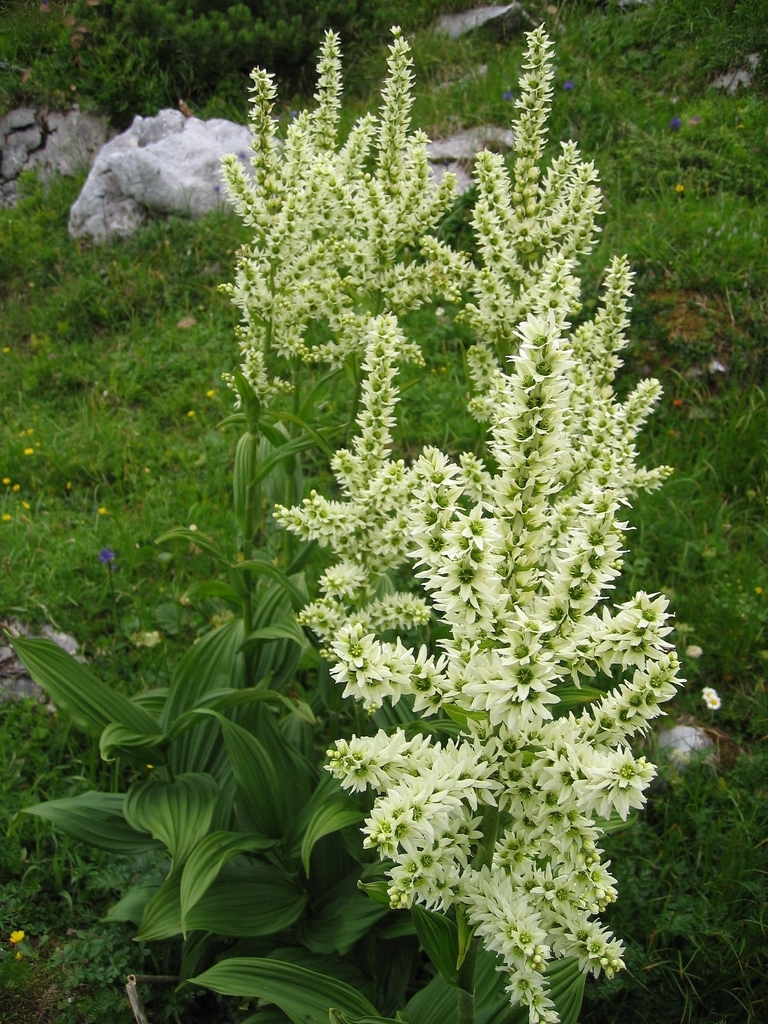
White Hellebore
Veratrum album
Veratrum album (commonly known as false helleborine, white hellebore, European white hellebore, or white veratrum; syn. Veratrum lobelianum Bernh) is a poisonous plant of the family Liliaceae or Melanthiaceae. It is native to Europe and parts of western Asia (western Siberia, Turkey, Caucasus).
From the article Veratrum album on Wikipedia (CC BY-SA), quoted section by section
Description
Veratrum album is a tall herbaceous perennial plant with alternate, pleated leaves. The flowers are white, marked with green on the top portion of the stalk. The fruit is a small pod containing winged seeds. The stout, simple stems are 50–175 cm (20–69 in) tall. The plants have an estimated lifespan of several centuries and often achieve dominance in wild areas as they are unpalatable to grazing herbivores.
At the table
Extracts from dried rhizomes of Veratrum album were briefly used as a pesticide against the Colorado potato beetle.
Research. In 1890, Georg Salzberger first isolated and named the alkaloid protoveratrine. Later investigation found that protoveratrine is a mixture of two closely related alkaloids, protoveratrine A and protoveratrine B. During the 1940s and 1950s, Veratrum album was studied in essential hypertension, hypertension during renal dysfunction, and pre-eclampsia.
Horticultural. Veratrum album is grown as an ornamental plant. In the UK, it has gained the Royal Horticultural Society's Award of Garden Merit.
Wikipedia: “Uses”
Toxicity
In beverages, V. album has been mistaken for the harmless yellow gentian (Gentiana lutea) or wild garlic (Allium ursinum), resulting in poisoning. All parts of the plant are poisonous.
Symptoms. Symptoms of Veratrum alkaloid poisoning typically occur within thirty minutes to four hours of ingestion, and include:
vomiting abdominal pain hypotension bradycardia nausea drowsiness dizziness dilated pupils
Treatment. Treatment for Veratrum alkaloid poisoning include supportive care and symptomatic treatments, such as fluid replacement and anti-emetics. Atropine and vasopressors act to combat bradycardia and hypotension. Duration of illness can last up to ten days but full recovery is possible within a few hours depending on dose and treatment.
Poisonings. Various Veratrum alkaloids were present in a German sneezing powder in 1982, resulting in the accidental poisoning of those who used it. Sneezing powders are commonly used to prank others. In 1983, there were nine cases of accidental poisoning as a result of these pranks due to the presence of Veratrum alkaloids in the sneezing powders. The victims were nine boys aged between 11 and 18 years old in Scandinavian countries who used supplies imported from the Federal Republic of Germany. All boys had inhaled the powder and six had ingested it. Symptoms typically presented within an hour, after which calls were made to authorities. …
Where it lives
Recorded sightings
—
geo-referenced records in GBIF, from museums, herbaria and field observers.
Drag the globe to turn it. Dots are where records exist, not a range map; darker means more records.
In the old herbals & bestiaries

Herbal of Virtues
1499 · p.123

On the Virtues of Herbs
Macer Floridus · 1150 · p.250

Herbarius
1485 · p.124

De medicinali materia libri sex
Dioscorides · 1552 · p.633

Commentaries on the Six Books of Dioscorides
Pietro Andrea Mattioli · 1560 · p.780

Hortus Eystettensis
Basilius Besler · 1640 · p.264

On the Virtues of Herbs
Macer Floridus (Odo of Meung) · 1090 · p.100

Latin Herbal with German Synonyms
1484 · p.151

The Great Herbary with all the figures of the herbs
1532 · p.144

Notable Commentaries on the History of Plants
Leonhart Fuchs · 1542 · p.306

Book of Herbs
Hieronymus Bock (Tragus) · 1546 · p.341

Notable Commentaries on the History of Plants
Leonhart Fuchs · 1549 · p.304
In the stacks
Searching the stacks…
Every page naming Veratrum album in the Biodiversity Heritage Library →
This page is assembled live from iNaturalist, GBIF, Wikipedia, the Source Library and the Internet Archive. It is not yet part of the hand-edited codex. iNaturalist taxon 85424.