- Plants
- ›Vascular Plants
- ›flowering plants
- ›Dicots
- ›Sunflowers, Bellflowers, Fanflowers, and Allies
- ›Sunflowers, Daisies, Asters, and Allies
- ›Asteroideae
- ›paper daisies
- ›cudweeds, everlastings, and pussytoes
- ›Coronidium
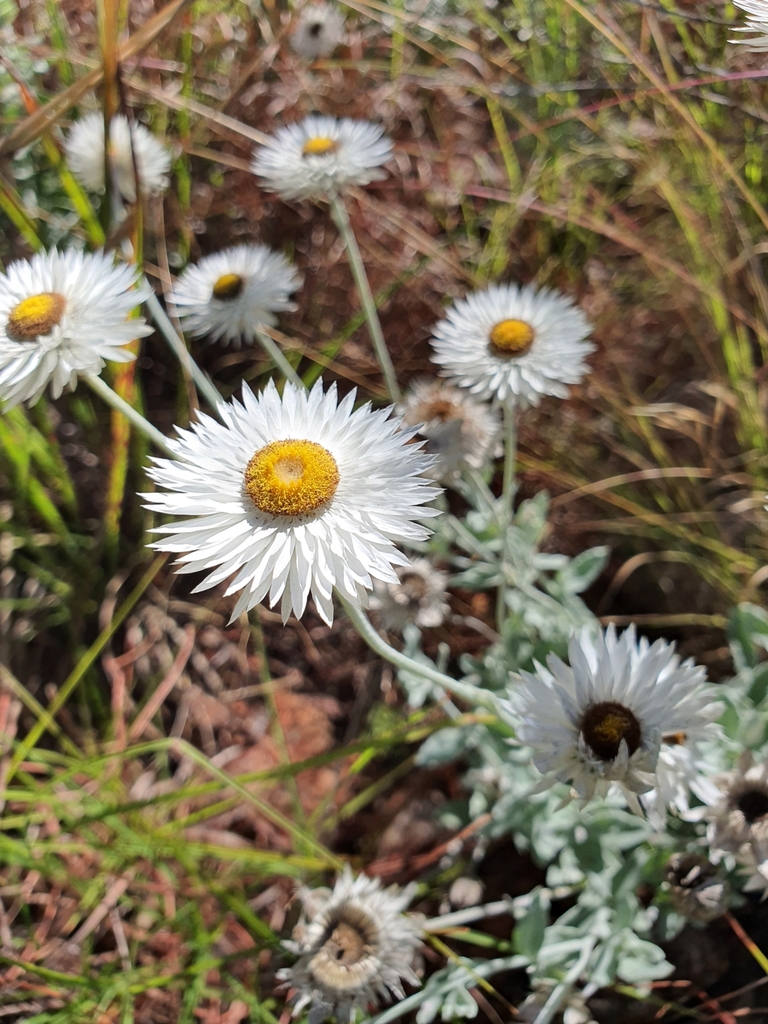
Coronidium newcastlianum
Coronidium newcastlianum is a species of flowering plant in the family Asteraceae and is endemic to Queensland, Australia. It is an erect, perennial herb with lance-shaped or egg-shaped stem leaves with the narrower end towards the base and covered with felt-like leaves, heads of flowers with white or pale pink bracts, and cylindrical to oblong cypselas with a persistent pappus.
From the article Coronidium newcastlianum on Wikipedia (CC BY-SA), quoted section by section
Description
Coronidium newcastlianum is an erect perennial herb that typically grows to a height of 60 cm (24 in) and has slender branches densely covered with woolly or felt-like hairs. The stem leaves are sometimes sessile, with narrowly oblong to lance-shaped or egg-shaped with the narrower end towards the base, 30–80 mm (1.2–3.1 in) long, 10–20 mm (0.39–0.79 in) wide and densely covered with woolly hairs. The heads are arranged singly on the ends of branched flowering stems, 40–50 mm (1.6–2.0 in) in diameter with white or pink involucral bracts about 5 mm (0.20 in) long. The cypselas are about 1.3 mm (0.051 in) long and the pappus has thread-like bristles joined at the base.
Range & habitat
Coronidium newcastlianum is found along the Great Dividing Range in the Einasleigh Uplands bioregions of Queensland where it grows in eucalypt woodlands on rocky hills.
Wikipedia: “Distribution and habitat”
Where it lives
Recorded sightings
—
geo-referenced records in GBIF, from museums, herbaria and field observers.
Drag the globe to turn it. Dots are where records exist, not a range map; darker means more records.
In the stacks
Searching the stacks…
Every page naming Coronidium newcastlianum in the Biodiversity Heritage Library →
This page is assembled live from iNaturalist, GBIF, Wikipedia, the Source Library and the Internet Archive. It is not yet part of the hand-edited codex. iNaturalist taxon 854465.