- Fungi Including Lichens
- ›Ascomycete Fungi
- ›Sac Fungi and Lichens
- ›Arthoniomycetes
- ›Arthoniales
- ›Christmas lichens, comma lichens, and allies
- ›Felipes
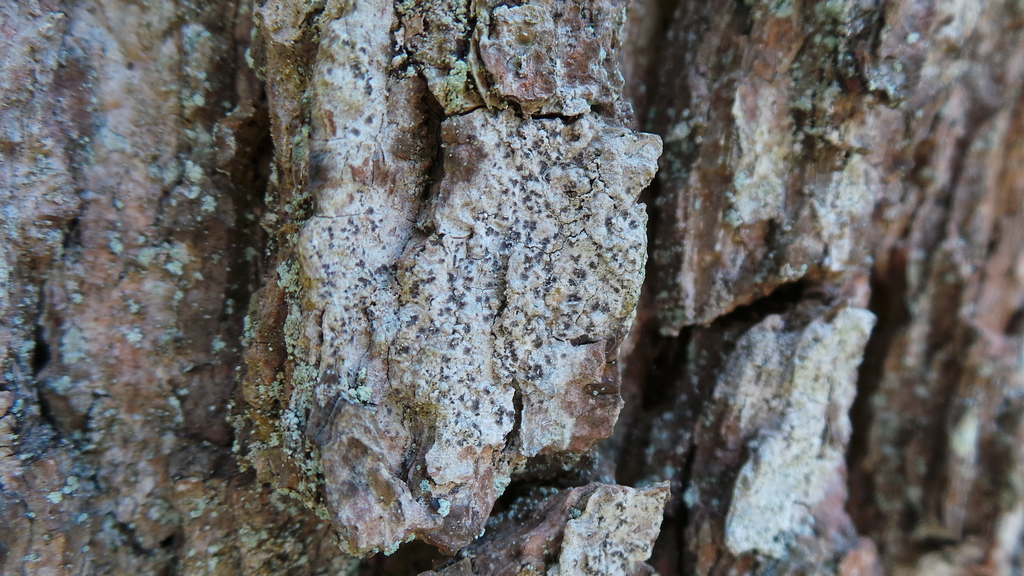
Felipes leucopellaeus
Felipes is a genus of lichenized fungi in the order Arthoniales. Circumscribed by Andreas Frisch and Göran Thor in 2014, it contains the single species Felipes leucopellaeus. Genetic analysis shows that the genus falls into the order Arthoniales, but its familial placement is uncertain. Felipes leucopellaeus is found across Europe and North America in temperate and boreal regions, typically in old-growth forest or wooded mires. It is crustose and corticolous.
From the article Felipes on Wikipedia (CC BY-SA), quoted section by section
Description
Felipes leucopellaeus is a crustose lichen. Its thallus is whitish to pale yellow or fawn in colour, variously described as being flaky (scurfy), minutely granular (leprose) or somewhat "cobwebby" (arachnoid) in appearance. Fresh growth often has a pinkish tinge, and the lichen has no distinct margin. Its apothecia (the lichen's spore-carrying structures) are dark brown to black in colour, ranging in shape from generally rounded to star-like or lobed.
What it does
Felipes leucopellaeus is a corticolous lichen, growing on tree bark – particularly acidic tree bark. In Europe, it is found on the bark of mature birch (Betula), oak (Quercus), pine (Pinus) and holly (Ilex) trees, as well as occasionally on old common heather (Calluna) stems. In North America, where it was first recorded in 1988, it has been found on the bark of Betula alleghaniensis (yellow birch) and Picea rubens (red spruce). It is uncommon in many of the places it occurs. In Italy, it is considered critically endangered, and it is a red-listed species in Poland and Lithuania. It is sometimes attacked by the lichenicolous species Chaenothecopsis vainioana.
Wikipedia: “Ecology”
Where it lives
Recorded sightings
—
geo-referenced records in GBIF, from museums, herbaria and field observers.
Drag the globe to turn it. Dots are where records exist, not a range map; darker means more records.
In the stacks
Searching the stacks…
Every page naming Felipes leucopellaeus in the Biodiversity Heritage Library →
This page is assembled live from iNaturalist, GBIF, Wikipedia, the Source Library and the Internet Archive. It is not yet part of the hand-edited codex. iNaturalist taxon 854522.