- Plants
- ›Vascular Plants
- ›flowering plants
- ›Dicots
- ›Sunflowers, Bellflowers, Fanflowers, and Allies
- ›Sunflowers, Daisies, Asters, and Allies
- ›Asteroideae
- ›groundsels and allies
- ›Doronicum
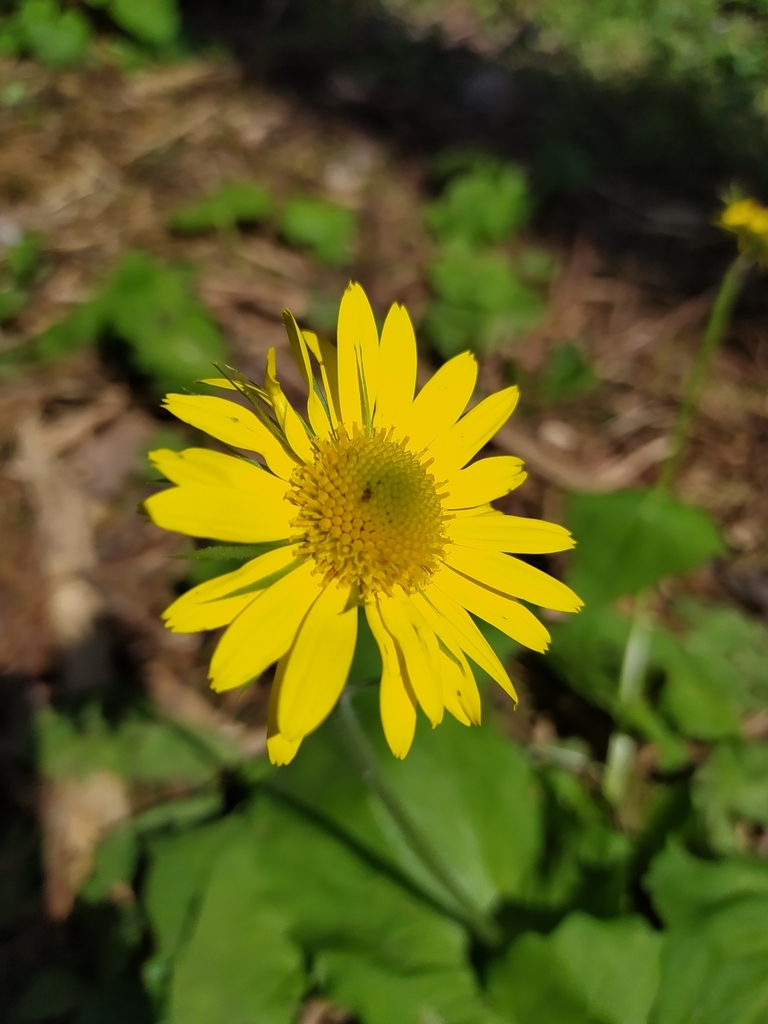
Oriental Leopard's-bane
Doronicum caucasicum
Doronicum orientale, the Oriental leopard's bane, is a European plant species in the family Asteraceae.
From the article Doronicum orientale on Wikipedia (CC BY-SA), quoted section by section
Description
Doronicum orientale is a perennial herb that has daisy-like yellow flower heads on long, straight stems, which attract nectar-eating insects. The plants grow to approximately 2 feet (60 cm) tall. The basal foliage is bright green with cordate leaves that have scalloped margins. Its native habitats include moist, rocky outcrops and woodland areas.
Range & habitat
It is native to southeastern Europe (Italy, Greece, the Balkans, Hungary, Moldova, Ukraine, southern European Russia) and parts of southwest Asia (Turkey, South Caucasus).
Wikipedia: “Distribution”
How it is grown
Doronicum orientale is widely cultivated as an ornamental. There are a few reports of the species having escaped cultivation and been found growing wild in parts of Canada, but the plant apparently failed to become established there. D. orientale is a hardy (to zone 3) perennial, blooming in early spring. It likes both shade and sun and is easily grown in moist, fertile soil. The plant attracts butterflies. Cultivars include 'Little Leo', which is semi-double.
Wikipedia: “Cultivation”
In human culture
The specific epithet "orientale," means "eastern" and is in reference to its native range of eastern Europe, not eastern Asia.
Wikipedia: “Etymology”
Where it lives
Recorded sightings
—
geo-referenced records in GBIF, from museums, herbaria and field observers.
Drag the globe to turn it. Dots are where records exist, not a range map; darker means more records.
In the stacks
Searching the stacks…
Every page naming Doronicum caucasicum in the Biodiversity Heritage Library →
This page is assembled live from iNaturalist, GBIF, Wikipedia, the Source Library and the Internet Archive. It is not yet part of the hand-edited codex. iNaturalist taxon 857164.