Nipan
Capparis lasiantha
Capparis lasiantha is an endemic Australian plant with a range that extends from the Kimberley region through the Northern Territory and Queensland to northern New South Wales, primarily in drier inland areas although the species extends to the coast in Central Queensland. Common names are numerous and include wyjeelah, nepine, split jack, nipang creeper, nipan, native orange and bush caper.
From the article Capparis lasiantha on Wikipedia (CC BY-SA), quoted section by section
Description
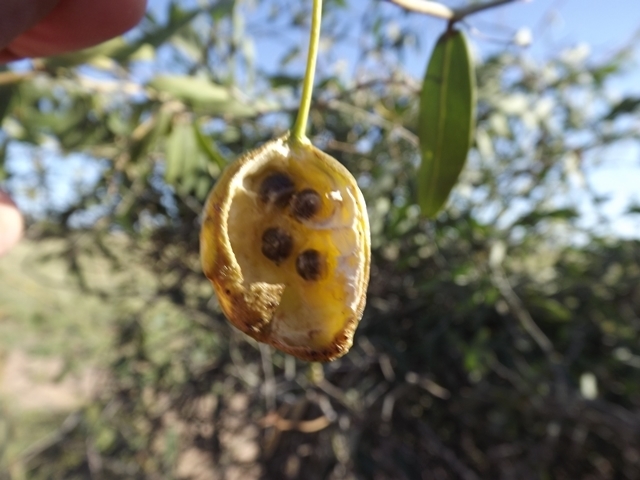
The seedlings and young plants begin life as climbing vines that cling to the host plants by means sharp spines on the stems. Some plants may retain this climbing form into maturity, while others go on to develop into a scrambling shrub up to 3 m (10 ft) in height. Mature plants produce large, white perfumed flowers which are followed by hard, ellipsoidal fruit up to 4 cm (1.6 in) long. Upon ripening the fruit becomes soft and fragrant, eventually splitting to reveal a sweet, edible pulp surrounding the seed.
What it does
Caterpillars of the caper white (Belenois java) feed on its leaves. Capparis lasiantha has been recorded as a host for the mistletoe species Lysiana subfalcata. The fruit was used as food by Aboriginal people throughout its range. A concoction from the bark was used as a treatment for animal bites and stings in the Broome region. Farmers could use the leaves as fodder for livestock in periods of drought.
Wikipedia: “Ecology and uses”
How it is grown
A drought tolerant plant, Capparis lasiantha can be grown in arid or subtropical gardens, its heavy flowering and edible fruit give it horticultural potential. It can be propagated by seed.
Wikipedia: “Cultivation”
Where it lives
Recorded sightings
—
geo-referenced records in GBIF, from museums, herbaria and field observers.
Drag the globe to turn it. Dots are where records exist, not a range map; darker means more records.
In the stacks
Searching the stacks…
Every page naming Capparis lasiantha in the Biodiversity Heritage Library →
This page is assembled live from iNaturalist, GBIF, Wikipedia, the Source Library and the Internet Archive. It is not yet part of the hand-edited codex. iNaturalist taxon 858218.