- Plants
- ›Vascular Plants
- ›flowering plants
- ›Dicots
- ›Heathers, Balsams, Primroses, and Allies
- ›heath family
- ›Epacrids, Styphelias and Allies
- ›Epacrideae
- ›Epacris
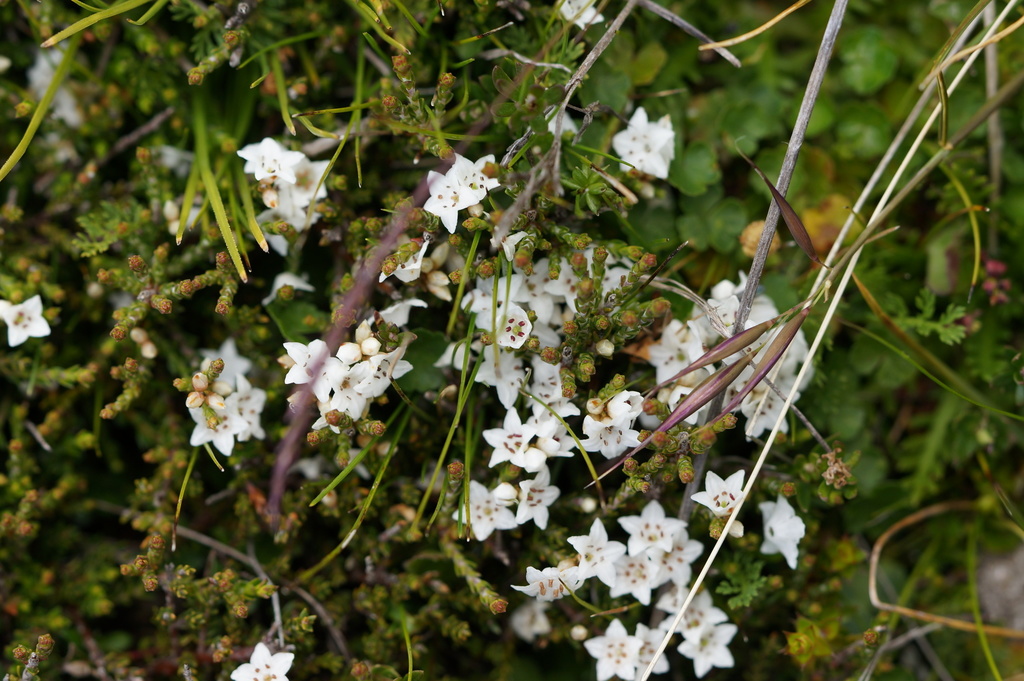
Snow Heath
Epacris petrophila
Epacris petrophila, commonly known as snow heath, is a species of flowering plant from the heath family, Ericaceae, and is endemic to south-eastern Australia. It is an erect, bushy, sometimes low-lying shrub with egg-shaped to elliptic leaves and tube-shaped white flowers in small clusters on the ends of branches.
From the article Epacris petrophila on Wikipedia (CC BY-SA), quoted section by section
Description
Epacris petrophila is an erect, bushy, sometimes low-lying shrub that typically grows to a height of 30–80 cm (12–31 in) and has softly-hairy branchlets. Its leaves are erect, elliptic or egg-shaped, sometimes with the narrower end towards the base, 1.1–3.3 mm (0.043–0.130 in) long and 0.7–1.7 mm (0.028–0.067 in) wide 0.1–0.2 mm (0.0039–0.0079 in) long, and with minute teeth on the edges. The flowers are borne in clusters up to 10 mm (0.39 in) long on the ends of branches and are more or less sessile with 8 to 10 bracts at the base. The sepals are egg-shaped, 2–3 mm (0.079–0.118 in) long and the petals are white, joined at the base to form a bell-shaped tube 1.3–2.0 mm (0.051–0.079 in) long with lobes 1.4–2.5 mm (0.055–0.098 in) long. Flowering occurs from December to February and the fruit is a capsule about 1.5 mm (0.059 in) long.
Range & habitat
Snow heath grows in the alpine and subalpine feldmark, heath and bog in New South Wales and the Australian Capital Territory south from Mount Kosciuszko, in a few locations in Victoria and in Tasmania where it is common on the Central Plateau.
Wikipedia: “Distribution and habitat”
What it does
The seeds of E. petrophila weigh about 0.02 g (0.00071 oz) and are only 0.5 mm (0.020 in) long, suggesting dispersal by wind or water, or in mud adhering to the feet of birds. The seed of Epacris petrophila was featured on the $1 postage stamp issued on 8 October 2019 by Australia Post. The stamp issue was one of three stamps, each featuring the seeds of threatened Australian plant species, recognising the work of the Australian Seed Bank Partnership.
== References ==
Wikipedia: “Ecology”
Where it lives
Recorded sightings
—
geo-referenced records in GBIF, from museums, herbaria and field observers.
Drag the globe to turn it. Dots are where records exist, not a range map; darker means more records.
In the stacks
Searching the stacks…
Every page naming Epacris petrophila in the Biodiversity Heritage Library →
This page is assembled live from iNaturalist, GBIF, Wikipedia, the Source Library and the Internet Archive. It is not yet part of the hand-edited codex. iNaturalist taxon 864429.