- Plants
- ›Vascular Plants
- ›flowering plants
- ›Dicots
- ›Legumes, Milkworts, and Allies
- ›Legumes
- ›Faboideae
- ›Mirbelieae
- ›Mirbelia
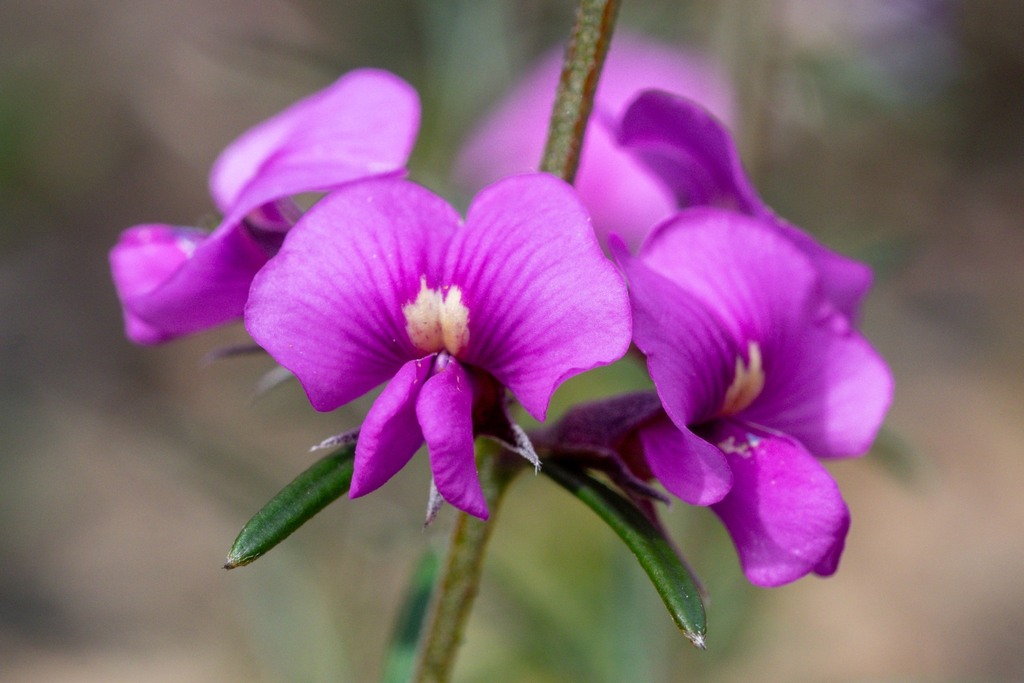
Mirbelia speciosa
Mirbelia speciosa is a species of flowering plant in the family Fabaceae and is endemic to eastern Australia. It is an erect shrub with narrowly linear leaves arranged in whorls of three, and bluish-purple flowers usually arranged singly in leaf axils.
From the article Mirbelia speciosa on Wikipedia (CC BY-SA), quoted section by section
Description
Mirbelia speciosa is an erect shrub that typically grows to a height of up to about 1 m (3 ft 3 in) and has angular stems. Its leaves are arranged in whorls of three, and are narrowly linear, 10–30 mm (0.39–1.18 in) long, 2–4 mm (0.079–0.157 in) long and sharply pointed, the edges rolled under. The flowers are mostly arranged in leaf axils, the sepals are 6–8 mm (0.24–0.31 in) long, silky-hairy and joined at the base to form a tube with tapering teeth about as long as the tube. The petals are 8–13 mm (0.31–0.51 in) long and bluish-purple, often with a yellowish mark near the base of the standard petal. Flowering occurs in July and August and the fruit is an oval pod 8–15 mm (0.31–0.59 in) long.
Range & habitat
This mirbelia grows in heath, woodland and forest north from the Illawarra region in New South Wales to north Queensland.
Wikipedia: “Distribution and habitat”
How it is grown
This species is not recommended for clay soils that are not well drained or sites with excessive frost. A sunny situation is preferred, though it does better with a small amount of shade. Fertilizers may be used, but are only recommended if they have a low pH (higher acid) levels. This plant strikes easily from tip cuttings. Alternatively, seed propagation is also successful. Seeds may be treated by very hot (but not boiling) water for two minutes. After drying overnight, they should be planted and placed in a sunny situation. Germination usually occurs within two weeks.
== References ==
Wikipedia: “Use in horticulture”
Where it lives
Recorded sightings
—
geo-referenced records in GBIF, from museums, herbaria and field observers.
Drag the globe to turn it. Dots are where records exist, not a range map; darker means more records.
In the stacks
Searching the stacks…
Every page naming Mirbelia speciosa in the Biodiversity Heritage Library →
This page is assembled live from iNaturalist, GBIF, Wikipedia, the Source Library and the Internet Archive. It is not yet part of the hand-edited codex. iNaturalist taxon 864773.