- Plants
- ›Vascular Plants
- ›flowering plants
- ›Dicots
- ›Sunflowers, Bellflowers, Fanflowers, and Allies
- ›Sunflowers, Daisies, Asters, and Allies
- ›Asteroideae
- ›Chamomiles, yarrows, and allies
- ›Artemisiinae
- ›Artemisia
- ›Artemisia
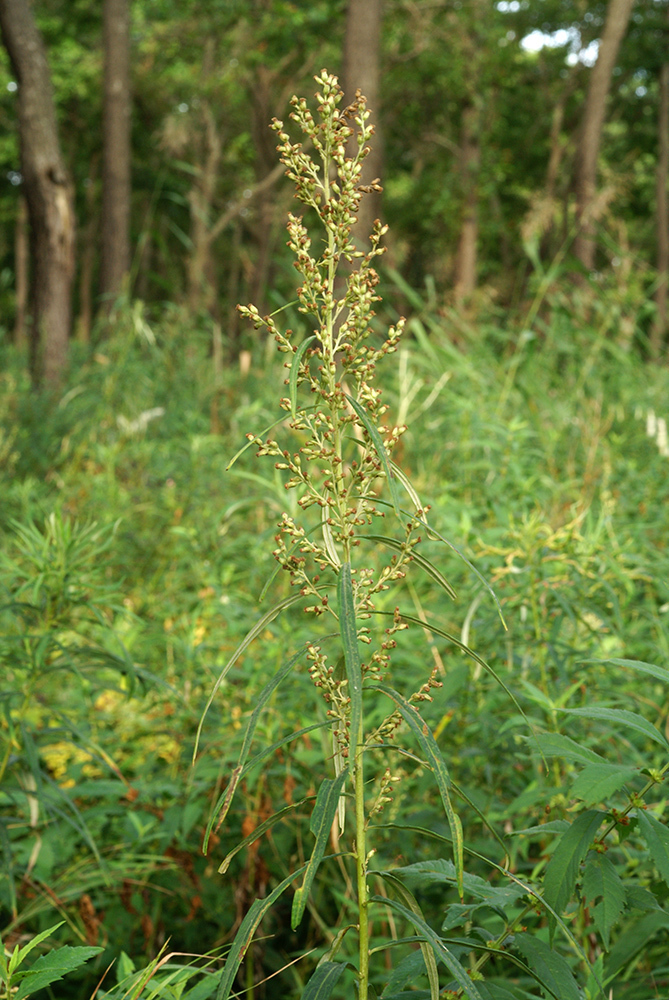
Seleng Wormwood
Artemisia selengensis
Artemisia vulgaris (common mugwort or common wormwood) is one of several species in the genus Artemisia commonly known as mugwort, although Artemisia vulgaris is the species most often called mugwort. This species is also occasionally known as riverside wormwood, felon herb, chrysanthemum weed, wild wormwood, old Uncle Henry, sailor's tobacco, naughty man, old man or St. John's plant (not to be confused with St John's wort). Mugworts have been used medicinally and as culinary herbs.
From the article Artemisia vulgaris on Wikipedia (CC BY-SA), quoted section by section
Description
Artemisia vulgaris is an aromatic, herbaceous, perennial plant that grows to 1.5 m (4 ft 11 in) in height. It spreads through vegetative expansion and the anthropogenic dispersal of root rhizome fragments—the plant rarely reproduces from seeds in temperate regions, as few seeds capable of germinating are produced by plants. Mugwort cannot easily be controlled by being ploughed into the soil, as sections of the plant's rhizomes move away from the parent plant if the soil is disturbed, causing the number of new plants to increase.
The stems are purple-looking and angular. The pinnate leaves are smooth and of a dark green tint on the upper surface. They have dense, whitish tomentose hairs on the underside, are glabrous on the upperside, and have lobes that are approximately 2.5–8 mm (0.098–0.315 in) wide. New leaves are opposite and are attached to the stem with a thin, long petiole. They are rounded, lack lobes, and are woolly-looking underneath. The yellow or reddish-looking flower heads, which appear from July to September, are arranged paniculate branching structure. They are 5 mm (3⁄16 in) long and radially symmetrical. The outer flowers in each capitulum are female and the inner ones bisexual. A. vulgaris flowers from midsummer to early autumn. …
Range & habitat
Artemisia vulgaris is native to temperate Europe, Asia, North Africa, and Alaska, and is naturalized in North America, where some consider it an invasive weed. It is a common plant growing in places containing low-nitrogen soils, such as waste places, roadsides and uncultivated areas. The plant, which prefers alkaline conditions, readily becomes established in open, sandy ground. The plant rarely reproduces from seeds in temperate regions, as few seeds capable of germinating are produced by plants, and the species mainly reproduces from rhizomes. Mugwort cannot easily be controlled by being ploughed into the soil, as sections of the plant's rhizomes move away from the parent plant if the soil is disturbed, causing the number of new plants to increase.
Wikipedia: “Distribution and habitat”
What it does
Several species of Lepidoptera (butterflies and moths) such as Ostrinia scapulalis feed on the leaves and flowers of the plant. It is possibly susceptible to being attacked by honey fungus.
Wikipedia: “Ecology”
At the table
Historically, A. vulgaris was referred to as the "mother of herbs" during the Middle Ages, and has been widely used in the traditional Chinese, European, and Hindu medicine. It supposedly possesses a wide range of pharmacological uses, including anticancer, anti-inflammatory, antioxidant, hepatoprotective, antispasmolytic, antinociceptive, antibacterial, antihypertensive, antihyperlipidemic, and antifungal properties.
Wikipedia: “Pharmacological uses”
In medicine
A. vulgaris houses a variety of phytochemicals which are responsible for its pharmacological properties. The phytochemicals belong to classes including flavonoids, essential oils, phenolic acids, coumarins, sterols, carotenoids, vitamins, and sesquiterpene lactones, among many others. Examples of the phytochemicals include vulgarin, artemisinin, scopoletin, camphene, camphor, sabinene, and some derivatives of quercetin and kaempferol.
Wikipedia: “Phytochemical constituents”
Where it lives
Recorded sightings
—
geo-referenced records in GBIF, from museums, herbaria and field observers.
Drag the globe to turn it. Dots are where records exist, not a range map; darker means more records.
In the old herbals & bestiaries

In the stacks
Searching the stacks…
Every page naming Artemisia selengensis in the Biodiversity Heritage Library →
This page is assembled live from iNaturalist, GBIF, Wikipedia, the Source Library and the Internet Archive. It is not yet part of the hand-edited codex. iNaturalist taxon 866150.