- Plants
- ›Vascular Plants
- ›flowering plants
- ›monocots
- ›grasses, sedges, cattails, and allies
- ›Sedges
- ›Cyperoideae
- ›Eleocharideae
- ›Eleocharis
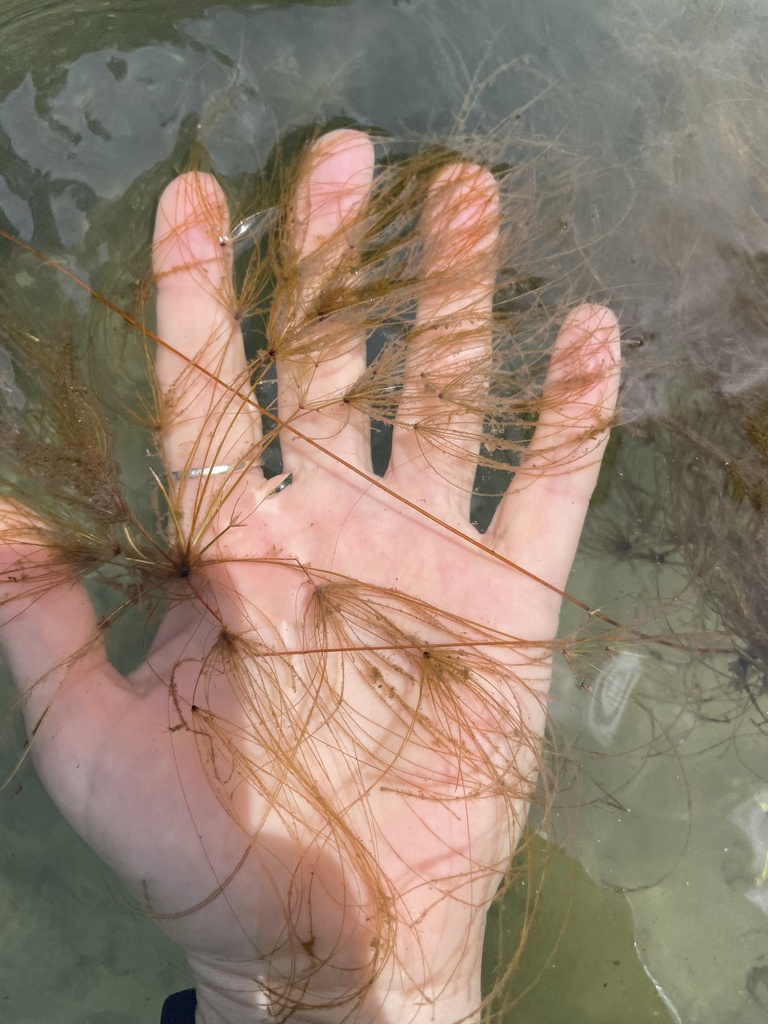
Algal Bulrush
Eleocharis confervoides
Eleocharis confervoides is a species of plant in the sedge family (Cyperaceae). It is a perennial, submerged, aquatic and deeply rooted herb. It is known by its common name Algal bulrush and has lots of synonyms. The species has worldwide but very spotty distribution and is native in many tropical and subtropical regions in America, Asia and Africa. It inhabits in water, usually in shallow or deep lakes and ponds. The plant has slender stem with many branches, the leaves float in the water and flowers are usually emergent over the water surface. Fruiting occurs in fall. The most occurrences of plant appear in April and frequency of occurrences is increasing the last years
From the article Eleocharis confervoides on Wikipedia (CC BY-SA), quoted section by section
Description
The plant grows underwater with its upper parts floating near the surface. The culm is long and thin, but strong, with nodes each with culms arranged in a circle around it (whorled). New whorls of branches arise from culms at the edge of the branches, estimating 4-19 culms per whorl. Culms have cylindric (with indentations or not) or 3-angled shape and are hair-like, becoming slimmer in the more distal whorls. Nodes in upper parts of the stem develop branches. The internodes between the whorls become more and more short distally, while the internodes of the culms of the last whorl are longer at the edge. In the same whorl, it is possible to be found culms with different development because they do not develop at the same time from the node. The branching repeated until nodes of the 4th order but the final subtending sterile culms or less often a stalked spikelet. Nodes subtend by greyish, pink or dark purple reduced leaves which are small and thin (bracts). There are two bracts; the lower bract subtends the oldest culms of the whorl, while the upper bract is far from the former on the culm whose tip bears the whorl. They are triangular or elliptical. Leaves are developed within the whorl, between the culm bases. They are usually long, triangular, with two convergent veins and slim. …
Range & habitat
The species, as the most species of Eleocharis, needs warm and wet climate to grow. It usually occurs in areas near the lakes or seasonally flooded areas. Specifically, it is a submerged aquatic grass growing in lakes. It has its roots in mud of the lake bottoms and is wholly submerged in 0.9-1.5 m of water. It can grow in any type of water; clear lakes, standing or running waters, swampy ponds. It prospers in very soft loose organic substrate into the water, and even in sandhill upland lake. It can also be found in open savanna, rarely in easterly savanna.
Wikipedia: “Habitat and ecology”
In human culture
The name Eleocharis is New Latin and is derived from Greek words ἑλεο- heleo- meaning "marsh" and χάρις -charis meaning "grace". The specific epithet confervoides is New Latin and is derived from word conferva which means seething, denoting "crowded-looking".
Wikipedia: “Etymology”
Where it lives
Recorded sightings
—
geo-referenced records in GBIF, from museums, herbaria and field observers.
Drag the globe to turn it. Dots are where records exist, not a range map; darker means more records.
In the stacks
Searching the stacks…
Every page naming Eleocharis confervoides in the Biodiversity Heritage Library →
This page is assembled live from iNaturalist, GBIF, Wikipedia, the Source Library and the Internet Archive. It is not yet part of the hand-edited codex. iNaturalist taxon 867214.