- Plants
- ›Vascular Plants
- ›flowering plants
- ›Dicots
- ›myrtles, evening primroses, and allies
- ›myrtle family
- ›Myrtoideae
- ›gum trees
- ›Eucalyptus
- ›Symphyomyrtus
- ›Adnataria
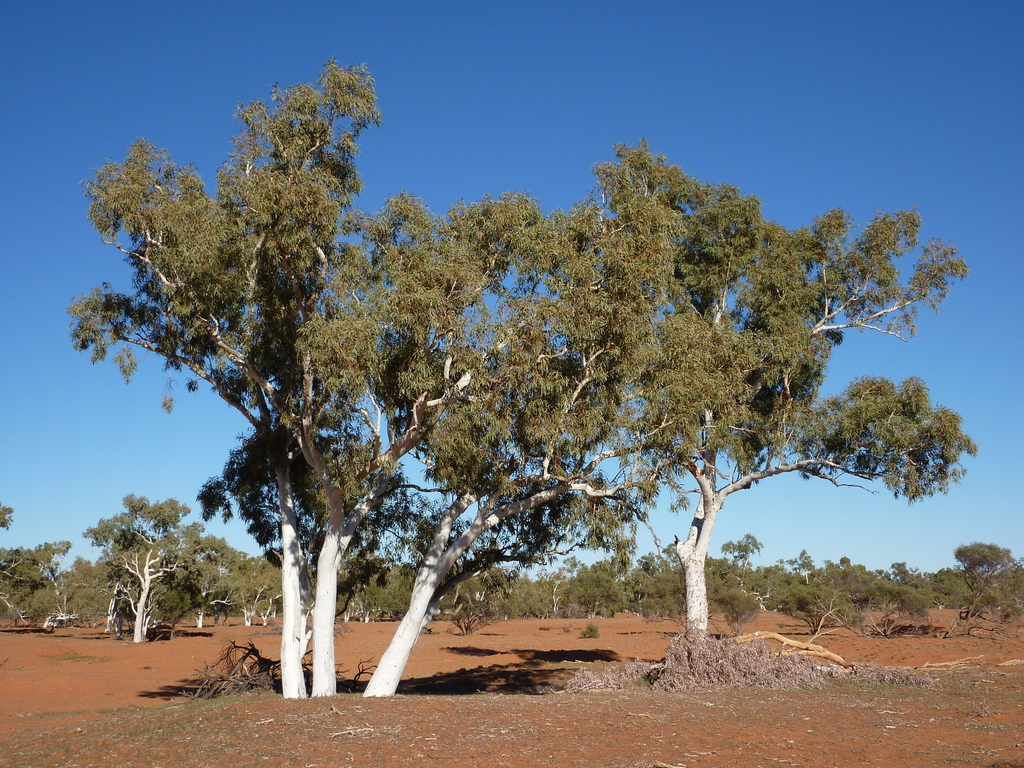
Smooth-barked Coolibah
Eucalyptus victrix
Eucalyptus victrix, commonly known as the smooth-barked coolibah, western coolibah or little ghost gum, is a species of small tree that is endemic to Australia. It has smooth bark, lance-shaped to curved adult leaves, flower buds in groups of seven, creamy white flowers and conical fruit.
From the article Eucalyptus victrix on Wikipedia (CC BY-SA), quoted section by section
Description
Eucalyptus victrix is a spreading tree that typically grows to a height of 1–12 m (3 ft 3 in – 39 ft 4 in) but can reach as high as 22 m (72 ft) and forms a lignotuber. It has smooth bark often with a box-type stocking of rougher bark at the base to a height of 1 m (3 ft 3 in). Young plants and coppice regrowth have broadly lance-shaped leaves that are 80–125 mm (3.1–4.9 in) long and 30–45 mm (1.2–1.8 in) wide. Adult leaves are the same shade of green on both sides, lance-shaped to curved, 90–150 mm (3.5–5.9 in) long and 8–25 mm (0.31–0.98 in) wide, tapering to a petiole 7–23 mm (0.28–0.91 in) long. The flower buds are arranged on the ends of branchlets in groups of seven on a branched peduncle 1–2 mm (0.039–0.079 in)long, the individual buds on pedicels 1–3 mm (0.039–0.118 in) long. Mature buds are oval, 3–5 mm (0.12–0.20 in) long and 2–3 mm (0.079–0.118 in) wide with a conical to rounded operculum. Flowering occurs between November and March and the flowers are creamy white. The fruit is a woody conical capsule 2–5 mm (0.079–0.197 in) long and 3–6 mm (0.12–0.24 in) wide with the valves near rim level or protruding.
Range & habitat
The smooth-barked coolibah is found on flats and flood plains in the Mid West, Pilbara, Kimberley and north eastern Goldfields-Esperance regions of Western Australia where it grows in sandy-loamy or clay-sand soils. It is also found through much of the Northern Territory and in far western Queensland.
Wikipedia: “Distribution”
At the table
Indigenous Australians traditionally used the tree for many purposes including as a food and water source, weapons, implements, firewood, shade, shelter and for cultural purposes. The Arrente peoples know the tree as ankerre, the Jaru as gurndad and the Pitjantjatjara as ankara.
Wikipedia: “Traditional uses”
How it is grown
This eucalypt is not commonly cultivated but is suitable as a garden ornamental plant which tolerates full sun and is suited to most soil types that are free-draining. It does not usually require pruning except to shape and form. It can be grown from seed and is tolerant to most diseases and pests. The tree is drought and wind tolerant.
Wikipedia: “Use in horticulture”
Where it lives
Recorded sightings
—
geo-referenced records in GBIF, from museums, herbaria and field observers.
Drag the globe to turn it. Dots are where records exist, not a range map; darker means more records.
In the stacks
Searching the stacks…
Every page naming Eucalyptus victrix in the Biodiversity Heritage Library →
This page is assembled live from iNaturalist, GBIF, Wikipedia, the Source Library and the Internet Archive. It is not yet part of the hand-edited codex. iNaturalist taxon 869447.