- Plants
- ›Vascular Plants
- ›flowering plants
- ›Dicots
- ›Legumes, Milkworts, and Allies
- ›Legumes
- ›Acacias, Mimosas, Mesquites, and Allies
- ›Acacia
- ›Plurinerves
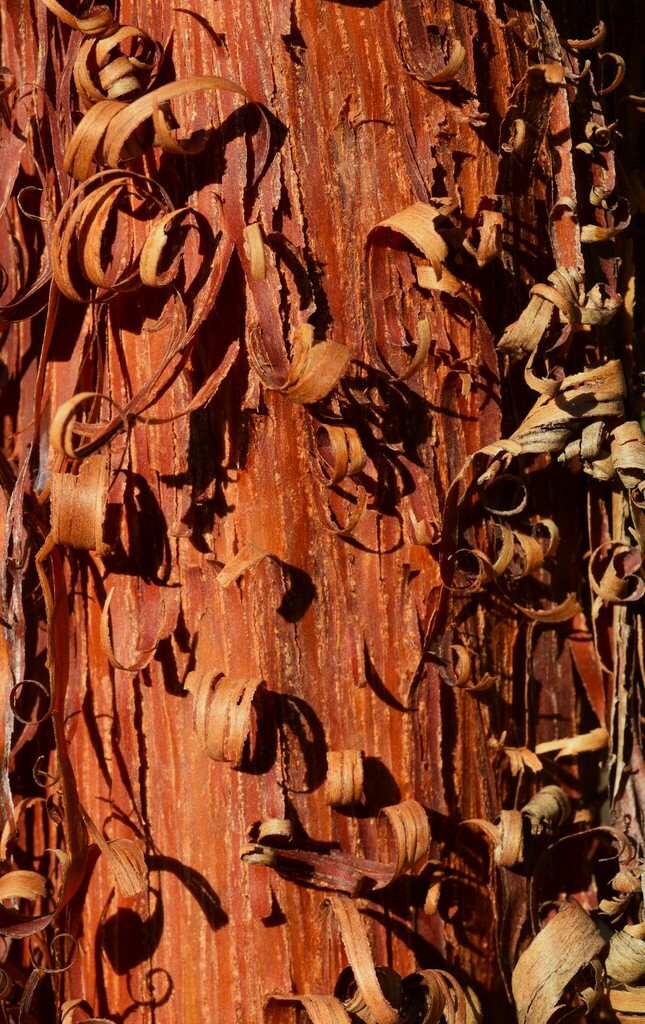
curly-bark wattle
Acacia monticola
Acacia monticola, commonly known as curley-bark wattle, Minni ritchi, red wattle, curley-bark tree, hill turpentine or gawar is a species of flowering plant in the family Fabaceae, and is endemic to north-western Australia. It is resinous, sticky shrub or tree with minni ritchi bark, branchlets angled towards the outer end and with wvy ridges, round, broadly egg-shaped, narrowly elliptic, flat phyllodes, spherical to oblong heads of yellow flowers, and narrowly oblong pods raised over the seeds.is a species of plant in the legume family that is native to northern Australia.
From the article Acacia monticola on Wikipedia (CC BY-SA), quoted section by section
Description
Acacia monticola is a resinous, multi-stemmed shrub or small tree that typically grows to a height of 2–8 m (6 ft 7 in – 26 ft 3 in) and has grey or reddish-brown minni ritchi bark and wavy brown branchlets that are angular near the outer ends. The phyllodes are flat, round, broadly egg-shaped with the narrower end towards the base, elliptic or narrowly elliptic, 10–32 mm (0.39–1.26 in) long, 5–15 mm (0.20–0.59 in) wide, with three to five longitudinal veins and a prominent gland up to 3 mm (0.12 in) above the pulvinus. The flowers are light golden yellow and not showy, borne in spherical or oblong heads, 6–10 mm (0.24–0.39 in) in diameter, rarely in spikes up to 22 mm (0.87 in) long on peduncles 10–20 mm (0.39–0.79 in) long. The flowers are not especially densely packed in the heads and are relatively large in size. Flowering occurs from April to August and the pods are narrowly oblong, 18–100 mm (0.71–3.94 in) long, 7–14.5 mm (0.28–0.57 in) wide, leathery, sticky with prominent edges and flat, but slightly raised over the seeds. The seeds are broadly oblong to oblong, 4–6.2 mm (0.16–0.24 in) long and shiny deep brown.
Range & habitat
Curley-bark wattle is widespread in Western Australia the Northern Territory and central-eastern Queensland, where it grows on red sand, ironstone or lateritic soils in pindan, and on stony plains and rocky ridges in woodland, open shrubland or spinifex. In northern Western Australia it is found in the Central Kimberley, Central Ranges, Dampierland, Gibson Desert, Great Sandy Desert, Little Sandy Desert, Northern Kimberley, Ord Victoria Plain, Pilbara and Tanami and in the Northern Territory in the Burt Plain, Central Arnhem, Central Kimberley, Central Ranges, Channel Country, Daly Basin, Dampierland, Davenport Murchison Ranges, Einasleigh Uplands, Gibson Desert, Great Sandy Desert, Gulf Fall and Uplands, Little Sandy Desert, MacDonnell Ranges, Mitchell Grass Downs, Mount Isa Inlier, Northern Kimberley, Ord Victoria Plain, Pilbara, Pine Creek, Sturt Plateau, Tanami andVictoria Bonaparte bioregions.
Wikipedia: “Distribution and habitat”
Where it lives
Recorded sightings
—
geo-referenced records in GBIF, from museums, herbaria and field observers.
Drag the globe to turn it. Dots are where records exist, not a range map; darker means more records.
In the stacks
Searching the stacks…
Every page naming Acacia monticola in the Biodiversity Heritage Library →
This page is assembled live from iNaturalist, GBIF, Wikipedia, the Source Library and the Internet Archive. It is not yet part of the hand-edited codex. iNaturalist taxon 869458.