- Plants
- ›Vascular Plants
- ›flowering plants
- ›Dicots
- ›Legumes, Milkworts, and Allies
- ›milkworts
- ›Polygaleae
- ›Polygaloides
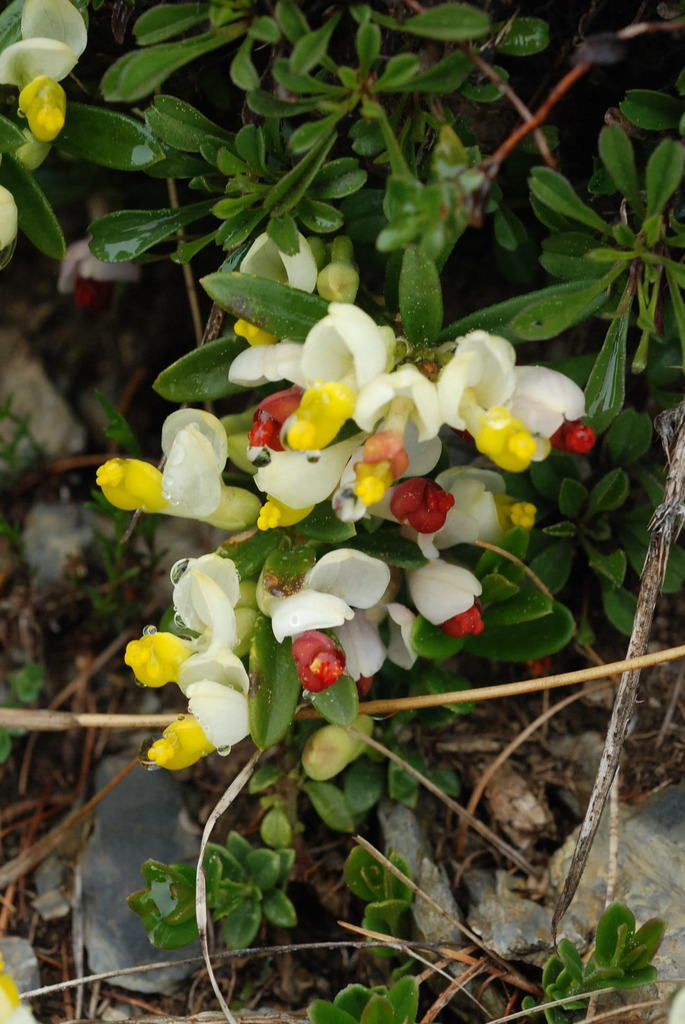
shrubby milkwort
Polygaloides chamaebuxus
Polygaloides chamaebuxus, synonym Polygala chamaebuxus, the shrubby milkwort, is an ornamental plant in the family Polygalaceae. Its flowers are solitary or in pairs in the leaf axils. The inner two sepals, the wings, are upright and white to yellow, sometimes pinkish or purple. The keel petals are bright yellow, aging to brownish-red or purple. It is native to the Alps and the mountains of west-central Europe. It was known to be grown in cultivation in about...
From the article Chamaebuxus alpestris on Wikipedia (CC BY-SA), quoted section by section
Description
Its flowers are solitary or in pairs in the leaf axils. The inner two sepals, the wings, are upright and white to yellow, sometimes pinkish or purple. The keel petals are bright yellow, aging to brownish-red or purple.
How it is grown
It was known to be grown in cultivation in about 1658 and was illustrated by Carolus Clusius. It has been given the Royal Horticultural Society's Award of Garden Merit. Several cultivars are also cultivated for garden use, including 'Grandiflora', whose flowers are purple-red and yellow. The plants are hardy, forming low-lying clumps up to 6 inches (15 cm) high and 20 inches (51 cm) in diameter. They may be propagated from softwood cuttings taken in early in the growing season. Some varieties grow best in ericaceous conditions.
Wikipedia: “Cultivation”
Where it lives
Recorded sightings
—
geo-referenced records in GBIF, from museums, herbaria and field observers.
Drag the globe to turn it. Dots are where records exist, not a range map; darker means more records.
In the stacks
Searching the stacks…
Every page naming Polygaloides chamaebuxus in the Biodiversity Heritage Library →
This page is assembled live from iNaturalist, GBIF, Wikipedia, the Source Library and the Internet Archive. It is not yet part of the hand-edited codex. iNaturalist taxon 869898.