- Animals
- ›Arthropods
- ›Hexapods
- ›Insects
- ›Winged and Once-winged Insects
- ›Ants, Bees, Wasps, and Sawflies
- ›Narrow-waisted Wasps, Ants, and Bees
- ›Ants, Bees, and Stinging Wasps
- ›Bees and Apoid Wasps
- ›Bees
- ›Mason, Leafcutter, Carder, and Resin Bees
- ›Megachilinae
- ›Osmiini
- ›Osmia
- ›Osmia
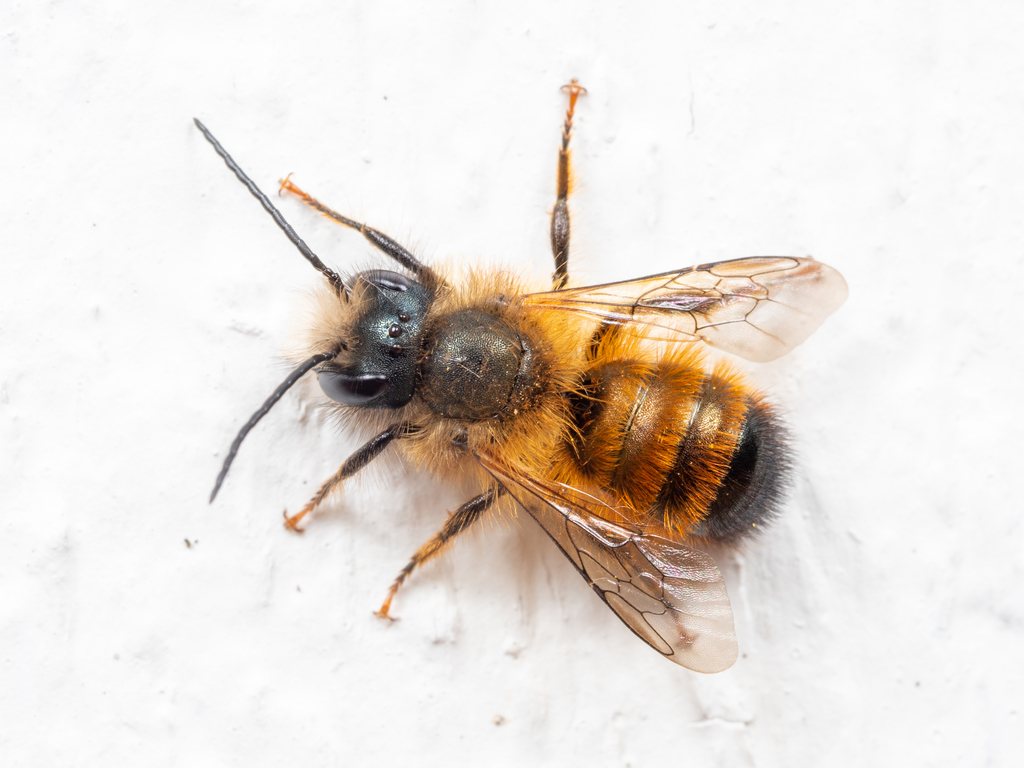
Red Mason Bee
Osmia bicornis
Osmia bicornis (synonym Osmia rufa) is a species of mason bee, and is known as the red mason bee due to its covering of dense gingery hair. It is a solitary bee that nests in holes or stems and is polylectic, meaning it forages pollen from various different flowering plants. These bees can be seen aggregating together and nests in preexisting hollows, choosing not to excavate their own. These bees are not aggressive; they will only sting if handled very roughly and are safe to be closely observed by children. Females only mate once, usually with closely related males. Further, females can determine the sex ratio of their offspring based on their body size, where larger females will invest more in diploid females eggs than small bees. These bees also have trichromatic colour vision and are important pollinators in agriculture.
From the article Osmia bicornis on Wikipedia (CC BY-SA), quoted section by section
Description
O. bicornis is about the same body size as the honeybee. Sexual dimorphism is observed in this species; females are larger than males, because the female larvae are provisioned with (and eat) more pollen. Body size in O. bicornis decreases as temperature in brood cells increases. Beyond 25 °C, body growth can be severely truncated, leading to small adult body size or mortality. The male and females are also distinguishable by antenna length, with males possessing an additional antenna segment, (characteristic of almost all Hymenoptera).
Males. Males are 8–10 mm long. They have a grey-white tuft of hair on their faces, including on the clypeus.
Females. The females have two horns and darker hairs on their heads, and are 10–12 mm long. Clypeal hairs are absent in females.
Wikipedia: “Description and identification”
Range & habitat
O. bicornis is found in England, southern Scotland (possibly northern Scotland, as well), Wales, Ireland, mainland Europe, Sweden, Norway, North Africa, Georgia, Turkey, and Iran. Of the 11 species identified of Osmia in England, O. bicornis is both the largest and most common species present. O. bicornis occupies a variety of nesting sites within nature and in sites of human construction. These bees have been known to nest in key holes, empty snail shells, plant stems, and empty beetle hollows. O. bicornis occupies the old shells of these three species: Helix nemoralis, Helix hortensis, and Helix pomatia and the nests of Anthophora species. Additionally, these bees make their nests in such sites as sandy banks, decaying trees planted in clay soil like the willow tree, old-mortared walls, flint stone holes, garden shed fifes, and window frame holes and cracks. The maximum foraging distance for O. bicornis is about 600 m, though generally high plant density around the nests allows bees to forage closer to the nest and for a shorter duration.
Wikipedia: “Distribution and habitat”
What it does
During mating season, male behaviour with respect to pursuing females is varied, with some males establishing territories close to nesting sites where females emerge and other males observing flowering sites nearby. Males do not normally engage in intrasexual aggression, though they do inspect each other. When a specific mate of interest is present, however, signs of aggression are evident among males. When several males become aware of a receptive female, all males try to mount her; the males do not assault each other directly. In some cases, females may escape and not mate with any of the males. Females are monogamous, mating with one male within a few days after emergence in the spring. However, males encounter difficulties in completing successful copulation with females, including male inability to determine from where and when females will emerge. Nests are dispersed widely, increasing the number of sites from which new females can emerge. Additionally, females fly away from the nests as soon as they emerge, increasing the mating challenge for males. To counteract these difficulties, males can increase their mating chances by positioning themselves close to foraging sites. …
Wikipedia: “Mating behaviour”
How it is grown
Red mason bees are excellent pollinators, particularly of apple trees. For effective use of these bees as pollinators of winter rape plantations in Poland, they should be located at least 300 m from entomophilous plants, which distract the bees from pollinating the plants of interest.
Wikipedia: “Agriculture”
Listen
Looking for field recordings…
Where it lives
Recorded sightings
—
geo-referenced records in GBIF, from museums, herbaria and field observers.
Drag the globe to turn it. Dots are where records exist, not a range map; darker means more records.
In the stacks
Searching the stacks…
Every page naming Osmia bicornis in the Biodiversity Heritage Library →
This page is assembled live from iNaturalist, GBIF, Wikipedia, the Source Library and the Internet Archive. It is not yet part of the hand-edited codex. iNaturalist taxon 876599.