- Plants
- ›Vascular Plants
- ›flowering plants
- ›monocots
- ›grasses, sedges, cattails, and allies
- ›grasses
- ›Pooideae
- ›Wheats, ryes, barleys and relatives
- ›Wheats, goatgrasses, and relatives
- ›Aegilops
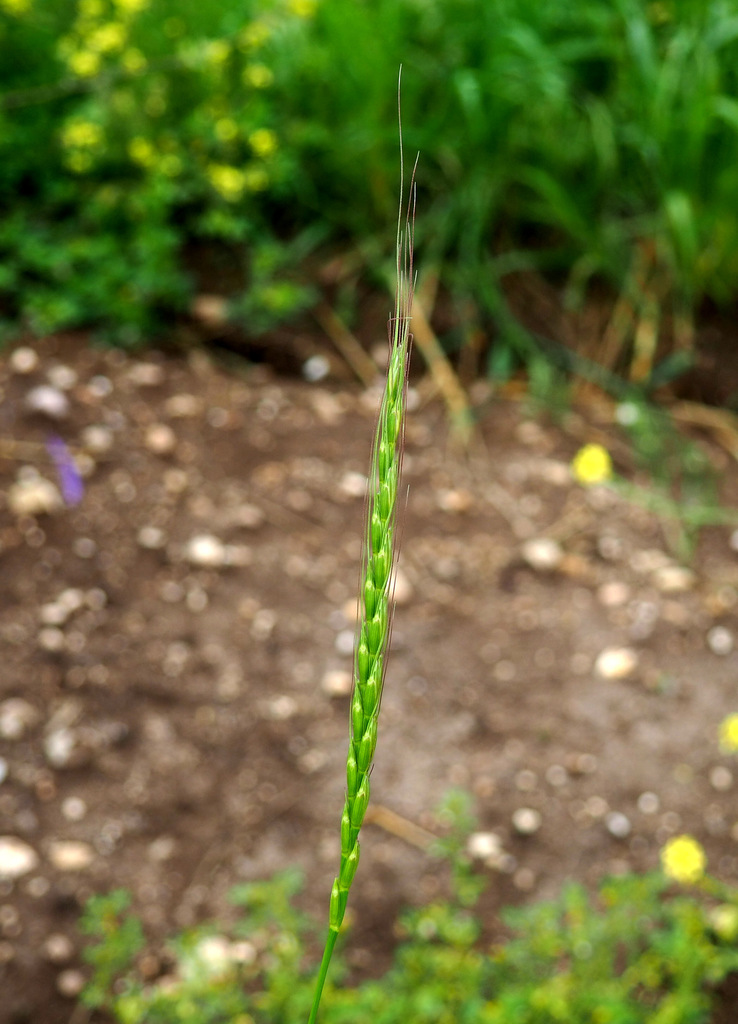
goatgrass
Aegilops bicornis
Aegilops bicornis (syn. Aegilops bicorne (misapplied), Triticum bicorne Forssk.) is a species in the family Poaceae native to the Levant, Western Mesopotamia, Egypt & Libya
Elsewhere this plant is commonly considered a weed.
From the article Aegilops bicornis on Wikipedia (CC BY-SA), quoted section by section
Description
This annual, tufted grass has geniculately ascending culms reaching 15 to 45 cm in length. The leaf sheaths feature ciliate oral hairs and falcate auricles, while the ligule is a membranous structure without cilia. The leaf blades, which are either flat or involute, grow between 5 to 10 cm long and 2 to 2.5 mm wide, with a smooth, hairless surface.
Flowers. The plant produces a single, linear raceme, measuring 5 to 8 cm long, with 12 to 16 fertile spikelets arranged bilaterally along its length. The rachis is fragile at the nodes, with oblong internodes that are about half the length of a fertile spikelet and detach along with the spikelet above
Spikelets. The fertile spikelets are elliptic, laterally compressed, and range from 5.5 to 8.5 mm in length. Each consists of one or two fertile florets, with diminished florets present at the tip. The spikelets detach as a whole, along with accessory branch structures. A rudimentary sterile spikelet is present at the base, numbering one per raceme.
Where it lives
Recorded sightings
—
geo-referenced records in GBIF, from museums, herbaria and field observers.
Drag the globe to turn it. Dots are where records exist, not a range map; darker means more records.
In the old herbals & bestiaries


In the stacks
Searching the stacks…
Every page naming Aegilops bicornis in the Biodiversity Heritage Library →
This page is assembled live from iNaturalist, GBIF, Wikipedia, the Source Library and the Internet Archive. It is not yet part of the hand-edited codex. iNaturalist taxon 878112.