- Plants
- ›Vascular Plants
- ›flowering plants
- ›monocots
- ›Agaves, Orchids, Irises, and Allies
- ›iris family
- ›Iridoideae
- ›Irideae
- ›Iris
- ›Iris
- ›Iris
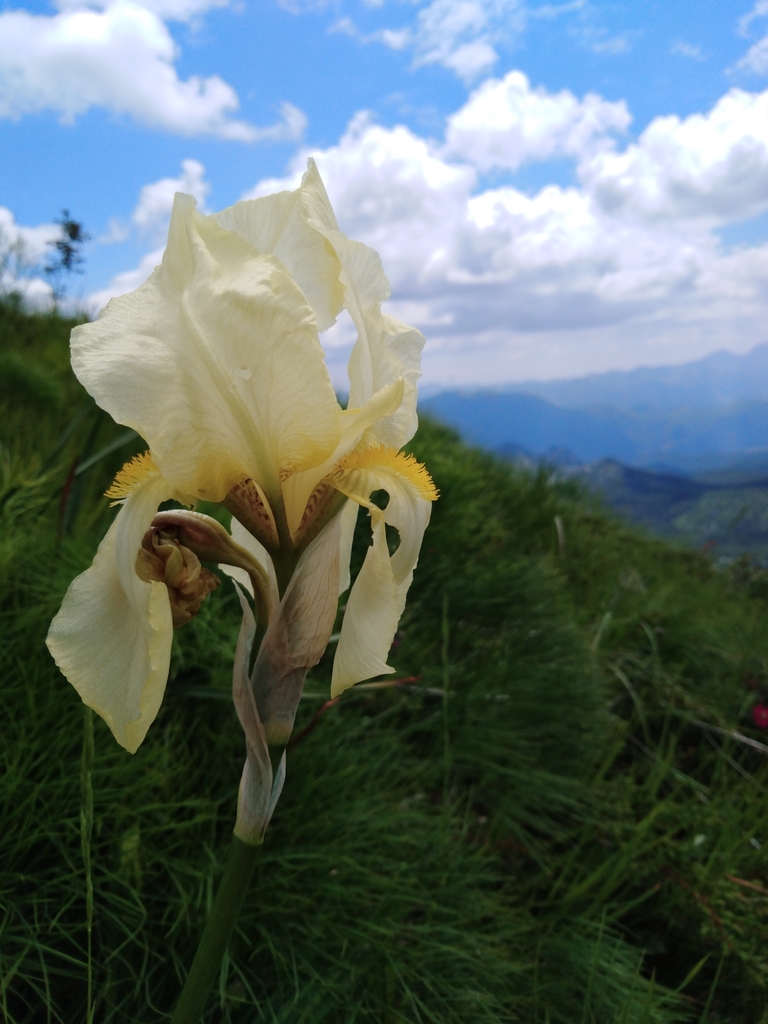
Iris orjenii
Iris orjenii, the Orjen iris, is a rare species of iris found in Montenegro and Bosnia and Herzegovina on the karst landscape of Orjen mountain. It grows in the wild on grassy slopes at 1,500 to 1,700 m (4,900 to 5,600 ft), in sunny or semi-shaded locations within Bosnian Pine communities. It is a member of the subgenus Iris, meaning that it is a bearded iris, and grows from a rhizome.
From the article Iris orjenii on Wikipedia (CC BY-SA), quoted section by section
Description
It has a fibrous and branched rhizome. The herbaceous leaves are bluish-green in color, and sword-shaped, and grow up to between 35–50 cm (14–20 in) long, and 2.5 to 3 cm in width. It has a slender stem or peduncle, that can grow up to between 30–50 cm (12–20 in) tall, and has several branches. The inflorescence (or blooms), are produced in April, or June, they are fan-shaped and contains two or three white flowers, with a purple mark.
Range & habitat
Iris orjenii is exclusively confined to Orjen, the highest mountain of the coastal Dinaric Alps, towering over the Bay of Kotor in southwestern Montenegro. Heavy glaciated during the Pleistocene period, glaciokarstic morphology dominates the higher portions of the mountain. Outstanding for intense precipitation averaging 5000 mm/a (maxima >8000 mm/a), Mount Orjen has by far the highest amount of rainfall in the Mediterranean and also one of the highest in Europe. The taxon shows a significant syntaxonomic affinity to open altimediterranean pastures within the Seslerion robustae alliance and open Mediterranean mountainous coniferous Pine woodland – Pinion heldreichii alliances. The examined partial populations grow under similar conditions on south facing slopes with abundant light. The new species is restricted to humid chromic luvic cambisols and rendzic leptosols at localities above tree line in the oro- to altimediterranean lifezone between 1550 and 1750 m in the eastern Orjen.
Wikipedia: “Habitat”
What it does
The iris appears in following alliances: Seslerion juncifoliae Horvat 30 (with the vicariant Seslerion robustae (Horvat) Lakus. endemic to Orjen) in the association Carici laevi-Helianthemetum balcanici Horvat 30 and Seslerio robustae-Juniperetum hemisphaericae (Hor.) Kus. and the Pinion heldreichii (Horvat) Lakus. alliance in the associations Fritillario-Pinetum heldreichii M. Jank. and Peucedano-Pinetum heldreichii M. Jank. According to preliminary observations two different subunits should be separated and both communities should be regarded as sub-associations within a united community. Apart from the subunit within Peucedano-Pinetum heldreichii M. Jank with notable altimediterranean Dinaric dry mountainous grassland and xerophytic tall herb taxa (Peucedanum longifolium, Senecio thapsoides ssp. visianianus and Juniperus nana (now a synonym of Juniperus communis var. saxatilis Pallas)) on not too shallow rendzic leptosols at the bases of higher cliffs, there is in depressions with deep chromic luvic cambisols a mesophytic tall herb community with numerous humidity indicators within Seslerion robustae where Iris orjenii forms a community of its own with respect to its spectrum of diagnostic species as well as its physiognomic structure. Associated species are Heracleum sphondylium, Lilium martagon var. cattaniae and Asphodelus albus. …
Wikipedia: “Synecology”
Where it lives
Recorded sightings
—
geo-referenced records in GBIF, from museums, herbaria and field observers.
Drag the globe to turn it. Dots are where records exist, not a range map; darker means more records.
In the stacks
Searching the stacks…
Every page naming Iris orjenii in the Biodiversity Heritage Library →
This page is assembled live from iNaturalist, GBIF, Wikipedia, the Source Library and the Internet Archive. It is not yet part of the hand-edited codex. iNaturalist taxon 879045.