- Plants
- ›Vascular Plants
- ›flowering plants
- ›Dicots
- ›Buttercups, Poppies, and Allies
- ›buttercup family
- ›Anemones, buttercups, larkspurs and allies
- ›anemones and allies
- ›Pulsatilla
- ›Pulsatilla
- ›Pulsatilla
- ›Patentes
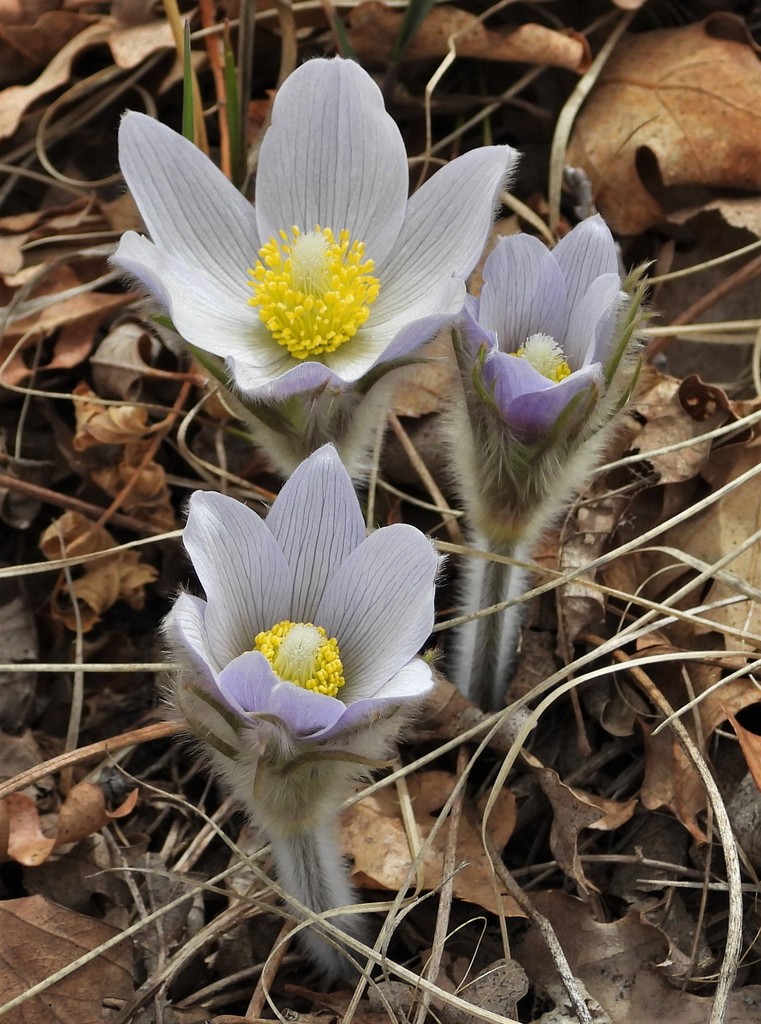
prairie pasqueflower
Pulsatilla nuttalliana
Pulsatilla nuttalliana, known as American pasqueflower, prairie pasqueflower, prairie crocus, or simply pasqueflower, is a flowering plant native to much of North America, from the western side of Lake Michigan, to northern Canada in the Northwest Territories, south to New Mexico in the southwestern United States. Pasqueflower is the provincial flower of Manitoba and the state flower of South Dakota.
From the article Pulsatilla nuttalliana on Wikipedia (CC BY-SA), quoted section by section
Description
The flowers of Pulsatilla nuttalliana develop before their foliage, blooming while the leaves are just beginning to emerge. The stalk supporting the flower can be quite fuzzy or nearly smooth in texture, but never completely hairless. A ring of three very divided bracts, surround the flowering stalk below the flower head. They are very dissimilar to the leaves. Each flower is at the end of a separate stalk, but each plant may have many flowers or a single bloom. The flowers have five to eight sepals of a lavender or blue purple color, and sometimes pale or nearly white in color. Plants that have higher numbers of sepals on flowers will usually revert to having the more common six in future years. The petals are oblong to elliptic in shape. The flowers resemble upward facing bells and are 20–40 mm long. The center of the flower is bright yellow with a mound of 150–200 stamens surrounding the many styles. The blooming period of P. nutalliana is very early, the flowers often emerging as soon as the snow melts and then being snowed upon again. The flowers will close up during colder weather and reopen during warmer periods.
After blooming the fertilized flowers will develop dry fruits called achenes with a feather like "tail" 20–40 mm long formed from the growing styles. Fertilized styles turn from being whitish to pink or pink-brown in color. Each achene contains a single seed. …
Range & habitat
The natural habitats of Pulsatilla nuttalliana include cool northern prairies, open slopes, fescue grasslands, granite outcrops in forests, and woodlands that are dry and open in montane and boreal areas. They will also grow in human created habitats like clearcut areas, roadsides, and the edges of gravel pits. Pulsatilla nuttalliana is widely distributed in North America from Alaska in the United States and Nunavut in Canada to Ontario and all the western provinces. In the United States they grow from Idaho to Wisconsin and south to Utah, Colorado, and parts of New Mexico. This area encompasses all of the upper Midwestern states and the Southern and Northern Rocky Mountains. Its global status is recorded as globally secure by NatureServe, but they also treat it as a subspecies rather than as a full species. It is assessed as critically imperiled in Washington, Illinois, and Ontario.
Wikipedia: “Habitat and distribution”
What it does
Pulsatilla nuttalliana is cross-pollinated by many insects including honeybees, solitary mining bees in andrenidae, bumblebees, and hover flies. Its seeds are distributed by the wind or by the catching in the fur of passing animals. The forage value to herbivores is low as the plant is mildly toxic due to protoanemonin content. When grazed it will produce new leaves from dormant buds. The numbers of Pulsatilla nuttalliana plants increase in heavily grazed meadows. It is adapted to habitat disturbances including wildfires. However, its seeds do not significantly persist in the soil.
Wikipedia: “Ecology”
How it is grown
The prairie pasqueflower is rarely grown in gardens as an ornamental flower and is frequently confused with the commonly-grown European species, Pulsatilla vulgaris. However, it is useful as an ornamental, particularly for those interested in North American native species. They are somewhat more often planted in gardens intended to resemble an Upper Midwest prairie or in rock gardens and for its forage value to bees in the spring. Fresh seed of Pulsatilla species, including of Pulsatilla nuttalliana, germinates readily without stratification or pretreatment in about 3 weeks or slightly more. Seed that has been dry-stored for some months will require a cool moist stratification for 60 days and then sprout at temperatures of 18 to 21°C. The seeds do not keep well and should be immediately planted or stored in cool dry conditions. Pasqueflowers are also propagated vegetatively for gardens or habitat restoration by taking 2–4 cm root cuttings and planting them in well drained potting mediums. Seedlings are difficult to transplant, and the transplantation of all plant sizes is dependent on avoiding root disturbance by digging with a substantial amount of soil. Good drainage is of critical importance for the health of prairie pasqueflower plants grown in gardens. …
Wikipedia: “Cultivation”
Where it lives
Recorded sightings
—
geo-referenced records in GBIF, from museums, herbaria and field observers.
Drag the globe to turn it. Dots are where records exist, not a range map; darker means more records.
In the stacks
Searching the stacks…
Every page naming Pulsatilla nuttalliana in the Biodiversity Heritage Library →
This page is assembled live from iNaturalist, GBIF, Wikipedia, the Source Library and the Internet Archive. It is not yet part of the hand-edited codex. iNaturalist taxon 881504.