- Plants
- ›Vascular Plants
- ›flowering plants
- ›Dicots
- ›Roses, Elms, Figs, and Allies
- ›rose family
- ›brambles, roses, strawberries, and allies
- ›Brambles
- ›Rubus
- ›Idaeobatus
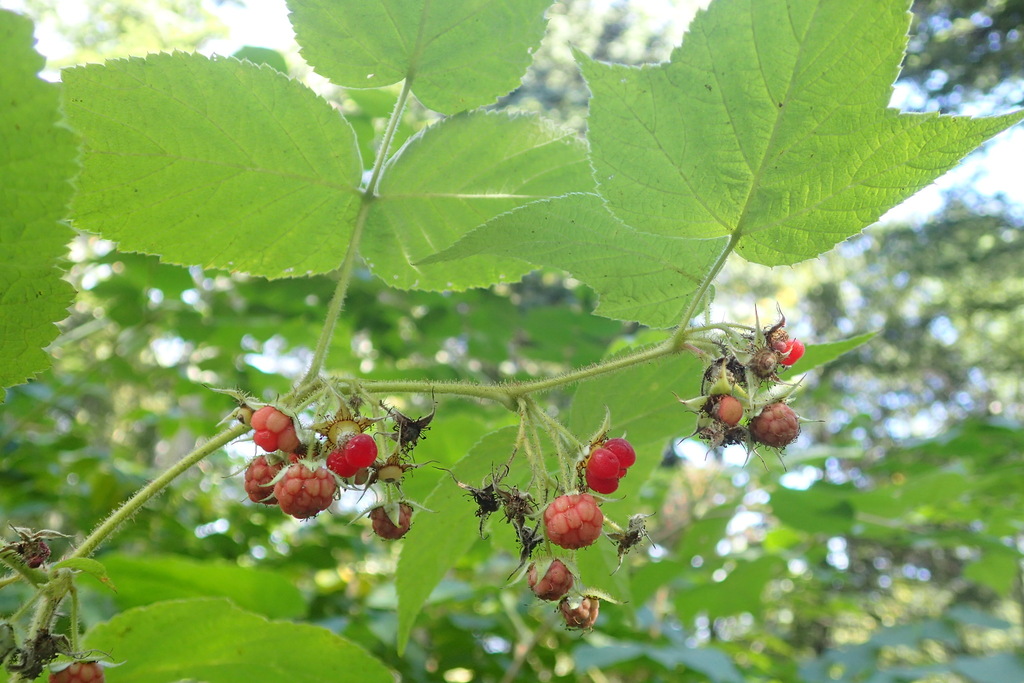
Rubus komarovii
Rubus idaeus (raspberry, also called red raspberry or occasionally European red raspberry to distinguish it from other raspberry species) is a red-fruited species of Rubus native to Europe and northern Asia and commonly cultivated in other temperate regions.
From the article Rubus idaeus on Wikipedia (CC BY-SA), quoted section by section
Description
Plants of Rubus idaeus are generally perennials, which bear biennial stems ("canes") from a perennial root system. In its first year, a new, unbranched stem ("primocane") grows vigorously to its full height of 1.5–2.5 metres (5–8 feet), bearing large pinnately compound leaves with five or seven leaflets, but usually no flowers. In its second year (as a "floricane"), a stem does not grow taller, but produces several side shoots, which bear smaller leaves with three or five leaflets. The flowers are produced in late spring on short racemes on the tips of these side shoots, each flower about 1 centimetre (3⁄8 inch) in diameter with five white petals. The fruit is red, edible, and sweet but tart-flavoured, produced in summer or early autumn; it is technically not a berry, but an aggregate fruit of numerous drupelets around a central core. In raspberries (various species of Rubus subgenus Idaeobatus), the drupelets separate from the core when picked, leaving a hollow fruit, whereas in blackberries and most other species of Rubus, the drupelets stay attached to the core. Its fruit persists for an average of 12 days, and bears an average of 35.2 seeds per fruit. Wild fruits average 76.3% water, and their dry weight includes 39.6% carbohydrates and 2.2% lipids.
Chemistry. Vitamin C and phenolics are present in red raspberries. …
Range & habitat
The species is native to Europe and northern Asia and commonly cultivated in other temperate regions. As a wild plant, R. idaeus typically grows in forests, forming open stands under a tree canopy, and denser stands in clearings. In the south of its range (southern Europe and central Asia), it occurs only at high altitudes in mountains.
Wikipedia: “Distribution and habitat”
At the table
R. idaeus is grown primarily for its fruits, but occasionally for its leaves, roots, or other parts.
Fruits. The fruit of R. idaeus is an important food crop, though most modern commercial raspberry cultivars derive from hybrids between R. idaeus and R. strigosus. The fruits of wild plants have a sweet taste and are very aromatic.
Leaves and other parts. Young roots of R. idaeus prevented kidney stone formation in a mouse model of hyperoxaluria. Tiliroside from raspberry is a potent tyrosinase inhibitor and might be used as a skin-whitening agent and pigmentation medicine.
Wikipedia: “Uses”
In human culture
The species name, idaeus, refers to its occurrence on Mount Ida near Troy in what is now northwest Turkey, where the ancient Greeks were most familiar with it.
Wikipedia: “Etymology”
Where it lives
Recorded sightings
—
geo-referenced records in GBIF, from museums, herbaria and field observers.
Drag the globe to turn it. Dots are where records exist, not a range map; darker means more records.
In the stacks
Searching the stacks…
Every page naming Rubus komarovii in the Biodiversity Heritage Library →
This page is assembled live from iNaturalist, GBIF, Wikipedia, the Source Library and the Internet Archive. It is not yet part of the hand-edited codex. iNaturalist taxon 882192.