- Animals
- ›Cnidarians
- ›True Jellies
- ›Discomedusans
- ›Root-mouth Jellies
- ›Dactyliophoran Jellies
- ›Fat-armed Jellies
- ›Catostylus
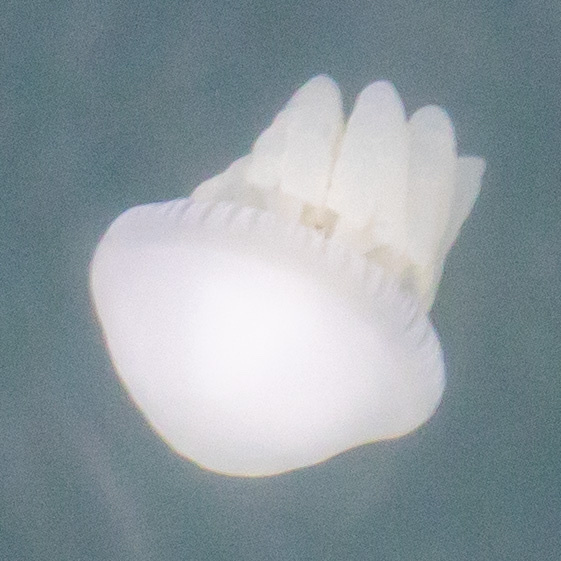
Catostylus perezi
Catostylus perezi, commonly known as the banana jellyfish, is a jellyfish in the family Catostylidae.
From the article Catostylus perezi on Wikipedia (CC BY-SA), quoted section by section
Description
Catostylus perezi has a smooth domed bell that is 147 mm in diameter and around eight sensory structures called rhopalia. The jellyfish also presents eight oral arms that can grow up to 85 mm long. When alive, the color of the jellyfish ranges from blue to transparent, but when preserved, it turns a creamy white color. This jellyfish is distinguished from other groups because it lacks appendages around its bell-shaped area. Catostylus perezi has been observed in the coastal waters of the Southern Arabian Peninsula and Persian Gulf region.
Range & habitat
Catostylus perezi can be found in the Persian Gulf and the Arabian Sea just off the coast of Pakistan. They are particularly found at Keti Bunder, Bhanbore, and Mirpur Sakro for about 6–8 months. They prefer warmer waters and shallow areas close to nutrient runoff. Catostylus perezi has also been spotted at the Main Outfall Drain Channel in Iraq.
Wikipedia: “Distribution and habitat”
What it does
Catostylus perezi move by thrusting their bell, which creates propulsion to help them get through the water. Due to having no control over which direction they go, they are passive feeders, feeding primarily on zooplankton and fish larvae using their oral arms. Though the jellyfish's sting is not harmful to humans, it does have nematocysts used to help aid in capturing prey and defending itself from predators. This species has shown to be very hardy with studies showing them being able to adapt to different environment changes. A 2022 study found that a mass jellyfish bloom would occur near power plants and ports that emit increased temperature waters, nutrient availability, and low predation. This suggests that the Catostylus perezi can easily adapt to different environments, which leads to their high abundance and popularity in fisheries.
Wikipedia: “Behavior and ecology”
Where it lives
Recorded sightings
—
geo-referenced records in GBIF, from museums, herbaria and field observers.
Drag the globe to turn it. Dots are where records exist, not a range map; darker means more records.
In the stacks
Searching the stacks…
Every page naming Catostylus perezi in the Biodiversity Heritage Library →
This page is assembled live from iNaturalist, GBIF, Wikipedia, the Source Library and the Internet Archive. It is not yet part of the hand-edited codex. iNaturalist taxon 885586.