- Animals
- ›Cnidarians
- ›True Jellies
- ›Discomedusans
- ›Root-mouth Jellies
- ›Dactyliophoran Jellies
- ›Lobonematid Jellies
- ›Lobonema
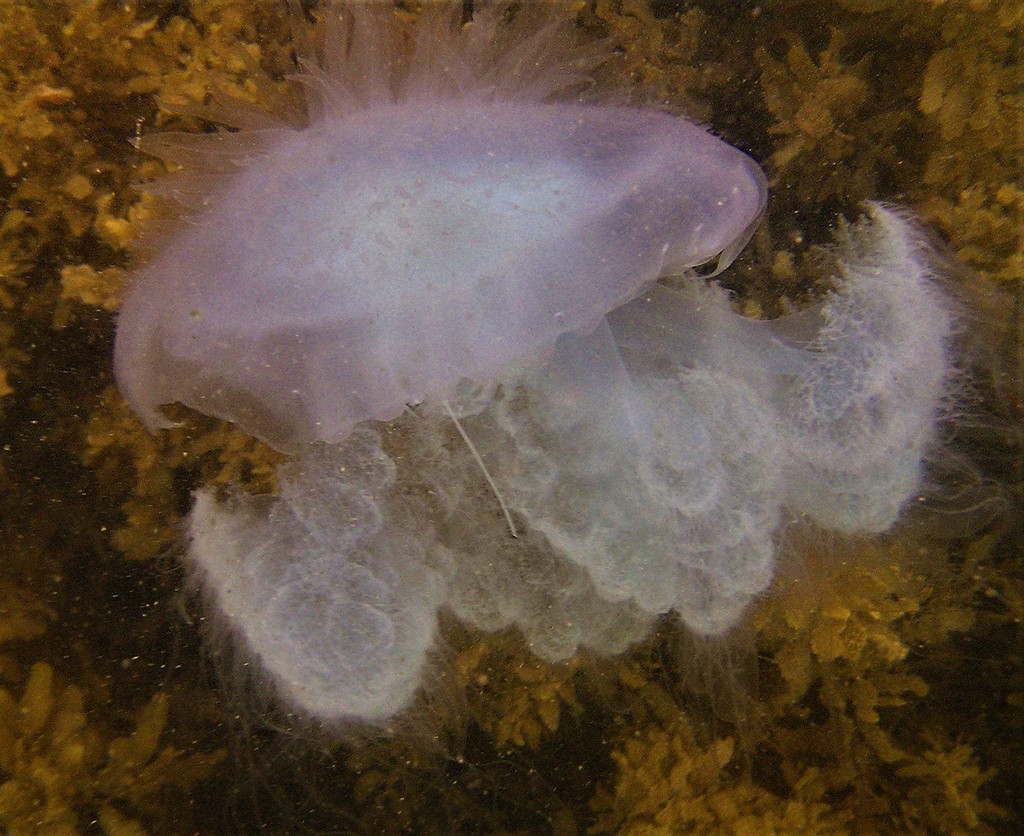
Lobonema smithii
Lobonema is a monotypic genus of cnidarians belonging to the family Lobonematidae. The only species is Lobonema smithii.
From the article Lobonema on Wikipedia (CC BY-SA), quoted section by section
Description
Lobonema smithii, commonly known as white jellyfish, is a species of jellyfish that often appears with a white or translucent color that spans across its whole body. It has a wide body, with its exumbrella being rough and rigid, which gives it a prominent umbrella shape. Additionally, the exumbrella is large, and notably gelatinous, which is one of this species most distinct characteristics. The order which Lobonema smithii is categorized under, Rhizostomeae, has many defining features that Lobonema smithii carries. Some of these are thin, oral arms that become infused the closer they are to the centerpiece of the jellyfish. With Lobonema smithii, these arms are very thin and abundant, almost resembling hair-like properties.
Morphology and anatomy. 23.6 cm wide, thick, tough, and rigid, and an erect exumbrella. This species has a notable gelatinous papillae, which is 3.5 to 4 cm long, pointed, nematocyst. This species has four velar lappets in each of its octants that are 9 to 10 cm long tapering, pointy and mouth arms which are 15 cm long. There are also distal three-winged portions that are one to one and a half as long as the proximal portion of the organism. Additionally, this species has long spindle appendages, with 16 radial canals attached to it.
Range & habitat
The species is found in Malesia. Lobonema smithi is mostly contained in the Manila Bay region. This organism has mainly only been spotted in the Indo-Pacific west. The depth this organism tends to be found in is the Pelagic zone, and does not seem to venture far out of that region. Additionally, this species mainly stays in tropical waters.
Wikipedia: “Distribution”
What it does
Reproduction for this species has not been thoroughly studied or documented with how rarely spotted this species has become. It is possible that based on this species life cycle that the reproductive process is very similar to other jellyfish. With this, the first step to jellyfish reproduction is the male releasing sperm from its mouth into the water it occupies. The females swim through this water and the sperm enters her oral cavity to reach unprotected eggs. This leads to these eggs become fertilized and develop into larvae, which begins the life cycle of this species.
Wikipedia: “Reproduction”
Where it lives
Recorded sightings
—
geo-referenced records in GBIF, from museums, herbaria and field observers.
Drag the globe to turn it. Dots are where records exist, not a range map; darker means more records.
In the stacks
Searching the stacks…
Every page naming Lobonema smithii in the Biodiversity Heritage Library →
This page is assembled live from iNaturalist, GBIF, Wikipedia, the Source Library and the Internet Archive. It is not yet part of the hand-edited codex. iNaturalist taxon 885591.