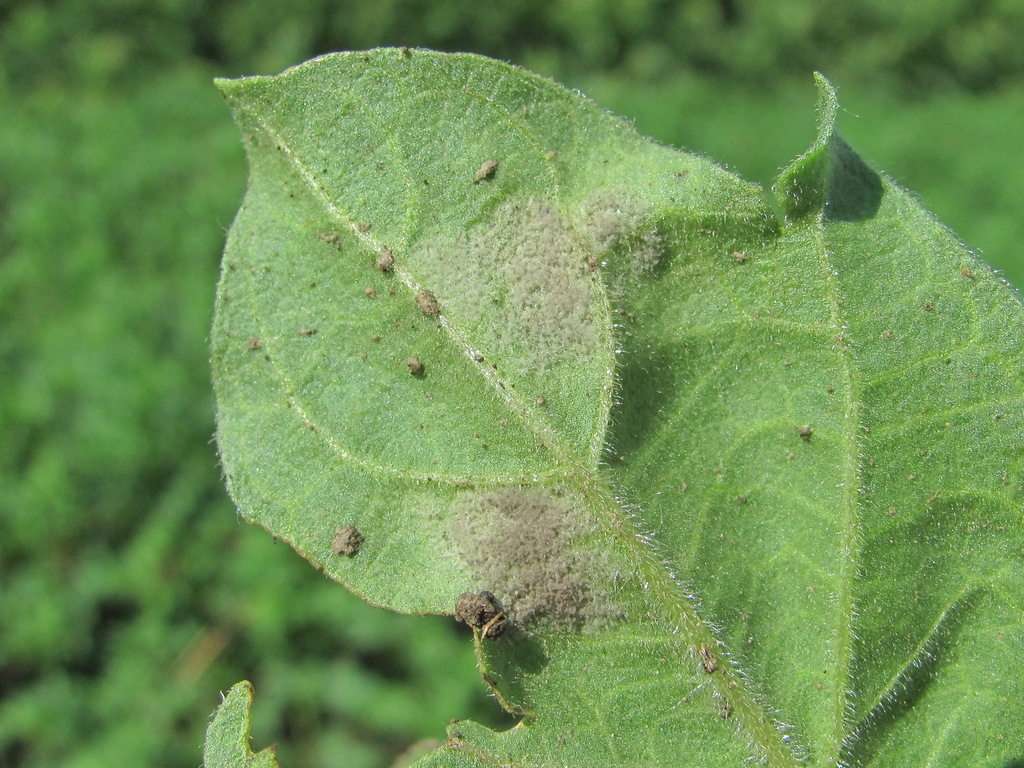
Peronospora hyoscyami
Peronospora is a genus of downy mildews that are obligate plant pathogens. They can cause severe damage to many different cultivated crops, as well as wild and ornamental plants. Peronospora is most closely related to Pseudoperonospora, and together they form the clade of downy mildews with coloured conidia. Peronospora has far more species than any other genus of the downy mildews. However, many species have been moved from this genus to other genera based on phylogenetic evidence. Among these are the species now in Hyaloperonospora, important pathogens of the Brassicaceae. Now, the Peronospora species of most importance is likely Peronospora tabacina. Peronospora tabacina causes blue mold on tobacco plants and can severely reduce yields of this economically important crop to the point where it has been classified as a bioweapon.
From the article Peronospora on Wikipedia (CC BY-SA), quoted section by section
Range & habitat
Most of the Peronospora species are highly specific to their hosts and can generally be found anywhere the host plant grows, or is being cultivated. A large portion of their life cycle is spent inside their host plant. Many species of Peronospora are seedborne pathogens, so the worldwide spread of Peronospora crop-plant pathogens is likely to be a result of unknowingly trading infected seeds to new areas. There are also many Peronospora species that are spread by wind currents, which allows them to disperse over large distances. Peronospora species prefer humid air and cool temperatures. One clade in the genus is known as the floricolous downy mildews. These species produce conidiophores exclusively on the flowers of their hosts.
Wikipedia: “Habitat and ecology”
In human culture
Peronospora was first described in 1837 by August Carl Joseph Corda, a Czech mycologist and physician, in his first of six volumes of his Icones fungorum hucusque cognitorum. Since then, many of the species originally placed in Peronospora have been allocated to other genera or given rise to new genera based on new techniques such as molecular genetics. There was an epidemic in 1960 of Peronospora tabacina affecting tobacco plants leading to $25 million in losses across eleven countries, which was about 30 percent of the tobacco plants. Another epidemic that was caused by Peronospora destructor reduced the yield of sweet onions by 25 percent in Georgia, USA in 2012, and led to an estimated $18.2 million in losses.
Wikipedia: “History”
Where it lives
Recorded sightings
—
geo-referenced records in GBIF, from museums, herbaria and field observers.
Drag the globe to turn it. Dots are where records exist, not a range map; darker means more records.
In the stacks
Searching the stacks…
Every page naming Peronospora hyoscyami in the Biodiversity Heritage Library →
This page is assembled live from iNaturalist, GBIF, Wikipedia, the Source Library and the Internet Archive. It is not yet part of the hand-edited codex. iNaturalist taxon 886690.