On eBird ↗
Guianan Cock-of-the-rock
Live sightings near you, the range map, bar charts of when it is seen, and Macaulay Library photos and recordings.
Guianan Cock-of-the-rock
Rupicola rupicola
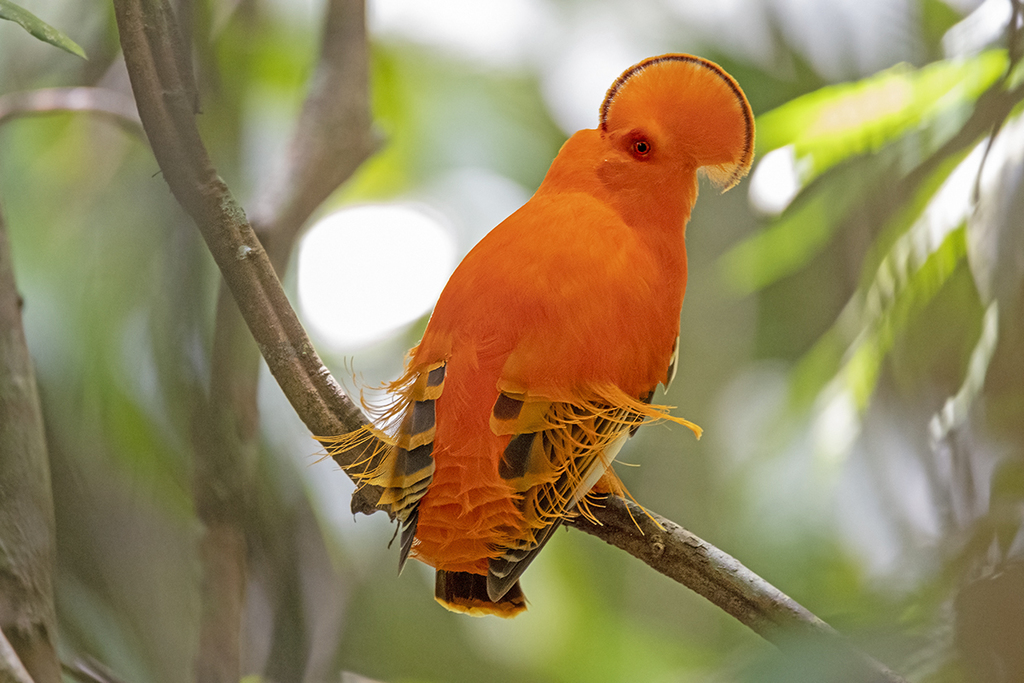
The Guianan cock-of-the-rock (Rupicola rupicola) is a species of cotinga, a passerine bird from South America. It is about 30 cm (12 in) in length and weighs about 200 to 220 g (7.1 to 7.8 oz). It is found in tropical rainforests, near its preferred habitat of rocky outcrops. The female's plumage is brownish/dark smokey grey in colour, and generally less noticeable than the males because of their nesting work in rocky areas. The male's feathers are a bright orange. Both have a heavy body, broad-based bill and wear a remarkable half-moon crest on the head. It is one of two species of the genus Rupicola, the other being the Andean cock-of-the-rock. The Guianan cock-of-the-rock lives across the forested region of northeastern South America. Its diet consists mostly of fruit, but they sometimes feast on small snakes and lizards.
The Guianan cock-of-the-rock breeds in the early months of the year and, on average, the female lays her eggs around March. The females choose a mate by flying down to the ground and pecking the male on his rump. The male then turns around and the mating takes place almost immediately. During the height of the mating season, males engage in competitive displays in the lek, which is a complex courting behaviour that is done to attract females. Males and females live separately except when the females choose a mate. The mating success varies based on multiple factors, ranging from the plumage exhibited by a male to the composition of the lek itself. There is speculation that the male–male competition is an important factor in lek formation and breeding.
From the article Guianan cock-of-the-rock on Wikipedia (CC BY-SA), quoted section by section
Description
The Guianan cock-of-the-rock is a stout-bodied bird with a prominent half-moon crest. It is a sexually dimorphic bird. The male's crest is more pronounced than the female's and is bright orange. The males also have an orange-tipped black tail, black, orange, and white wings, a bright orange bill, an orange iris yellowing as it nears the outer edge, and silky-orange filamentous feathers of the inner remiges. Both sexes also have orange legs and skin. The less conspicuous female is dark brownish-grey overall and has a yellow-tipped black bill, a duller orange iris, and a smaller crest. One-year-old juvenile male looks similar to an adult female but has orange speckles over its body. After two years, the juvenile males become mostly orange with brown and grey spots. Males attain their definitive plumage at around three years. Juvenile females look almost identical to their adult counterparts. Guianan cocks-of-the-rock have a total length of approximately 30 cm (12 in) and a total weight of around 200 to 220 g (7.1 to 7.8 oz). The two species of cock-of-the-rock are allopatric, and therefore do not meet with one another. The plumage of the male Andean cock-of-the-rock is redder and its wings are mostly black, lacking the orange colouration seen on the male Guianan. The female Andean cock-of-the-rock is reddish brown rather than the brownish-gray of the Guianan.
Range & habitat
As suggested by its name, the Guianan cock-of-the-rock is found in the Guianan Shield, occurring in French Guiana, Suriname, Guyana, southern Venezuela, eastern Colombia, and northern Amazonian Brazil. Its preferred habitats are humid forests near rocky outcrops. They are normally found at an altitude of 300 to 2,000 m (980 to 6,560 ft). The Guianan cock-of-the-rock has distinctive territorial markings. Males usually take dominance of an area on the ground, although sometimes they occupy middle strata in forests. They make their characteristic marking by clearing out debris from the ground, including twigs, leaves, and pellets. This area is called a "court". Quality of courts is known to have some influence on mate choice. The court quality is determined by the territory density and location to the center of activity in the lek. The reason for the focus on the center of activity in the lek is that successful males tended to own courts in the most densely clustered lek areas. Guianan courts are commonly found in the Guianan Shield, a forested region in northeastern South America.
Wikipedia: “Range and habitat”
What it does
The diet of the adult Guianan cock-of-the-rock consists mainly of fruits meaning they are frugivorous. Up to 65 species of fruit have been reported in their diet, primarily from canopy trees or lianas. Three-quarters (75%) of the fruit eaten by the Guianan cock-of-the-rock at one study site were either black- or red-coloured fruit. In British Guiana, E. Thomas Gilliard found papayas growing at the base of a huge rock. On top of the rock were perched females that were nesting. He found that no other papayas were growing in that part of the forest and speculated that the perched females ate papayas in the forest where they are native and dropped the seeds below where they were nesting. Small snakes, lizards, insects and frogs are occasionally found in its diet. By selectively feeding on nearby fruit trees and then defecating or regurgitating the seeds within the leks, these birds can actively influence the regeneration and succession of the forest habitat where they breed.
Wikipedia: “Diet”
In human culture
The generic and specific names are derived from the Latin words rupes "rock" or "cliff", and cola "inhabiting", which express its habit of nesting on rock walls.
Wikipedia: “Etymology”
Listen
Looking for field recordings…
Where it lives
Recorded sightings
—
geo-referenced records in GBIF, from museums, herbaria and field observers.
Drag the globe to turn it. Dots are where records exist, not a range map; darker means more records.
In the stacks
Searching the stacks…
Every page naming Rupicola rupicola in the Biodiversity Heritage Library →
This page is assembled live from iNaturalist, GBIF, Wikipedia, the Source Library and the Internet Archive. It is not yet part of the hand-edited codex. iNaturalist taxon 8882.