- Plants
- ›Vascular Plants
- ›flowering plants
- ›Dicots
- ›Legumes, Milkworts, and Allies
- ›Legumes
- ›Acacias, Mimosas, Mesquites, and Allies
- ›Acacia
- ›Plurinerves
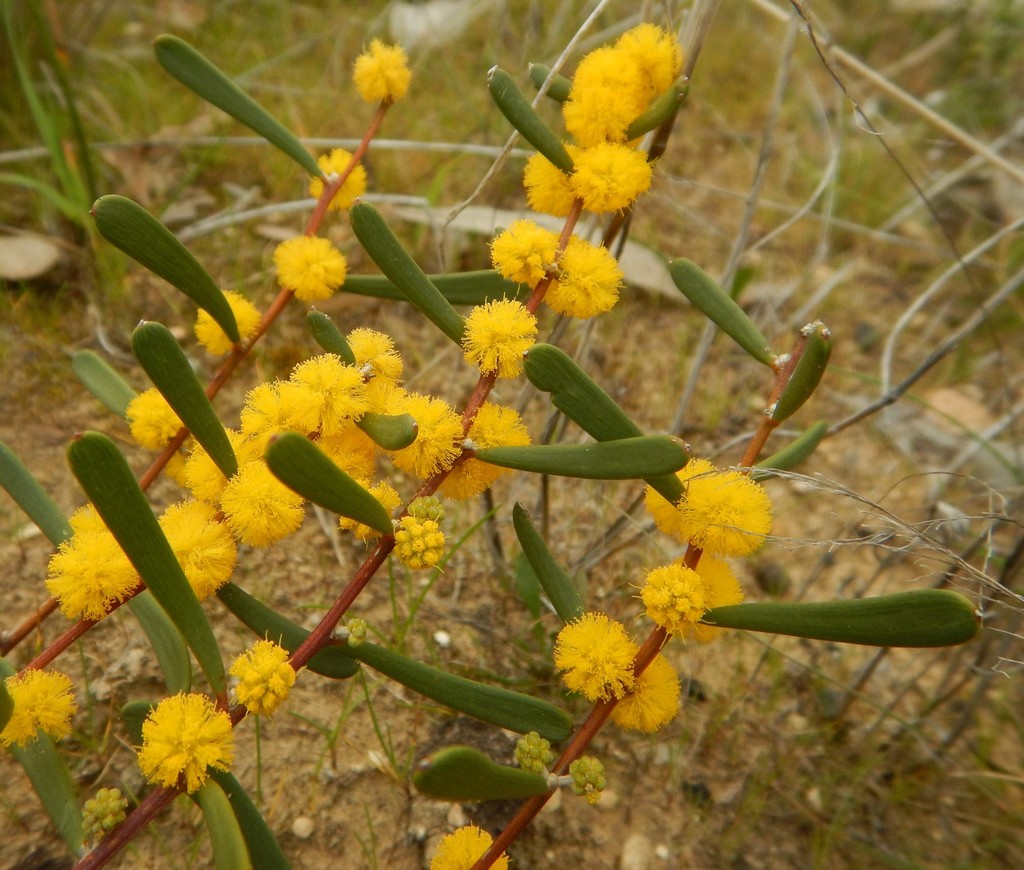
mealy wattle
Acacia farinosa
Acacia farinosa, commonly known as mealy wattle, is a shrub that is endemic to Australia. It grows to between 1 and 2 metres high and has ascending phyllodes. The yellow globular flower heads generally appear between August and October in its native range. These are followed by curled and twisted pods which are up to 6 cm long and 2–3 mm wide.
From the article Acacia farinosa on Wikipedia (CC BY-SA), quoted section by section
Description
Acacia farinosa is a rounded shrub that typically grows to a height of 1–2 m (3 ft 3 in – 6 ft 7 in) and has glabrous, terete branchlets that have soft hairs pressed against the surface. Its phyllodes are ascending, oblanceolate to linear, mostly 20–70 mm (0.79–2.76 in) long, 2–6 mm (0.079–0.236 in) wide, rigid, thick and more or less fleshy. There is a gland 2–9 mm (0.079–0.354 in) above the base of the phyllode. The flowers are borne in spherical heads on a peduncle 2–4 mm (0.079–0.157 in) long, each head 3.5–4 mm (0.14–0.16 in) in diameter with seven to seventeen golden yellow flowers. Flowering occurs from July to November, and the pods are linear, crusty, rigid, curved and twisted, up to 60 mm (2.4 in) long, 2–3 mm (0.079–0.118 in) wide and glabrous. The seeds are elliptic, 3.5–4.0 mm (0.14–0.16 in) long and black with a small aril on the end.
Range & habitat
Mealy wattle mostly grows in sand or loam in shrubland and woodland, often with lerp mallee (Eucalyptus incrassata), in the Eyre and Yorke Peninsulas, on Kangaroo Island and south-eastern South Australia, and extending to western Victoria between Edenhope and Swan Hill.
Wikipedia: “Distribution and habitat”
Where it lives
Recorded sightings
—
geo-referenced records in GBIF, from museums, herbaria and field observers.
Drag the globe to turn it. Dots are where records exist, not a range map; darker means more records.
In the stacks
Searching the stacks…
Every page naming Acacia farinosa in the Biodiversity Heritage Library →
This page is assembled live from iNaturalist, GBIF, Wikipedia, the Source Library and the Internet Archive. It is not yet part of the hand-edited codex. iNaturalist taxon 888318.