- Fungi Including Lichens
- ›Ascomycete Fungi
- ›Sac Fungi and Lichens
- ›Operculate Ascomycetes
- ›Pezizales
- ›morels and allies
- ›Kalapuya
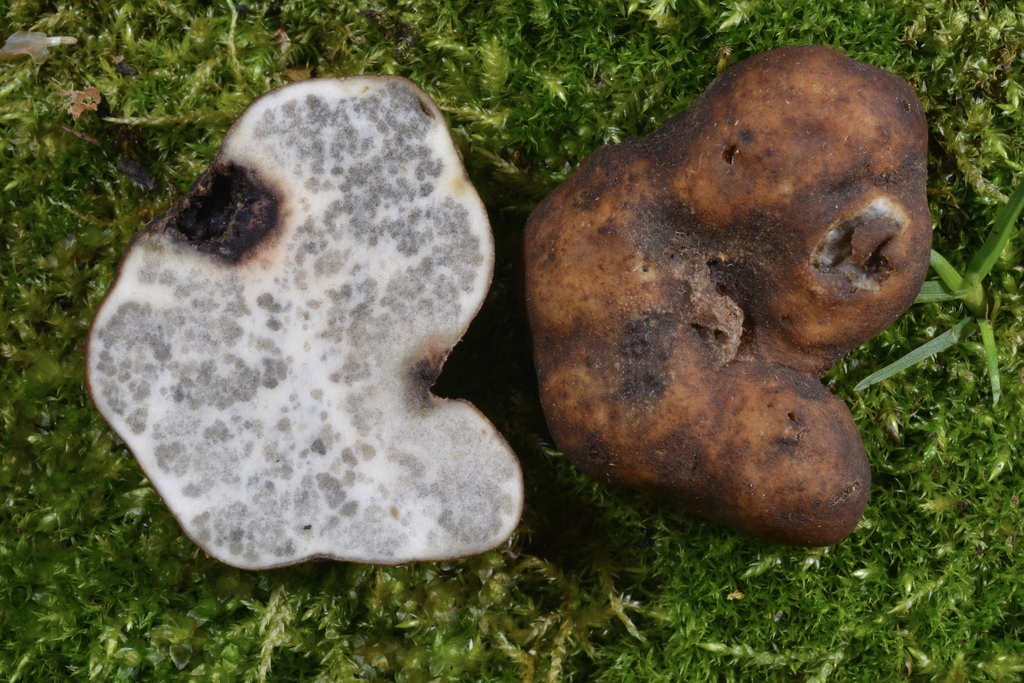
Oregon brown truffle
Kalapuya brunnea
Kalapuya brunnea is a species of truffle in the monotypic fungal genus Kalapuya. The truffle occurs only in the Pacific Northwest region of the United States, in western Oregon and northern California. Known locally as the Oregon brown truffle, it was formerly thought to be an undescribed species of Leucangium until molecular analysis demonstrated that it was distinct from that genus. The truffle is reddish brown with a rough and warty outer skin, while the interior spore-producing gleba is initially whitish before developing greyish-brown mottling as it matures. Mature truffles have an odor resembling garlicky cheese, similar to mature Camembert. The species has been harvested for culinary purposes in Oregon.
From the article Kalapuya brunnea on Wikipedia (CC BY-SA), quoted section by section
Description
The truffle-like fruit bodies of Kalapuya are roughly spherical, with lobes and furrows, and dimensions of typically 12–60 millimetres (1⁄2–2+3⁄8 inches) by 10–45 mm (3⁄8–1+3⁄4 in). The peridium (outer "skin") is up to 2 mm thick, and ranges in color from light yellowish-brown to orange-brown to reddish-brown, usually with darker patches in maturity. The surface texture is rough, as the truffle is covered with flat to rounded warts that are 0.5–3 mm wide; larger warts often have smaller warts on them. Older specimens develop narrow cracks over the surface such that it becomes areolate or rimose. The undersurface of the peridium has an branching basal attachment that is roughly similar in texture to cartilage, and which breaks off readily when the truffle is extracted from the soil. The internal spore-bearing tissue, the gleba, is initially whitish and firm, but develops grayish-brown mottling as it matures. The spores are ellipsoid in shape, with a smooth surface, and contain a large central oil drop surrounded by smaller droplets. The spore dimensions are 32–43 by 25–38 μm, the walls measuring 1–3 μm thick. Although not reactive with Melzer's reagent, spores stain readily with Methyl blue. The asci contain 6 to 8 spores per ascus. They are variably shaped, with dimensions of 70–110 by 60–100 μm, with a stem 10–40 by 6–10 μm, and a forked base. …
Range & habitat
The species is known only from the Pacific Northwest region of the United States, where it grows in Douglas fir forests that are up to about 50 years old; the authors suggest that it is obligately symbiotic with this tree. Usually appearing from October through March, fruit bodies grow in the top 2–10 cm (3⁄4–4 in) of soil, beneath soil litter, at elevations ranging from roughly sea level to about 500 m (1,600 ft). It occurs on the west side of Oregon's Cascade Range, as well as in the Coastal Ranges of Oregon and northern California.
Wikipedia: “Distribution and habitat”
At the table
The truffle is edible, and has been harvested for culinary purposes, although with less frequency than other Pacific Northwest truffles. Both the flavor and odor of the edible fruit body resemble mature Camembert cheese. One source described the taste as follows: "Served in melted butter on sliced baguette, they reminded of buttered lobster."
Wikipedia: “Uses”
Where it lives
Recorded sightings
—
geo-referenced records in GBIF, from museums, herbaria and field observers.
Drag the globe to turn it. Dots are where records exist, not a range map; darker means more records.
In the stacks
Searching the stacks…
Every page naming Kalapuya brunnea in the Biodiversity Heritage Library →
This page is assembled live from iNaturalist, GBIF, Wikipedia, the Source Library and the Internet Archive. It is not yet part of the hand-edited codex. iNaturalist taxon 890164.