- Animals
- ›Molluscs
- ›Gastropods
- ›Heterobranchs
- ›Euthyneura
- ›Ringipleura
- ›Nudipleura
- ›Nudibranchs
- ›Doridina
- ›Doridoidei
- ›Chromodoridoidea
- ›Chromodorids
- ›Miamirinae
- ›Hypselodoris
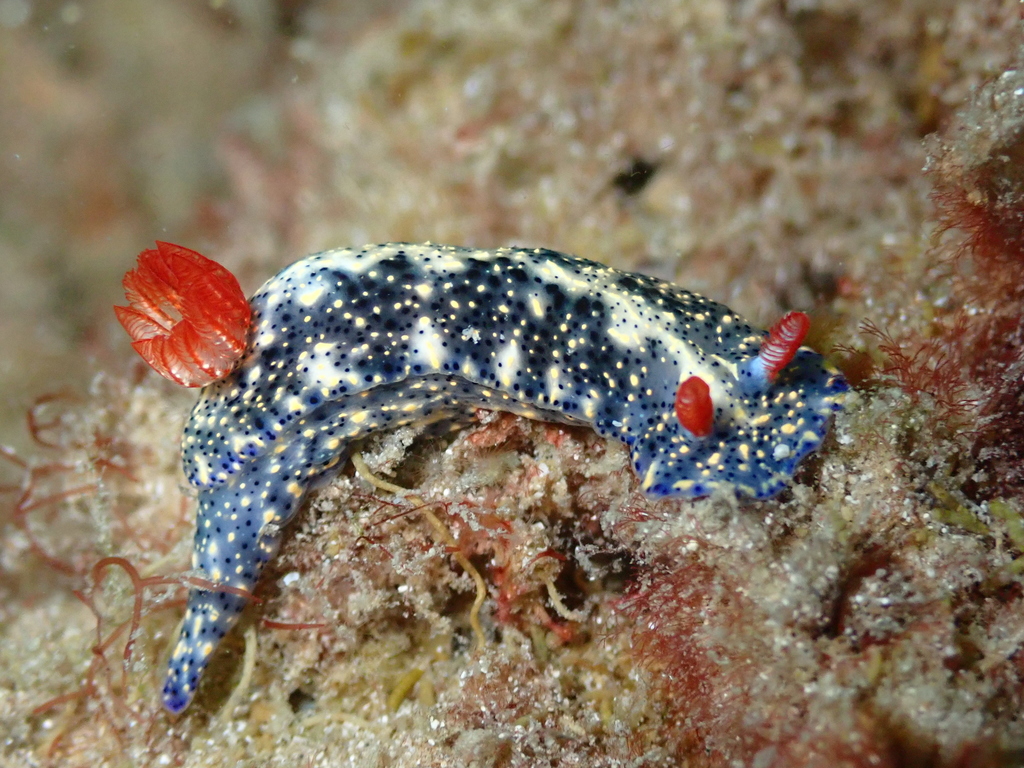
Saint Vincent's Nudibranch
Hypselodoris saintvincentius
Hypselodoris saintvincentius is a species of sea slug or dorid nudibranch, a marine gastropod mollusk in the family Chromodorididae.
From the article Hypselodoris saintvincentius on Wikipedia (CC BY-SA), quoted section by section
Description
Hypselodoris saintvincentius has a dark blue-black body which is covered in hundreds of small black and white spots. There is typically a creamy-white irregular, lined pattern present on its dorsum. The gills and rhinophores are orange, sometimes outlined in white. This species can reach a total length of at least 40 mm and has been observed feeding on sponges from the genus Dysidea.
Range & habitat
This nudibranch is known only from Southern and Southwestern Australia. This species was described from the intertidal zone at Coobowie, west coast of St Vincent Gulf, South Australia 35.044260°S 137.739888°E / -35.044260; 137.739888. It is related to the widespread tropical species Hypselodoris infucata and the similar Australian species Hypselodoris obscura. It has been reported from depths to 12 m and from Western Australia.
Wikipedia: “Distribution”
Where it lives
Recorded sightings
—
geo-referenced records in GBIF, from museums, herbaria and field observers.
Drag the globe to turn it. Dots are where records exist, not a range map; darker means more records.
In the stacks
This page is assembled live from iNaturalist, GBIF, Wikipedia, the Source Library and the Internet Archive. It is not yet part of the hand-edited codex. iNaturalist taxon 891258.