- Animals
- ›Arthropods
- ›Hexapods
- ›Insects
- ›Winged and Once-winged Insects
- ›Ants, Bees, Wasps, and Sawflies
- ›Narrow-waisted Wasps, Ants, and Bees
- ›Ants, Bees, and Stinging Wasps
- ›Bees and Apoid Wasps
- ›Bees
- ›Honey Bees, Bumble Bees, and Allies
- ›Apine Bees
- ›Digger Bees
- ›Amegilla
- ›Asaropoda
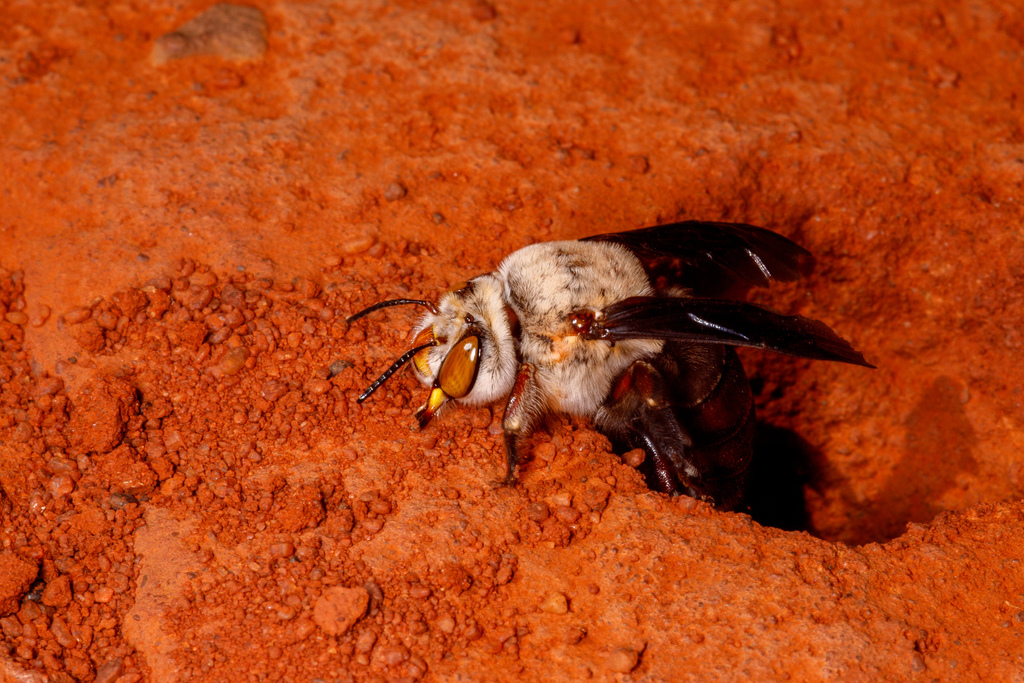
Dawson's Burrowing Bee
Amegilla dawsoni
Amegilla dawsoni, sometimes called the Dawson's burrowing bee, is a species of bee that nests by the thousands in arid claypans in Western Australia. It is a long tongued bee, of the tribe Anthophorini and genus Amegilla, the second largest genus in Anthophorini.
The Dawson's burrowing bee is one of the largest Australian bee species, growing to be 23 millimetres (0.91 in) in length and 45 millimetres (1.8 in) in wingspan. With the exception of their faces, the bees are covered in brown fur, if male, or brown and white fur if female. They are similar in size and coloring to Australian carpenter bees.
From the article Amegilla dawsoni on Wikipedia (CC BY-SA), quoted section by section
Description
This dark-winged bee species is among Australia's largest bees, similar in size and coloring to Xylocopa, or carpenter bee, species. The bee can get up to 23 mm in body length and 45 mm in wing span. Both sexes are densely furry, with the exception of their lower facial regions, which jut outwards and tend to be bare, and colored anywhere from light yellow to dark brown.
Wikipedia: “Appearance”
Range & habitat
The Amegilla dawsoni is located only in Australia. The bees can be found in the arid regions on the Western half of the continent. They are widespread across this region, with the northern and southernmost extremes of their mating and nesting distributions being approximately 700 kilometers apart. This region is known for its limited and randomly distributed rainfall, which can result in a resource deficit of flowering plants. In this case, the bee has been known to migrate north and south along its distribution to nest in better-suited environments.
Wikipedia: “Distribution and habitat”
What it does
The female bees do not need to enter the flower corollas to collect nectar. They collect nectar by inserting their long proboscis into the flower. These bees collect nectar from four main genera of plant. They will forage at these plants even if there are more readily available sources of nectar and pollen. These include:
Cassia Eremophila Solanum Trichodesma
Wikipedia: “Diet and feeding”
In human culture
Australian wild bee ecologist Kit Prendergast has a large tattoo of two Amegilla dawsoni mating on her right shoulder.
Wikipedia: “Popular culture”
Listen
Looking for field recordings…
Where it lives
Recorded sightings
—
geo-referenced records in GBIF, from museums, herbaria and field observers.
Drag the globe to turn it. Dots are where records exist, not a range map; darker means more records.
In the stacks
Searching the stacks…
Every page naming Amegilla dawsoni in the Biodiversity Heritage Library →
This page is assembled live from iNaturalist, GBIF, Wikipedia, the Source Library and the Internet Archive. It is not yet part of the hand-edited codex. iNaturalist taxon 893439.