- Plants
- ›Vascular Plants
- ›flowering plants
- ›Dicots
- ›Sunflowers, Bellflowers, Fanflowers, and Allies
- ›Sunflowers, Daisies, Asters, and Allies
- ›Asteroideae
- ›Sunflowers and Allies
- ›Agnorhiza
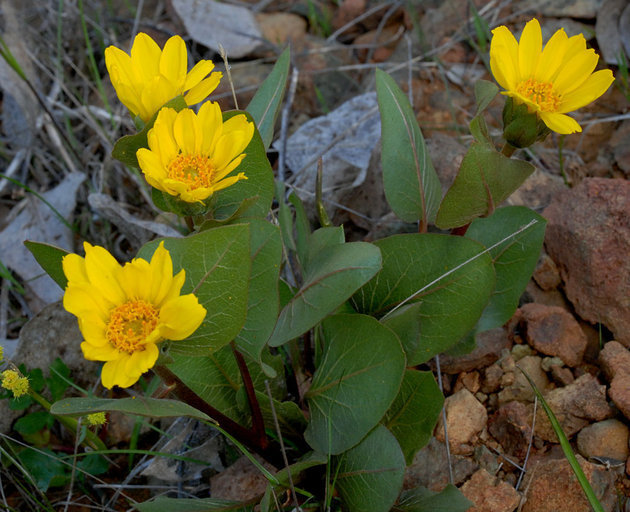
Bolander's mule's ears
Agnorhiza bolanderi
Agnorhiza bolanderi is a species of flowering plant known by the common name Bolander's mule's ears. It is endemic to California, where it is known only from a narrow section of the Sierra Nevada foothills about 275 kilometers long from Shasta County to Mariposa County. It grows in chaparral and grassland habitat, usually on serpentine soils.
From the article Agnorhiza bolanderi on Wikipedia (CC BY-SA), quoted section by section
Description
Agnorhiza bolanderi is a perennial herb growing from a thick taproot and caudex unit. This underground stem part helps it survive wildfire, which is common in its chaparral habitat. The aboveground stem grows up to 30 centimeters long. It is glandular and sticky in texture. The leaves have oval blades up to 12 centimeters long. The inflorescence is a solitary bell-shaped, sunflower-like flower head sometimes tucked amongst the uppermost leaves. The head contains about 13 yellow ray florets which may be 2 to 3 centimeters long or more. At the center are yellow disc florets. The fruit is an achene about 7 millimeters long which does not have a pappus. The species is named for German-American botanist Henry Nicholas Bolander, 1831–1897.
Where it lives
Recorded sightings
—
geo-referenced records in GBIF, from museums, herbaria and field observers.
Drag the globe to turn it. Dots are where records exist, not a range map; darker means more records.
In the stacks
Searching the stacks…
Every page naming Agnorhiza bolanderi in the Biodiversity Heritage Library →
This page is assembled live from iNaturalist, GBIF, Wikipedia, the Source Library and the Internet Archive. It is not yet part of the hand-edited codex. iNaturalist taxon 893767.