- Plants
- ›Vascular Plants
- ›flowering plants
- ›Dicots
- ›Heathers, Balsams, Primroses, and Allies
- ›heath family
- ›Epacrids, Styphelias and Allies
- ›Styphelieae
- ›Acrotriche
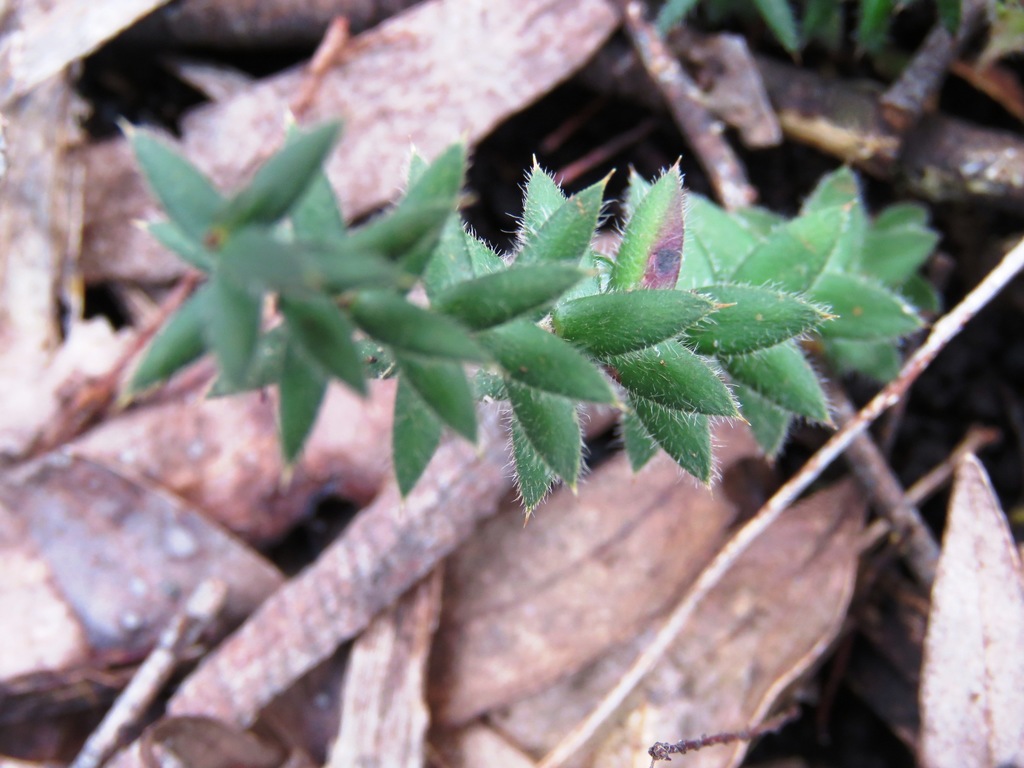
trailing ground-berry
Acrotriche prostrata
Acrotriche prostrata, commonly known as trailing ground-berry, is a species of flowering plant in the family Ericaceae and is endemic to Victoria. It is a trailing shrub with prostrate stems, widely spreading, lance-shaped to egg-shaped leaves and spikes of 5 to 14 light green flowers and spherical, green drupes.
From the article Acrotriche prostrata on Wikipedia (CC BY-SA), quoted section by section
Description
Acrotriche prostrata is a training shrub that has prostrate main stems and short side stems that sometimes grow to a height of up to about 15 cm (5.9 in), the branchlets hairy. The leaves are widely-spreading, lance-shaped to egg-shaped, 4–16 mm (0.16–0.63 in) long, 1–8 mm (0.039–0.315 in) wide and sharply-pointed. The flowers are arranged in spikes of 5 to 14 on the previous year's or older wood with bracteoles 2–3 mm (0.079–0.118 in) long. The sepals are 2.8–4.0 mm (0.11–0.16 in) long and the petals are light green and joined at the base forming a tube 5.5–6.5 mm (0.22–0.26 in) long, the lobes 2.3–2.6 mm (0.091–0.102 in) long. Flowering mostly occurs between April and July and the fruit is an oval, greenish drupe 5–7 mm (0.20–0.28 in) long.
Range & habitat
Trailing ground-berry often grows in damp forests, mostly in the southern half of Victoria.
== References ==
Wikipedia: “Distribution and habitat”
Where it lives
Recorded sightings
—
geo-referenced records in GBIF, from museums, herbaria and field observers.
Drag the globe to turn it. Dots are where records exist, not a range map; darker means more records.
In the stacks
Searching the stacks…
Every page naming Acrotriche prostrata in the Biodiversity Heritage Library →
This page is assembled live from iNaturalist, GBIF, Wikipedia, the Source Library and the Internet Archive. It is not yet part of the hand-edited codex. iNaturalist taxon 893930.