- Plants
- ›Vascular Plants
- ›flowering plants
- ›Dicots
- ›proteas, lotuses, planes, and allies
- ›Protea family
- ›Paired Proteas
- ›Embothrieae
- ›Hakeinae
- ›Grevillea
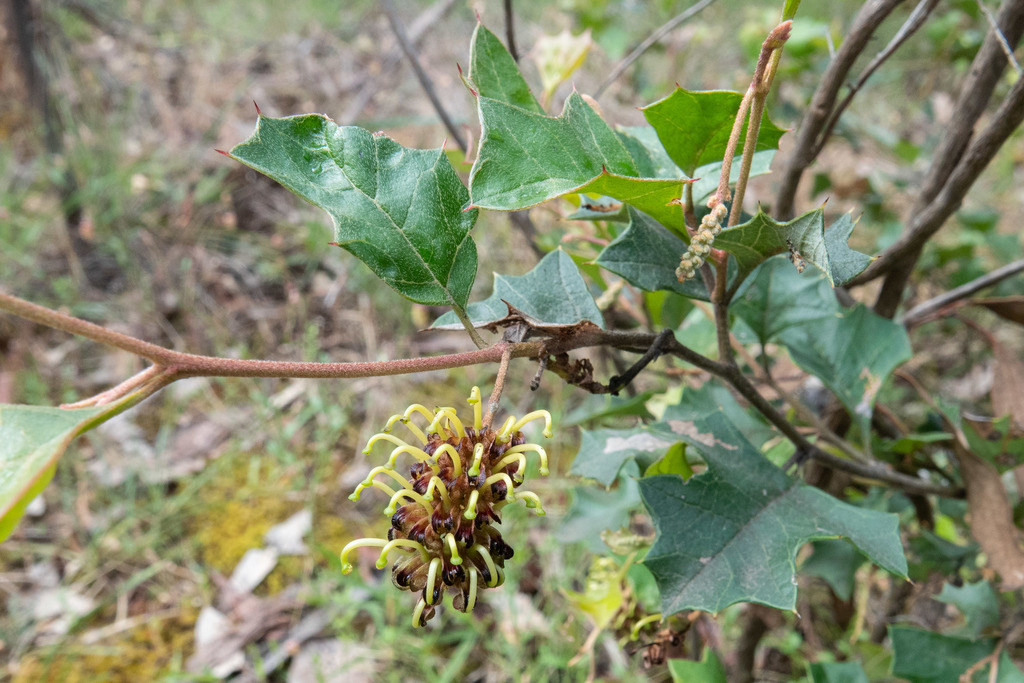
goldfields grevillea
Grevillea dryophylla
Grevillea dryophylla, also known as Goldfields grevillea, is a spreading shrub which is endemic to Victoria, Australia. It grows to between 0.3 and 1.5 metres (1 ft 0 in and 4 ft 11 in) in height. The flowers are green and light brown, maroon or dull-yellow and appear between August and November (late winter to late spring) in its native range.
From the article Grevillea dryophylla on Wikipedia (CC BY-SA), quoted section by section
Description
Grevillea dryophylla is a spreading to erect shrub that typically grows to a height of 0.3–1.5 m (1 ft 0 in – 4 ft 11 in) and has hairy branchlets. Its leaves are 20–85 mm (0.79–3.35 in) long and 20–70 mm (0.79–2.76 in) wide in outline, and usually have three to seven lobes 6–30 mm (0.24–1.18 in) long and 5–20 mm (0.20–0.79 in) wide, occasionally simple or with two to five teeth. The tips of the teeth or lobes are usually sharply pointed, the edges are turned down and the lower surface in covered with wavy to curly hairs. The flowers are arranged in groups on a rachis 10–40 mm (0.39–1.57 in) long and are green to light brown or dull yellow, the pistil 13.5–15.5 mm (0.53–0.61 in) long with a glabrous red to pink or dull yellow style. Flowering occurs from August to November and the fruit is a glabrous, silky-hairy follicle 9–12.5 mm (0.35–0.49 in) long.
Range & habitat
Goldfields grevillea occurs in dry sclerophyll forest in an area bounded by St Arnaud, Bendigo, Castlemaine and Maryborough.
Wikipedia: “Distribution and habitat”
Where it lives
Recorded sightings
—
geo-referenced records in GBIF, from museums, herbaria and field observers.
Drag the globe to turn it. Dots are where records exist, not a range map; darker means more records.
In the stacks
Searching the stacks…
Every page naming Grevillea dryophylla in the Biodiversity Heritage Library →
This page is assembled live from iNaturalist, GBIF, Wikipedia, the Source Library and the Internet Archive. It is not yet part of the hand-edited codex. iNaturalist taxon 893947.