- Plants
- ›Vascular Plants
- ›flowering plants
- ›Dicots
- ›Mints, Plantains, Olives, and Allies
- ›figwort family
- ›Eremophila
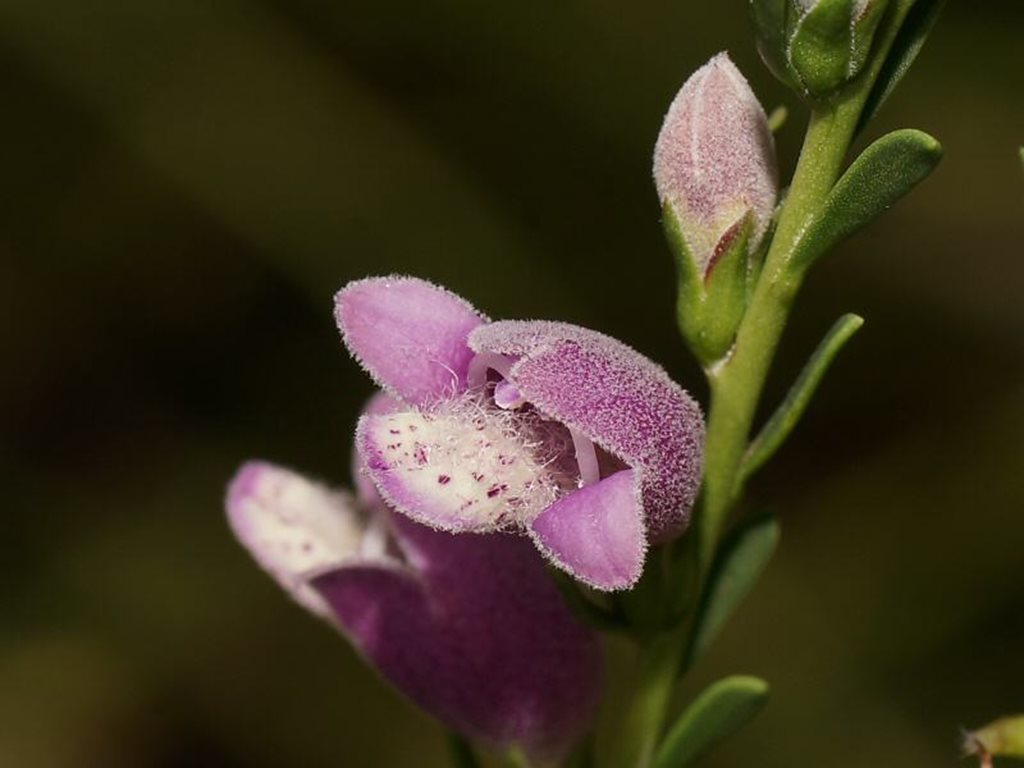
spreading emu-bush
Eremophila divaricata
Eremophila divaricata, also known as spreading emu bush, is a flowering plant in the figwort family, Scrophulariaceae and is endemic to Australia. It is a shrub with stiff, spreading, tangled branches which are often spiny on their ends, erect leaves and mauve to lilac-coloured flowers.
From the article Eremophila divaricata on Wikipedia (CC BY-SA), quoted section by section
Description
Eremophila divaricata is a spreading shrub with stiff, tangled branches often ending in a sharp spine and which grows to a height of 0.5–1.5 m (2–5 ft) and a width of up to 2 m (7 ft). The leaves are arranged alternately along the branches and are erect, linear to oblong in shape, mostly 5–20 mm (0.2–0.8 in) long and 1–4 mm (0.04–0.2 in) wide, usually glabrous and mid-green in colour. The flowers are arranged singly in leaf axils on a stalk 1–3 mm (0.04–0.1 in) long. There are 5 overlapping, egg-shaped to lance-shaped sepals which are 4–7.5 mm (0.2–0.3 in) long. The petals are 22–28 mm (0.9–1 in) long and joined at their lower end to form a tube. The petals are mauve to pinkish lilac-coloured, rarely white, with purple spots or streaks inside the tube. The outside of the tube and petal lobes are covered with fine hairs while the inside of the lobes is glabrous and the inside of the tube is filled with long, soft hairs. The 4 stamens are fully enclosed in the petal tube. Flowering time is mostly from September to April and is followed by fruits which are oval-shaped with a pointed end, hairy and 3.6–6 mm (0.1–0.2 in) long.
Range & habitat
E. divaricata subsp. divaricata occurs on the floodplains of the Murray, Paroo, Darling and lower Murrumbidgee rivers in New South Wales, Victoria, Queensland and South Australia, often forming dense thickets in heavy clay soils in river red gum and black box communities. Subspecies callewatta is only known from one location near Bourke.
Wikipedia: “Distribution and habitat”
How it is grown
As suggested by its common name, spreading emu bush has arching branches which often extend to ground level. It is a tough, hardy plant, resistant to disease although not to predation by kangaroos, however the shrub recovers from even the harshest pruning. It is easy to propagate from cuttings and can be grown in a range of soils, including heavy clay. Its natural habitat suggests it can handle long dry spells followed by occasional flooding and it can survive the most severe frosts.
== References ==
Wikipedia: “Use in horticulture”
Where it lives
Recorded sightings
—
geo-referenced records in GBIF, from museums, herbaria and field observers.
Drag the globe to turn it. Dots are where records exist, not a range map; darker means more records.
In the stacks
Searching the stacks…
Every page naming Eremophila divaricata in the Biodiversity Heritage Library →
This page is assembled live from iNaturalist, GBIF, Wikipedia, the Source Library and the Internet Archive. It is not yet part of the hand-edited codex. iNaturalist taxon 894270.