- Plants
- ›Vascular Plants
- ›flowering plants
- ›Dicots
- ›Sunflowers, Bellflowers, Fanflowers, and Allies
- ›Sunflowers, Daisies, Asters, and Allies
- ›chicories, dandelions, and allies
- ›Lettuce, Chicory, Dandelion and Salsify Tribe
- ›dandelions, hawksbeards, and rattlesnake roots
- ›Taraxacum
- ›Ceratoidea
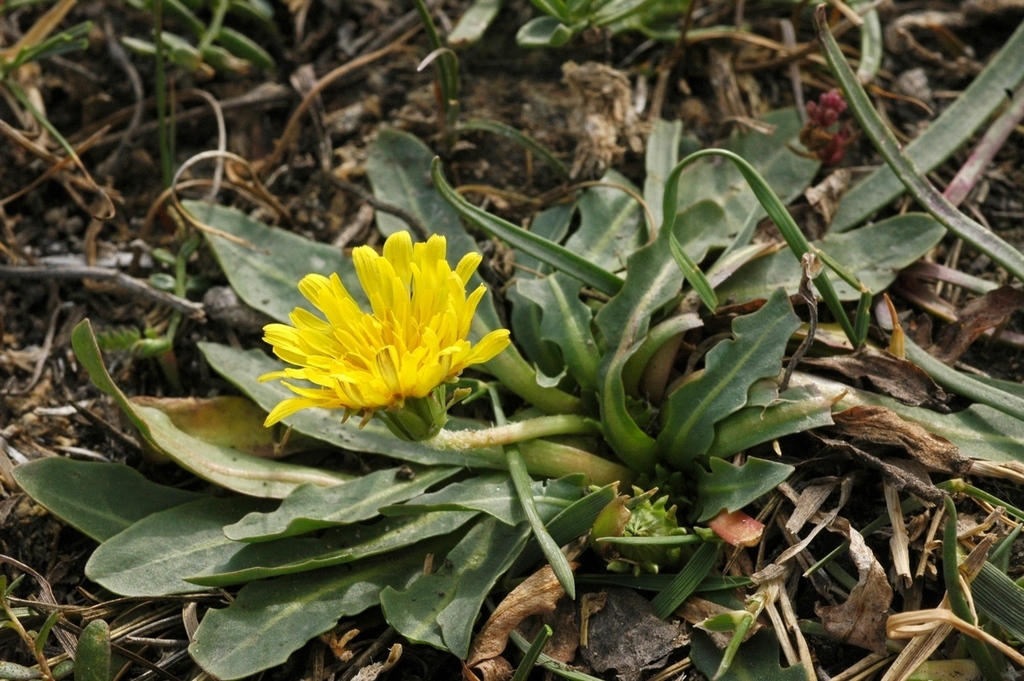
Russian dandelion
Taraxacum kok-saghyz
Taraxacum kok-saghyz, often abbreviated as TKS and commonly referred to as the Kazakh dandelion, rubber root, or Russian dandelion, is a species of dandelion native to Kazakhstan, Kirghizia and Uzbekistan, that is notable for its production of high quality rubber. T. kok-saghyz was discovered in Kazakhstan in 1932 by the Soviet Union in an effort to find a domestic source of rubber.
From the article Taraxacum kok-saghyz on Wikipedia (CC BY-SA), quoted section by section
Description
Taraxacum kok-saghyz is a perennial plant with a yellow composite flower characteristic of the genus Taraxacum. Each flower head may be approximately one inch in diameter and be made up of 50 to 90 florets. Plants may contain 25 to 50 leaves arranged in one or more rosettes at the upper end of the root. Taraxacum kok-saghyz can be differentiated from the common dandelion (Taraxacum officinale) by its generally smaller, grayish green leaves and hornlike structures on the bracts surrounding the bud. Flowers are hermaphrodite, insect-pollinated (entomophilous) and are on stalks that reach about a foot in height. Taraxacum kok-saghyz is usually in flower from May through June, with seeds ripening from June through July. It is a diploid species that reproduces sexually, and produces good pollen. Another species, a triploid apomict that also has horned bracts and produces rubber, T. brevicorniculatum Korol. has frequently been misidentified as T. kok-saghyz.
How it is grown
Taraxacum kok-saghyz does best in loose, well-drained soils with high moisture retention and a pH between 5.5 and 8.5, in full or nearly-full sun. The plant grows well in temperate climates. The greatest growth is recorded in soils containing 2–8% organic matter.
Wikipedia: “Growing conditions”
In human culture
Kok-saghyz is derived from the Kazakh kök-sağız (көк-сағыз), with kök meaning green and saghyz meaning rubber or gum. Its latex was traditionally used as a kind of chewing gum.
Wikipedia: “Etymology”
Where it lives
Recorded sightings
—
geo-referenced records in GBIF, from museums, herbaria and field observers.
Drag the globe to turn it. Dots are where records exist, not a range map; darker means more records.
In the stacks
Searching the stacks…
Every page naming Taraxacum kok-saghyz in the Biodiversity Heritage Library →
This page is assembled live from iNaturalist, GBIF, Wikipedia, the Source Library and the Internet Archive. It is not yet part of the hand-edited codex. iNaturalist taxon 897096.