- Plants
- ›Vascular Plants
- ›flowering plants
- ›Dicots
- ›pinks, cactuses, and allies
- ›Amaranth family
- ›Salicornioideae
- ›Salicornieae
- ›Halostachys
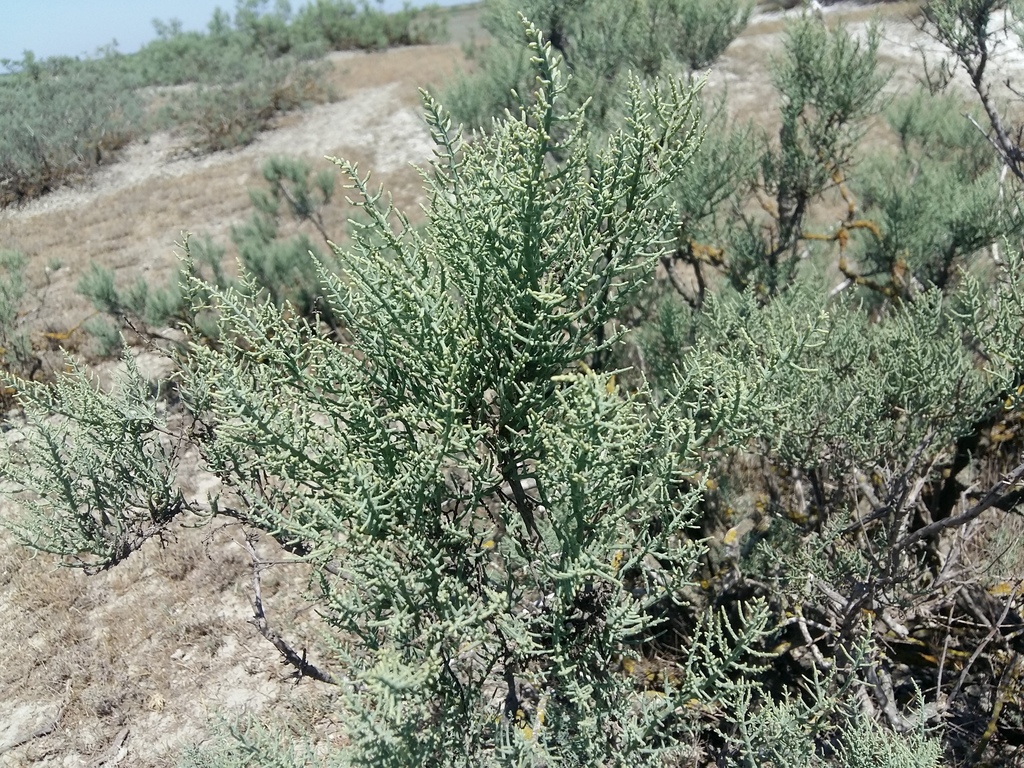
Halostachys caspica
Halostachys is a genus of flowering plants in the plant family Amaranthaceae, containing a single species, Halostachys caspica. The plants are small to medium halophytic shrubs with apparently jointed fleshy stems and scale-like leaves. They are native to western and central Asia and northern China.
From the article Halostachys on Wikipedia (CC BY-SA), quoted section by section
Description
Halostachys caspica grows as a shrub to 1–3 m height and width. The erect stems are much branched, older twigs are mostly leafless. The young twigs are blue-green, fleshy, apparently jointed (articulated), with glabrous fine papillose surface. The opposite leaves are fleshy, glabrous, connate basally and surrounding the stem (thus forming the joints), with very short scale-like triangular blades. The inflorescences consist of numerous opposite lateral cylindrical spikes, 15-30 × 2–5 mm, on jointed peduncles. Groups of three bisexual flowers are sitting in the axils of rhombic-quadrate bracts. The opposite bracts are not connate to each other. The obovoid to obpyramidal perianth consists of three connate tepals, the apex with three incurved lobes. There is one stamen exserting the flower. The ovoid ovary bears two subulate papillate stigmas. The flowering and fruiting phase reaches from July to November. The fruit is enclosed by the fleshy, somewhat inflated, three-angled, shiny perianth. The fruit wall (pericarp) is membranous. The erect seed is oblong and red-brown, containing the half-annular embryo and copious perisperm (feeding tissue).
Range & habitat
The distribution area of Halostachys caspica reaches from Southeast Europe, Caucasus (Russia, Armenia, eastern Turkey), Southwest Asia (northern Iran, Afghanistan, Pakistan), Central Asia (Turkmenistan, Mongolia) to Xinjiang and western Gansu (China). The plants are halophytes and grow in salt marshes, salty and alkaline mudflats, salty ditches, in dry river beds, and along the shores of salt lakes.
Wikipedia: “Distribution and habitat”
At the table
Halostachys caspica grows under extreme ecological conditions, and is a good fodder plant for the sustainable development on salty soils. The best fodder quality is achieved during the flowering phase. Economically important phytochemicals are flavonoids with antimicrobial and antioxidant properties.
Wikipedia: “Uses”
Where it lives
Recorded sightings
—
geo-referenced records in GBIF, from museums, herbaria and field observers.
Drag the globe to turn it. Dots are where records exist, not a range map; darker means more records.
In the stacks
Searching the stacks…
Every page naming Halostachys caspica in the Biodiversity Heritage Library →
This page is assembled live from iNaturalist, GBIF, Wikipedia, the Source Library and the Internet Archive. It is not yet part of the hand-edited codex. iNaturalist taxon 897542.