- Plants
- ›Vascular Plants
- ›flowering plants
- ›Dicots
- ›Legumes, Milkworts, and Allies
- ›Legumes
- ›Acacias, Mimosas, Mesquites, and Allies
- ›Senegalia
Soap-pod Tree
Senegalia rugata
Senegalia rugata is a spiny climbing shrub native to China and tropical Asia, common in the warm plains of central and south India.
It is renowned as a raw material for shampoo, and the leaves and young shoots are often eaten. Archaeobotanical evidence shows its use for hair care in the pre-Harrapan levels of Banawali, some 4500–4300 years ago.
From the article Senegalia rugata on Wikipedia (CC BY-SA), quoted section by section
Description
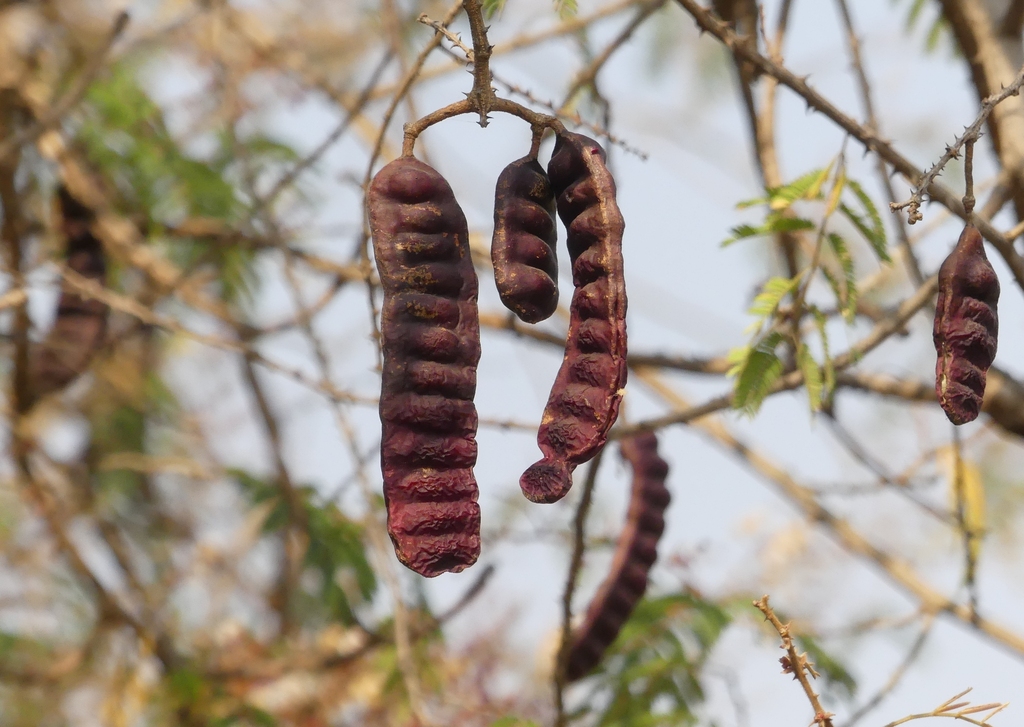
A woody climber, shrub, or small tree up to 5 metres (16 ft) tall, with numerous spines. Leaves are bipinnate. Cream to pale-yellow flowers, though buds are red to purplish-red and when the flowers are open they appear cream. The seed pods are distinctive. When fresh, they are smooth, thick, and fleshy; however, when they dry, they become wrinkled, blackish, and very hard.
Range & habitat
The species is native to Asia, including China. Countries and regions to which it is native include: Papua New Guinea (Eastern New Guinea); Indonesia (West Papua, Kai Islands, Sulawesi, Nusa Tenggara, Maluku, Jawa, Sumatera); Philippines; Malaysia (Peninsular Malaysia); Thailand; Cambodia; Vietnam; Zhōngguó/China (Guangdong, Yunnan); Laos; Myanmar; India (Andaman Islands, Assam), Bangladesh, Nepal, East Himalaya. It has been introduced/naturalized to the following countries/regions: Nouvelle Caledonie; Australia (Queensland); Japan (Okinawa); Réunion; Madagascar; Seychelles; Brazil (southeast); Jamaica The species is invasive in countries around the world, including New Caledonia.
Wikipedia: “Distribution”
What it does
In the Philippines the plant occurs in low and medium elevation thickets. The species grows both in the forest and within villages in Chiang Mai Province, Thailand. S. rugata grows in forest or thickets in Zhōngguó/China, most commonly near watercourses in valleys, at an altitude of between 880 and 1,500 metres (2,890 and 4,920 ft). The tree is food for the larvae of the butterfly Pantoporia hordonia.
Wikipedia: “Habitat and ecology”
At the table
This species is used in a variety of ways in Cambodia. The young leaves are included in salads. The fruit is used for washing hair and in local medicine. To treat abscesses, eczema and leprosy the fruit can also be used externally or as a laxative when they are taken internally. The pulp of the fruit, without the seeds, is used as a diuretic and emetic, while the seeds are reputed to make delivery in childbirth easier. Traditional healers of Nakhon Nayok Province, Thailand, use the leaves of this species to treat irregular menstruation. Amongst the Karen people of Chiang Mai Province, Thailand, the plant is one of the most widely used legumes. They use the fruit in a cold infusion both as soap and shampoo, and as a medicine for food poisoning. The dried fruit is used in holy water for the rituals to pay respect to elderly people and to evict wickedness. Investigating plant use amongst both Karen and Lawa people living in Pang Hin Fon district (Chiang Mai), S. rugata was one of the plants that provided both food and health-products. …
Wikipedia: “Food, medicine, and other uses”
In human culture
The two American botanists, Nathaniel Lord Britton (1859–1934, co-founder of the New York Botanical Garden), and Joseph Nelson Rose (1862–1928, of the Smithsonian), first described the taxa in 1928 in the publication North American Flora (vol. 23[2]: 120, published by the New York Botanical Garden. This taxa was subsumed into the well-known species Acacia concinna, however with advances in DNA analysis and consequent revision of plant phylogeny, the species S. rugata was recognized as having precedence in 2015 by Maslin and others. The epitaph rugata is derived from rugatus (Latin), meaning 'wrinkled', referring to the state of the pods when dry.
Wikipedia: “History”
Where it lives
Recorded sightings
—
geo-referenced records in GBIF, from museums, herbaria and field observers.
Drag the globe to turn it. Dots are where records exist, not a range map; darker means more records.
In the stacks
Searching the stacks…
Every page naming Senegalia rugata in the Biodiversity Heritage Library →
This page is assembled live from iNaturalist, GBIF, Wikipedia, the Source Library and the Internet Archive. It is not yet part of the hand-edited codex. iNaturalist taxon 898755.