- Plants
- ›Vascular Plants
- ›flowering plants
- ›Dicots
- ›Legumes, Milkworts, and Allies
- ›Legumes
- ›Acacias, Mimosas, Mesquites, and Allies
- ›Vachellia
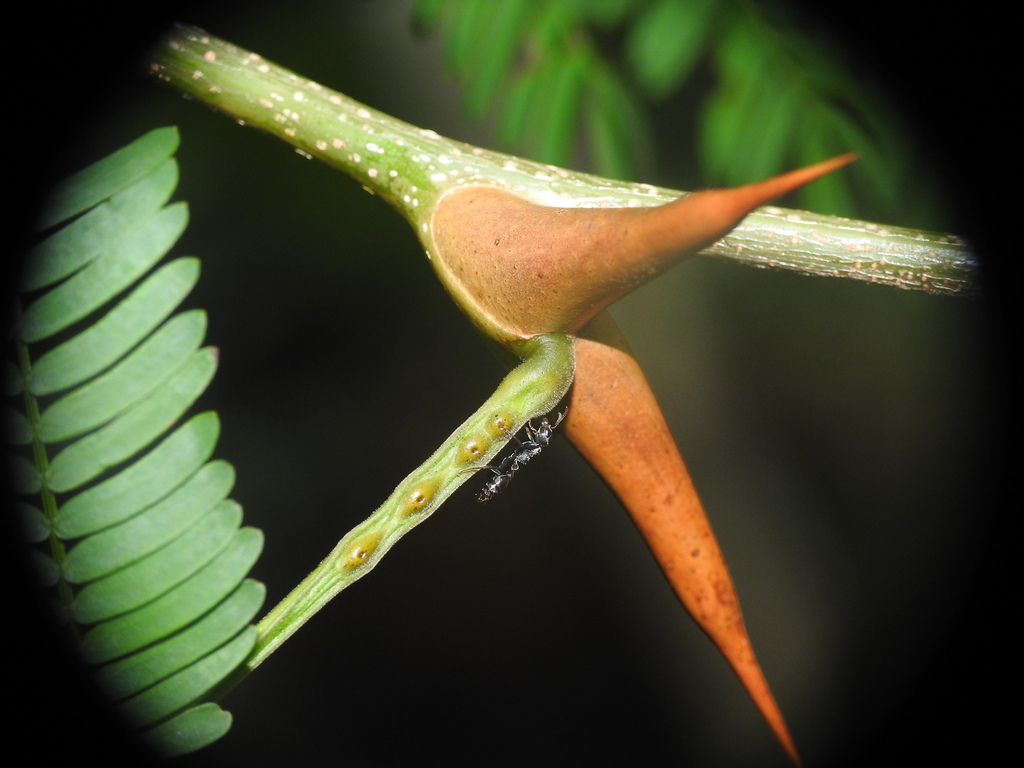
Vachellia collinsii
Vachellia collinsii is a species of flowering plant. It grows in secondary succession in seasonally dry ecosystems in southern Central America, where it exhibits a symbiotic relationship with several species of ant (Pseudomyrmex spinicola, Pseudomyrmex ferruginea). The ant-Vachellia system involving this species has been studied by ecologists like Daniel Janzen in Palo Verde National Park and Santa Rosa National Park, both in Guanacaste Province, Costa Rica. The ants chew holes in the tips of the hollow
From the article Vachellia collinsii on Wikipedia (CC BY-SA), quoted section by section
Description
Vachellia collinsii can grow upwards of 40 feet tall. The tree grows relatively straight with thorns generously distributed across the branches. The small, pinnate leaves grow opposite from each other similar to a Mimosa. Since this species has a diverse geological and ecological distribution, it has a wider range of morphological traits. Nonetheless, differences between other ant-acacias can be seen through elongated cylindrical inflorescences, somewhat small stipular spines, terete—cylindrical—spines that wrap around a cross section, 3-5 often dome-shaped petiolar glands, a lack of rachis glands, and leaflets with lateral veins. On the petioles, are green bumps called extrafloral nectaries that create sugar for symbiotic ants. From top to bottom of these trees, there is less suppression of lateral growth, thus, allowing for more numerous and full branches near the base of the tree, creating a pyramid shape with a strong central trunk. While most tree species typically have auxin that grow downward, suppressing branch growth on the sides, this is not the case for Vachellia Collinsii, as it lacks a strong apical meristem. This results in branching throughout the entire length of the tree. They are extrafloral because the true, yellow flowers produce a different kind of nectar. The tips of leaflets may produce Beltian bodies, food bodies which are rich in protein and lipids. …
Range & habitat
Vachellia collinsii is native to Central America and parts of Africa. In southern Central America, where there are seasonally dry ecosystems, this tree grows in secondary succession, preferring Savanna-like climates. Acacias like full sun and are rarely found in the trophic understory of many jungles. Acacias can thrive in climates with higher humidity, above 70% humidity. The Vachellia collinsii has a wide distribution across the world compared to other acacias, as well as a wide ecological distribution, considering it can grow from sea level to 1000 meters elevation.
Wikipedia: “Distribution”
What it does
Vachellia collinsii exhibits a symbiotic relationship with several species of ants. Some noted species include Pseudomyrmex spinicola and Pseudomyrmex ferruginea. The ant-Vachellia system involving this species has been studied by ecologists like Daniel Janzen in Palo Verde National Park and Santa Rosa National Park, which are both located in Guanacaste Province, Costa Rica. The ants chew holes in the tips of the hollow stipular thorns, known as domatia, so that they can enter and create their colony inside. A single ant colony may span several V. collinsii trees. Medium sized herbivores are often deterred by the thorns alone, but the ants help protect the trees from other potentially threatening animals. Smaller animals such as caterpillars have no issue avoiding the thorns, and larger animals like elephants are less affected by these thorns. When a predator brushes and shakes the plant’s thorns in an attempt to feed, the ants will become disturbed, run outside, and release alarm pheromones to alert other ants. All ants that come in contact with the alarm pheromones become aggressive and attack the animal by biting and stinging. Beyond defending the trees from herbivores, ants occupying V. collinsii trees may even cut down surrounding vegetation and trim the encroaching branches of other plants. This provides V. …
Wikipedia: “Ecology”
Where it lives
Recorded sightings
—
geo-referenced records in GBIF, from museums, herbaria and field observers.
Drag the globe to turn it. Dots are where records exist, not a range map; darker means more records.
In the stacks
Searching the stacks…
Every page naming Vachellia collinsii in the Biodiversity Heritage Library →
This page is assembled live from iNaturalist, GBIF, Wikipedia, the Source Library and the Internet Archive. It is not yet part of the hand-edited codex. iNaturalist taxon 898801.