- Plants
- ›Vascular Plants
- ›flowering plants
- ›Dicots
- ›Legumes, Milkworts, and Allies
- ›Legumes
- ›Faboideae
- ›Dalbergieae
- ›Nissolia
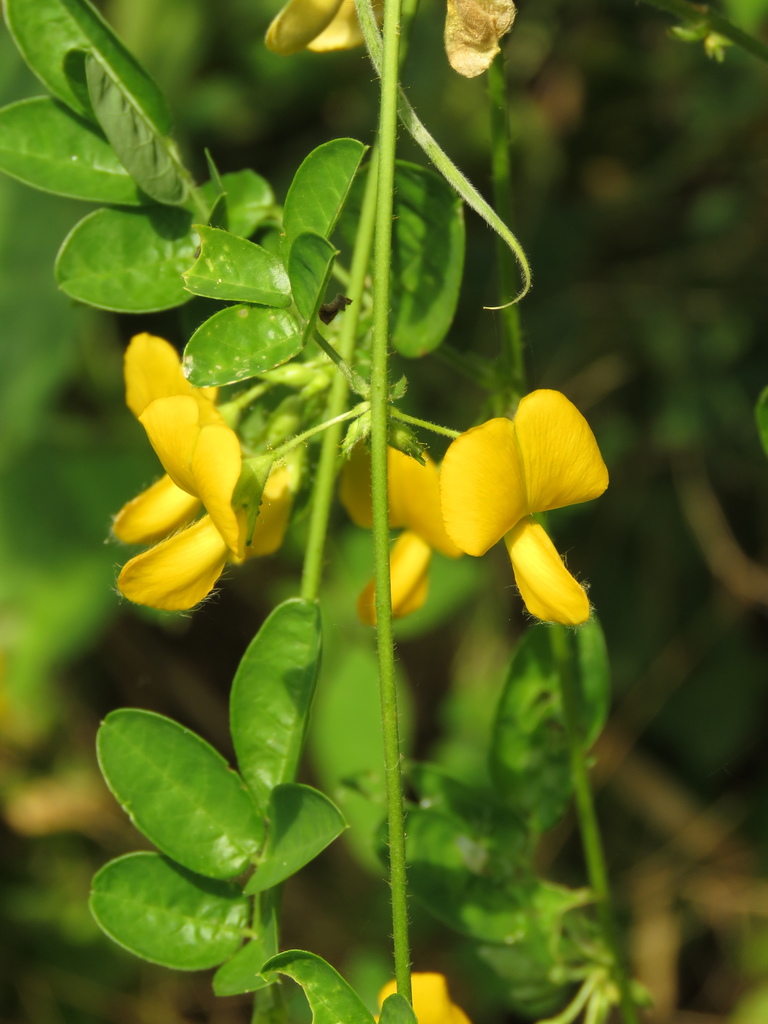
Nissolia vincentina
Nissolia vincentina has no English name, though all Nissolia species can be called yellowhoods. It is a vine native to Tropical America. It belongs to the family Fabaceae.
From the article Nissolia vincentina on Wikipedia (CC BY-SA), quoted section by section
Description
Nissolia vincentina displays these key features distinguishing it from similar species:
The vine's physical features vary greatly. The climbing, twining or prostrate stems can be densely hairy to hairless, often with some hairs bearing glands. Leaves are pinnately divided into 5 leaflets, each up to 50 mm (2 in) long and about half as wide. Solitary or few flowers on pedicels up to 30 mm (1+3⁄16 in) long arise where leaves are attached to the stem. Flowers with yellow petals are up to 22 mm (7⁄8 in) long. Calyces are somewhat bell-shaped, up to 10 mm (3⁄8 in) long, hairy or not, and sometimes bearing glandular hairs. Calyx teeth 2–7 mm (3⁄32–9⁄32 in) vary in shape, sometimes having narrow, slender tips tapering to a fine point, and other times being thicker with no such slender tip. The loment-type fruits are nearly round in cross section, composed of 7-12 segments. Seeds are dark reddish brown, about 5.5 mm × 1 mm (3⁄16 in × 1⁄16 in) in size.
Range & habitat
Nissolia vincentina inhabits disjunct populations, occurring in the tropical parts of southern Mexico, including the Yucatan Peninsula, in the Caribbean in the Dominican Republic, in Central America in Honduras, Nicaragua and Costa Rica, and in South America in Colombia, Venezuela and Brazil.
Wikipedia: “Distribution”
What it does
In Mexico's Yucatan Peninsula, Nissolia vincentina is recognized as contributing as livestock forage, as being medicinal, and as of value in beekeeping. Also in the Yucatan Peninsula, it is a weed in cornfields.
Wikipedia: “Human interactions”
In human culture
The genus name Nissolia honors the French botanist (1647–1735) Guillaume Nissole. The species name vincentina references the Caribbean volcanic island Saint Vincent, which John Bellenden Ker noted as the home of the plant from which he described the species when he formally named it in 1824.
== References ==
Wikipedia: “Etymology”
Where it lives
Recorded sightings
—
geo-referenced records in GBIF, from museums, herbaria and field observers.
Drag the globe to turn it. Dots are where records exist, not a range map; darker means more records.
In the stacks
Searching the stacks…
Every page naming Nissolia vincentina in the Biodiversity Heritage Library →
This page is assembled live from iNaturalist, GBIF, Wikipedia, the Source Library and the Internet Archive. It is not yet part of the hand-edited codex. iNaturalist taxon 898815.