- Animals
- ›Molluscs
- ›Gastropods
- ›Heterobranchs
- ›Euthyneura
- ›Tectipleura
- ›Eupulmonata
- ›Common Land Snails and Slugs
- ›Helicina
- ›Arionoidei
- ›Roundback Slugs and Allies
- ›Roundback Slugs
- ›Arion
- ›Kobeltia
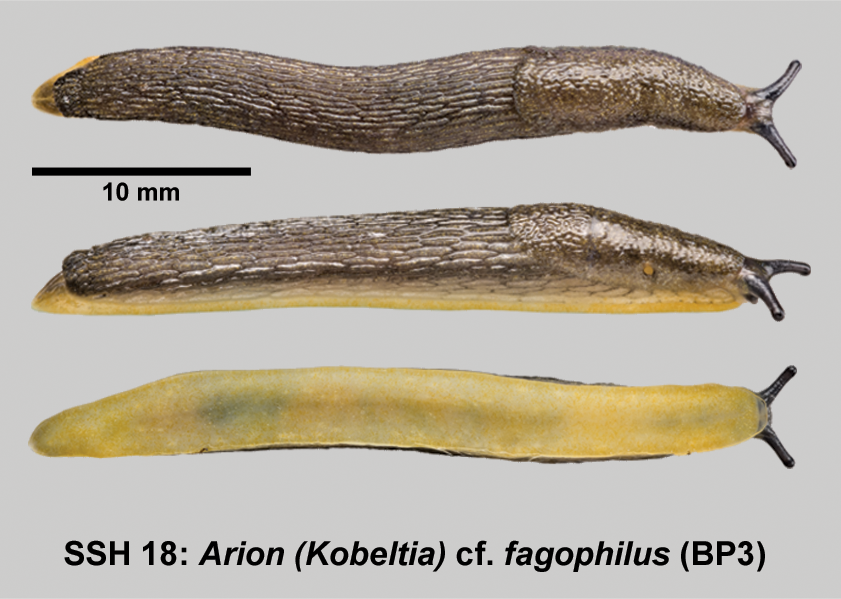
Arion fagophilus
Arion fagophilus, is a large terrestrial gastropod mollusk in the family Arionidae, the round back slugs....
From the article Arion fagophilus on Wikipedia (CC BY-SA), quoted section by section
Description
(Original description by de Winter) The measured holotype is 25 mm long and 5.5 mm wide, with a mantle length of 9 mm. This small to medium-sized Arion slug is immediately recognizable by its striking coloration: a dull grey dorsum and parts of the mantle contrast sharply with white flanks and a bright orange sole and foot-fringe. Internally, the free oviduct consists of two parts: a large, soft section containing a ligula, followed by a muscular, shining section (resembling Arion hortensis Férussac, 1819 ). A thin-walled structure surrounds the epiphallus outlet, which is a key feature, as it differs significantly from the papilla found in other Arion (Kobeltia) species. This species, with a holotype is visually unique. Unlike other species in the subgenus Kobeltia, the foot-fringe shares the bright yellow-orange colour of the sole. The slug's white flanks are particularly noteworthy: this color is the ground colour itself, not caused by concentrated white pigment granules, as seen in Arion hortensis. While white pigment granules are sparsely scattered across the body, the transition from the grey upper body to the white flanks is often marked by faint, darker lateral bands, which may be barely visible in some specimens. When stretched out against a white surface, the tentacles of living animals show a bright reddish colour. …
Where it lives
Recorded sightings
—
geo-referenced records in GBIF, from museums, herbaria and field observers.
Drag the globe to turn it. Dots are where records exist, not a range map; darker means more records.
In the stacks
Searching the stacks…
Every page naming Arion fagophilus in the Biodiversity Heritage Library →
This page is assembled live from iNaturalist, GBIF, Wikipedia, the Source Library and the Internet Archive. It is not yet part of the hand-edited codex. iNaturalist taxon 899656.