- Plants
- ›Vascular Plants
- ›flowering plants
- ›Dicots
- ›Buttercups, Poppies, and Allies
- ›moonseed family
- ›Anamirta
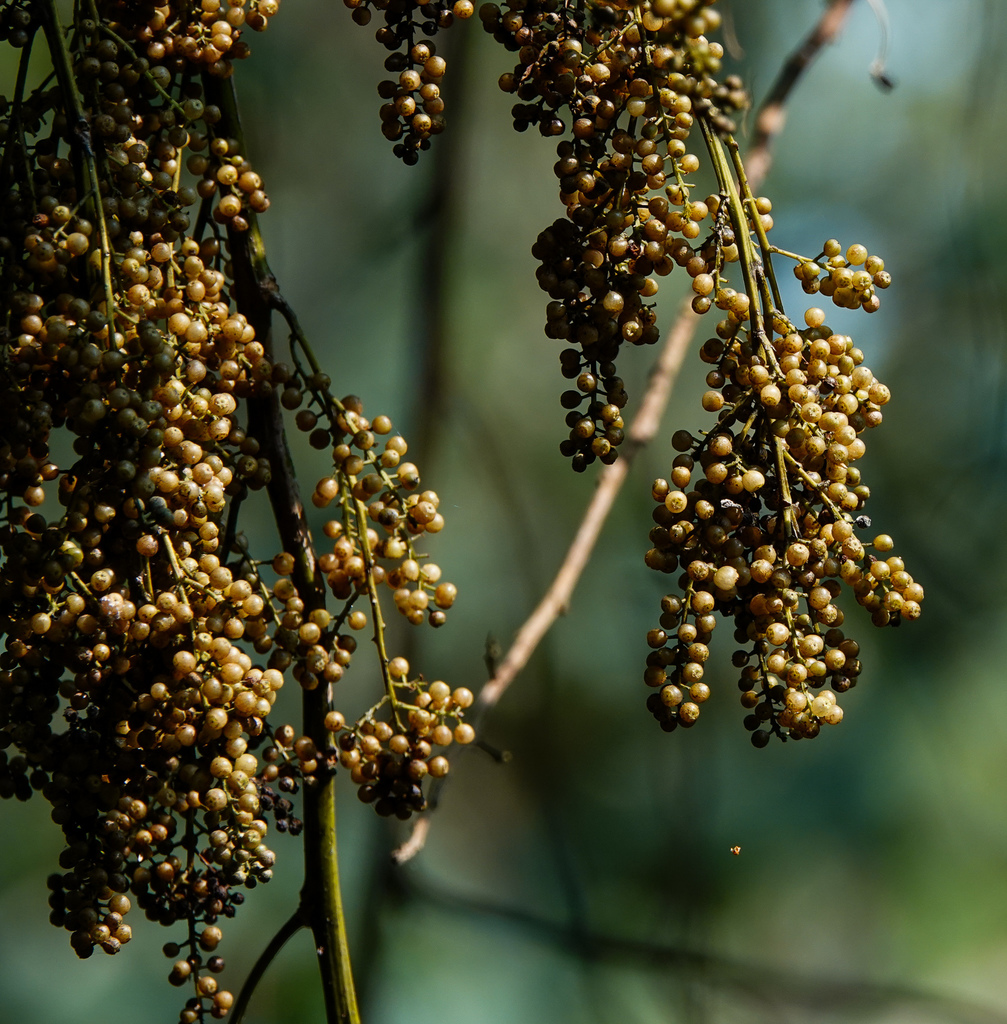
Anamirta cocculus
Anamirta cocculus (Marathi: काकमारी) is a Southeast Asian and Indian climbing plant. It is the source of picrotoxin, a poisonous compound with stimulant properties.
The plant is large-stemmed (up to 10 cm in diameter); the bark is "corky gray" with white wood. The "small, yellowish-white, sweet-scented" flowers vary between 6 and 10 millimeters across; the fruit produced is a drupe, "about 1 cm in diameter when dry".
From the article Anamirta cocculus on Wikipedia (CC BY-SA), quoted section by section
At the table
Its crushed seeds are an effective pediculicide (anti-lice) and are also traditionally used to stun fish or as a pesticide. In pharmacology, it is known as Cocculus Indicus. Although poisonous, hard multum is a preparation made from Cocculus Indicus, etc., once used (by 19th century brewers) to impart a more intoxicating quality ("giddiness") to beer than provided by the alcoholic content alone. Charles Dickens referred to those engaging in such practices as "brewers and beer-sellers of low degree,... who do not understand the wholesome policy of selling wholesome beverage." Although appearing in many homeopathic volumes and at least two brewers' guides, the use of such preparations was outlawed in England, during the mid-19th century, with fines of £500 for sale and £200 for use of the drug. The wood of the plant is used for fuel and carving.
Wikipedia: “Uses”
Where it lives
Recorded sightings
—
geo-referenced records in GBIF, from museums, herbaria and field observers.
Drag the globe to turn it. Dots are where records exist, not a range map; darker means more records.
In the stacks
Searching the stacks…
Every page naming Anamirta cocculus in the Biodiversity Heritage Library →
This page is assembled live from iNaturalist, GBIF, Wikipedia, the Source Library and the Internet Archive. It is not yet part of the hand-edited codex. iNaturalist taxon 900868.